

Cross-Channel Marketing: 5 Steps to Unified Messaging
Want to create a seamless customer experience across all platforms? Cross-channel marketing connects your channels – like email, social media, and SMS – to deliver consistent, personalized messaging. But most businesses struggle to get it right. Here’s how you can fix that in 5 simple steps:
- Map Customer Journeys and Define Roles: Assign specific purposes to each channel (e.g., email for nurturing with lead magnets, SMS for time-sensitive offers) to guide users effectively.
- Build a Messaging Framework: Create clear brand guidelines and adjust tone for each platform without losing consistency.
- Centralize Customer Data: Merge data from all systems into one source to enable real-time personalization.
- Design Coordinated Campaigns: Tailor campaigns for each platform while keeping timing and messaging aligned.
- Measure and Improve: Track key metrics like conversion paths, engagement rates, and customer lifetime value to refine strategies.
Key takeaway: Consistency across platforms can boost revenue by 23% and lead to 38% higher customer spending. Let’s break down how to make it happen.
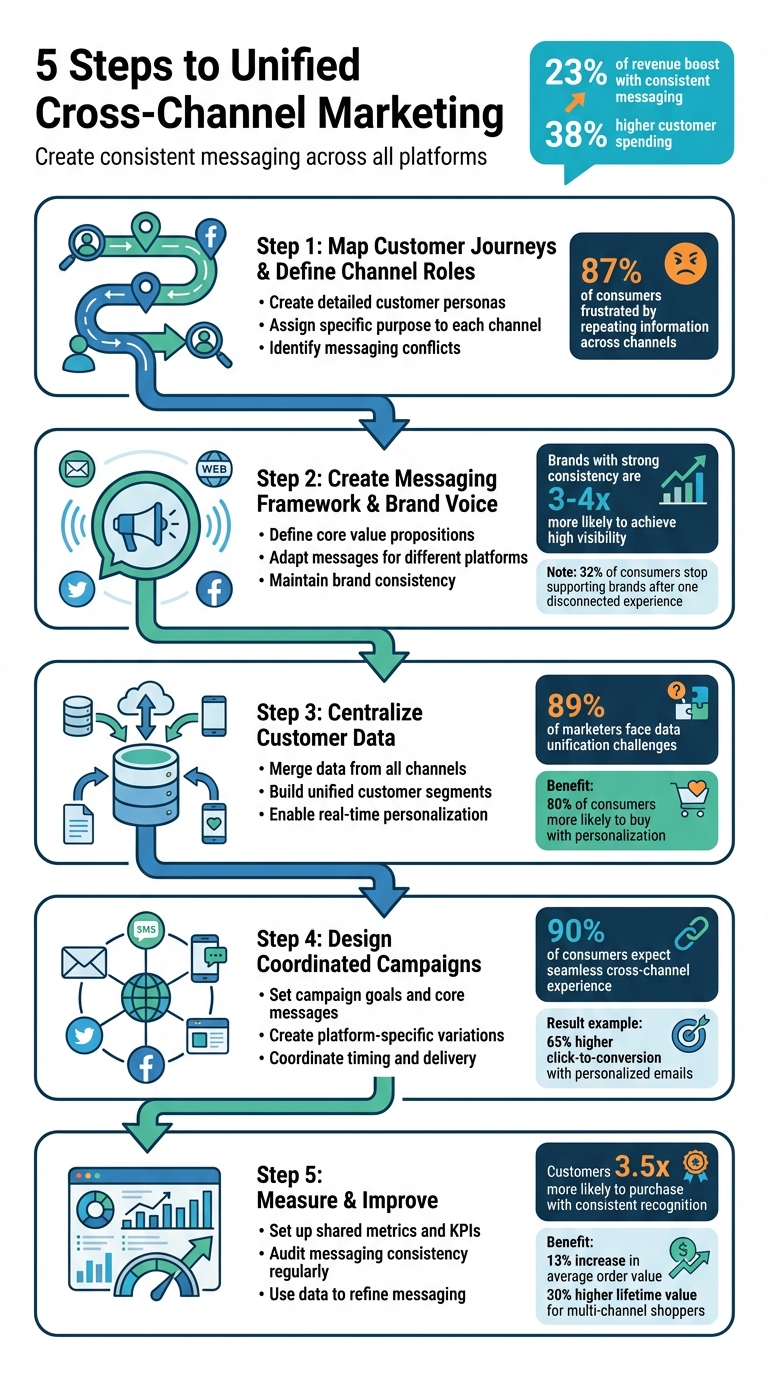
5-Step Cross-Channel Marketing Framework for Unified Messaging
Step 1: Map Customer Journeys and Assign Channel Roles
Create Customer Personas and Map Their Journeys
Start by developing detailed customer personas that include psychographics, behavior patterns, and emotional states. This helps you identify the "ah-ha moment" – the point where users truly understand the value of your product – and work backward to map the touchpoints leading up to it.
Modern customer journey mapping isn’t about static diagrams anymore. Instead, it’s about real-time orchestration. Focus on specific customer actions, like browsing without adding items to their cart, selectively subscribing, or making one-time purchases. Validate these insights through customer interviews to ensure accuracy. A seamless experience matters – 87% of consumers express frustration when they have to repeat information across different channels.
Once you have a clear understanding of customer behaviors, assign a unique role to each channel to guide users through their journey.
Assign a Purpose to Each Channel
Every channel should serve a specific purpose. For example, email can be used for identity tracking and nurturing, SMS or push notifications for time-sensitive offers, and social media for building awareness and retargeting interest.
Here’s a breakdown of how channels typically align with different stages of the customer journey:
| Journey Stage | Main Channel | Key Messaging Goal |
|---|---|---|
| Awareness | Social Media / Paid Ads | Introduce your brand and solve immediate pain points |
| Consideration | Email / Blog / Search | Share educational content and social proof |
| Purchase | Landing Pages / SMS | Eliminate friction and include clear calls-to-action |
| Retention | Email / Mobile Push | Provide personalized recommendations and loyalty rewards |
| Advocacy | Social / Referral SMS | Encourage reviews and sharing of positive experiences |
Before assigning these roles, ensure each channel is integrated with your CRM so they can share real-time data. Also, set specific KPIs for each channel. For instance, track clicks for social ads and measure conversions for landing pages.
While each channel has its own role, make sure their messages work together without creating confusion.
Find Messaging Conflicts Across Channels
Messaging conflicts often happen when channels operate in silos. For instance, sending a "Buy now!" message for an item someone just purchased or overlapping discount offers can undermine your strategy.
In 2025, the apparel brand Rebecca Minkoff addressed this issue by integrating their B2C CRM with marketing automation tools. Using "flow filters", they paused emails when texts or alerts were active, ensuring consistent communication.
"I fundamentally think that if you’re going to be sending emails and SMS, they have to know what each other are doing." – Jonathan Guez, CTO, Sunrise Brands
To prevent conflicts, regularly audit your channels. A Customer Data Platform (CDP) can consolidate customer behaviors into a single profile, ensuring you don’t mistakenly treat the same person as multiple users. Additionally, set up automation rules to pause promotional messages for customers with open support tickets, and use "smart send time" techniques to avoid overwhelming users with notifications.
Mastering Cross-Channel Marketing For A Seamless Customer Journey
Step 2: Create a Messaging Framework and Brand Voice
Once your channels are defined, the next step is to ensure your messaging aligns to create a cohesive and reliable brand experience.
Define Core Messages and Value Propositions
Your value proposition is where three key elements meet: what your customers need, what your company excels at, and the gaps your competitors leave unaddressed. A strong value proposition balances your brand’s promise with the effort and risk your customers face. Each core message you craft should include what marketers call "permissions to believe." In plain terms, this means backing up your claims with solid proof – like customer service awards, Net Promoter Scores (NPS), or testimonials. For instance, if you promise "lightning-fast support", you need hard data to prove it, such as average response times under two minutes or glowing customer feedback.
To make your messages stick, connect product features to the values and emotions your customers care about. People don’t just buy features – they buy the feelings and benefits those features bring. This approach builds trust and ensures your messaging has a lasting impact.
Adapt Messages for Different Platforms
While your core message remains steady, how you deliver it should change depending on the platform. For example, Twitter might call for a lighthearted, conversational tone, LinkedIn may require a more professional approach, and email often benefits from a personal touch. Despite these adjustments, your brand identity should remain consistent across all platforms.
"While your marketing message and branding should remain consistent, it’s important to tailor the content so it feels natural for each individual platform." – Andre Kazimierski, CEO, Improovy Painters Naperville
A great example of this is Mercedes-Benz’s 2013 campaign for the CLA Coupe. They targeted millennials by blending paid social media ads, influencer-led videos, and traditional media. By tweaking their luxury message to better connect with younger audiences, they achieved a 14% boost in sales.
To keep things on track, create an editorial guide that outlines your brand voice and how it should shift across platforms. Simple exercises like "This But Not That" (e.g., "Confident but not arrogant" or "Smart but not academic") can help your team hit the right tone every time.
Maintain Brand Consistency Across Touchpoints
Consistency doesn’t mean copying and pasting the same message everywhere. Instead, it’s about using visual and tonal elements – like colors, logos, fonts, and photo filters – that make your brand instantly recognizable. This creates what’s known as "ambient recognition", where customers can identify your brand even without a logo.
For example, in 2023, Revolve, a fashion retailer, revamped its messaging by integrating 16 unique data points after upgrading its email platform. They incorporated dynamic content into transactional emails while maintaining a consistent tone and visual identity. The result? A 17% jump in engagement rates in just two weeks. Research also shows that brands with a strong, consistent presence are 3–4 times more likely to achieve high visibility. On the flip side, 32% of consumers say they’d stop supporting a brand after just one disconnected experience.
To avoid these pitfalls, conduct regular content audits across departments like sales, support, and marketing. This helps catch inconsistencies before they harm customer trust.
"We are humans, speaking to humans." – Slack Brand Guidelines
Step 3: Centralize Customer Data for Personalization
Creating a successful messaging framework depends on having unified customer data. Yet, 89% of marketers face challenges in achieving this. The solution? Centralize all your customer information in one place where it can be effectively utilized.
Merge Data from All Channels
Start by pinpointing every system that holds customer information. This could include your CRM (like Salesforce or HubSpot), e-commerce platform, customer service tools, point-of-sale systems, loyalty program databases, and online activity trackers. The goal is to integrate these systems seamlessly by merging, cleaning, and standardizing your data. While data integration focuses on gathering information into a central warehouse, data unification ensures that the data is cleaned, validated, and normalized for consistency.
To avoid errors when matching records, standardize elements like naming conventions, date formats (mm/dd/yyyy), and required fields across all sources. Petco offers a great example – they implemented SAP Emarsys to unify their customer data and automate engagement, leading to a 15% increase in won-back customers.
"Data unification goes beyond merging the data and emphasizes a consistent, standardized, and unified view of it across the entire organization." – AdRoll
This foundational integration enables dynamic segmentation and real-time personalization.
Build Unified Customer Segments
Once your data is unified and standardized, you can create dynamic customer segments that are far more effective than static lists. Unlike traditional lists that remain stagnant, dynamic segments update automatically in real time as customer behaviors change. For instance, when a customer completes a purchase, they’re instantly removed from the "abandoned cart" sequence across all channels.
Dynamic segmentation also benefits from identity resolution, a process that matches various identifiers (like email addresses, social media handles, or guest checkout records) to a single individual. This eliminates duplicate messaging and ensures a cohesive experience. Rappi, for example, used real-time audience syncing to build behavioral cohorts for new users. By tailoring onboarding across push notifications, emails, and in-app messages, they reduced customer acquisition costs by 30%.
Personalize Messages Across Channels
With unified customer segments in place, you can personalize messaging based on customer behavior. Unified profiles allow for coordinated, tailored experiences across all channels. Research shows that 80% of consumers are more likely to buy from brands offering personalized experiences, and 76% expect marketing messages to reflect their preferences. For instance, if a customer browses a product on your website, that behavior should inform the email they receive the next day and even the social ad they see later.
Take Isadore, a cycling apparel brand, as an example. By integrating website browsing data with email campaigns using Bloomreach, they achieved a 50% boost in email-driven revenue and reduced product returns by 29%. Their success stemmed from using behavioral data – not just demographics – to deliver the right message at the right time. Centralizing your data ensures every channel has access to the same up-to-date customer information, making personalized marketing a reality.
sbb-itb-b3a7196
Step 4: Design Campaigns That Work Across Channels
Once you’ve centralized your customer data, it’s time to craft campaigns that carry a unified message while playing to the strengths of each channel. Research indicates that consistent brand messaging across multiple platforms can boost brand visibility by 23%, and a whopping 90% of consumers now expect brands to provide a seamless experience across all channels they interact with. To make this work, start by defining your campaign objectives and core messages – these will serve as the backbone of your strategy.
Set Campaign Goals and Core Messages
Start by outlining your campaign goals and pinpointing your target audience. Tie your KPIs directly to the different stages of the customer journey. For example, if you’re launching a new product, your awareness goal might aim for 50,000 social impressions, while your decision-stage goal could focus on converting 500 first-time buyers through email and SMS or interactive lead magnets. Use the unified messaging framework you created in Step 2, along with the customer data you gathered in Step 3, to guide these efforts.
Once you’ve nailed down your goals, define a single, overarching message that aligns with your framework. This message will act as the anchor for all the variations you create across different platforms. A great example of this approach comes from fashion retailer Revolve. In 2024, they used the Cordial platform to draw from 16 unique data points – like abandoned browse history and customer brand preferences – to personalize their product recommendation emails. The result? Their personalized emails were twice as effective as batch messages, driving 65% higher click-to-open and click-to-conversion rates.
Create Platform-Specific Variations
While your core message remains the same, how you present it should adapt to each channel. Each platform has its own strengths, so tailor your content accordingly: use detailed storytelling for email, keep things brief for SMS, and lean into visuals for social media.
| Channel | Best Use Case | Format Adaptation |
|---|---|---|
| Detailed storytelling and nurture sequences | Long-form content with visuals and multiple CTAs | |
| SMS | Time-sensitive offers and urgent alerts | Short messages (160 characters or fewer) with a single CTA |
| Social Media | Real-time engagement and brand discovery | Platform-specific visuals (e.g., Stories vs. Feed posts) |
| Push Notifications | App-specific updates and re-engagement | Brief, real-time alerts based on app behavior |
Coordinate Timing and Delivery Sequences
Once you’ve tailored your message for each platform, timing becomes crucial. Sync your delivery schedules to ensure your messages hit at the right moment. Automated workflows, triggered by real-time customer actions like abandoned carts or recent site visits, can help you avoid overwhelming your audience. Leverage real-time data from your unified segments to fine-tune these workflows. For example, if a customer clicks on an SMS link, you can automatically cancel the follow-up email to prevent message fatigue.
McConnell’s Fine Ice Creams offers a great case study here. By connecting their POS system with a CRM, they automated thank-you messages and follow-ups, leading to an eightfold increase in POS revenue.
Finally, AI tools can help analyze engagement data to pinpoint each customer’s preferred communication channel.
"Channel affinity has really helped us reduce over-messaging and create opportunities to do more brand-building in extensive flows." – Luke Styles, CRM Manager at Lorna Jane
Step 5: Measure and Improve Messaging Consistency
Your cross-channel campaigns are live. Now comes the critical part: tracking the right metrics to separate successful campaigns from those that miss the mark. Research shows that customers are 3.5 times more likely to make a purchase when they experience consistent recognition across channels. Additionally, average order values increase by 13% when messaging adapts to previous interactions. To keep things on track, it’s essential to have systems in place to detect and address issues early.
Set Up Shared Metrics and KPIs
Measuring the impact of your coordinated campaigns is key to refining your messaging. Focus on metrics like Customer Acquisition Cost (CAC), Lifetime Value (LTV), and the LTV:CAC ratio to assess long-term profitability and the effectiveness of your messaging. For a deeper dive, analyze journey-specific indicators such as:
- Path to Conversion: Understand which channel combinations are driving the most sales.
- Time to Conversion: Get a clear picture of how long your sales cycle actually takes.
Another important metric is Channel-Assisted Conversions, which highlights the role of upper-funnel activities. For instance, a customer might discover your brand on Instagram, research on your website, and finally convert through email. Each channel contributes to the sale and deserves credit. Additionally, tracking Share of Voice (SoV) can provide insights into market share growth. Cross-channel strategies often deliver 3 to 4 times higher SoV, and even a 10% SoV advantage can lead to a 0.5% annual market share increase.
| Metric Category | Key KPIs to Track | Purpose for Messaging Consistency |
|---|---|---|
| Foundational | CAC, LTV, LTV:CAC Ratio | Tracks long-term profitability of unified messaging |
| Engagement | CTR, Unsubscribe Rate, Abandoned Carts | Shows if the message resonates with the audience on specific channels |
| Journey | Path to Conversion, Velocity, Touchpoint Analysis | Evaluates how well the messaging sequence moves customers forward |
| Advanced | Assisted Conversions, Share of Voice (SoV) | Measures the overall impact of consistent brand presence |
Audit Messaging Consistency Regularly
Regular audits are vital to catch inconsistencies before they harm your brand. Review your email campaigns, landing pages, and social media to ensure that your tone, visuals, and offers align across all platforms. Keep an eye out for outdated promotions, mismatched visuals, or tone shifts that might confuse your audience. One of the biggest frustrations for consumers when shopping across multiple channels? Inconsistent pricing and promotions.
Don’t overlook your tech stack. Disconnected systems can create data silos, leading to fragmented customer experiences. In fact, 62% of marketers reported using more tools in 2025 than just two years earlier, often resulting in redundancies and weak integrations. Automation tools, like flow filters, can help prevent duplicate messaging and streamline processes.
"I fundamentally think that if you’re going to be sending emails and SMS, they have to know what each other are doing." – Jonathan Guez, CTO, Sunrise Brands
Break down performance by source – whether it’s SEO, email, paid ads, or social media – to identify which platforms deliver the best ROI and where your messaging might be falling short. Using tiered control groups can also help measure the effectiveness of your multi-channel strategy. For instance, segment your audience into groups exposed to varying numbers of channels (e.g., 3-channel vs. 2-channel vs. 1-channel) to determine the incremental lift.
Consistent audits not only reveal gaps but also provide actionable insights to refine your messaging framework, ensuring your strategy remains unified and effective.
Use Data to Refine Your Messaging
Data-driven adjustments can have an immediate impact on your messaging. For example, in 2025, beauty brand Laura Geller conducted a 30-day holdout test to evaluate the effect of increasing message frequency. By increasing weekly text messages for engaged subscribers from 4 to 7, the brand saw a boost in both revenue and profitability across most customer segments.
Similarly, luxury skincare brand Tata Harper consolidated its email and SMS efforts into a single B2C CRM in 2025. This move eliminated double-counting of revenue and gave the team a clearer view of which messages and channels were driving results. If you’re using platforms like Subpage.co for lead magnets or gated content, track which pieces bring in the most qualified leads and adjust your cross-channel promotions accordingly.
AI-powered tools can further enhance your strategy by predicting which platform each customer is most likely to engage with next, allowing you to route messages more effectively. ASUS, for example, saved 90 hours per week by centralizing its marketing data, enabling faster report generation. Consolidating tools into a single source of truth can also reduce tech costs by around 18%. Plus, customers who shop across multiple channels tend to have a 30% higher lifetime value compared to those who stick to just one.
Conclusion: Implementation Checklist
Transform your strategy into actionable steps with this straightforward checklist. You can even create a checklist lead magnet to capture data while helping your audience. Each task is designed to help you establish a cohesive cross-channel messaging system. Keep your mapping, messaging framework, and data strategies handy as you work through these steps.
Step 1: Map Customer Journeys and Define Channel Roles
Identify all touchpoints – email, social media, website, SMS, and in-store interactions. Pinpoint areas where conflicting messages might create friction. Assign a clear role to each channel to ensure messages don’t overlap unnecessarily.
Step 2: Develop a Messaging Framework and Brand Voice
Create style guidelines that outline your brand’s voice, tone, and visual elements across all platforms. Tailor your content to meet the unique requirements of each platform, such as vertical videos for TikTok or high-quality images for Instagram, while maintaining a consistent value proposition. Make sure all teams adhere to these guidelines across every touchpoint.
Step 3: Centralize Customer Data for Personalization
Break down data silos by using tools like a Customer Data Platform (CDP) or B2C CRM to combine information from email, SMS, POS systems, and loyalty programs into one unified source. Use identity resolution to connect behaviors across devices and sessions to a single customer profile. Clean up duplicate records and standardize formats, like dates and phone numbers, for consistency.
Once your data is unified and customer segments are established, you’ll be ready to execute coordinated campaigns.
Step 4: Create Campaigns That Work Across Channels
Shift your focus to cross-channel KPIs, such as Customer Lifetime Value (CLV) or cross-channel conversion rates, instead of individual metrics for each channel. Use automation to streamline handoffs between channels, like triggering retargeting ads for users who didn’t click on an email. Leverage dynamic content tools to personalize messaging based on recent user activity.
Step 5: Monitor and Refine Messaging Consistency
Apply multi-touch attribution to give credit to all channel interactions. Conduct regular audits to ensure your messaging aligns with your brand voice and campaign goals. Use unified dashboards to track high-performing channel combinations and reallocate resources from underperforming ones in real time. If you’re using platforms like Subpage.co for gated content or lead magnet ideas, monitor which pieces attract the most qualified leads and adjust your cross-channel strategy accordingly.
Consistent measurement and optimization ensure your messaging stays aligned and effective.
FAQs
What’s the best way to map customer journeys for cross-channel marketing?
To effectively map customer journeys for cross-channel marketing, start by developing detailed buyer personas and gathering unified customer data. This includes tracking behaviors like website visits, email clicks, social media interactions, and even offline activities. These insights give you a clear picture of how customers progress through the funnel, from the initial awareness stage to long-term loyalty.
Once you have this foundation, outline a timeline of key touchpoints. These could include blog posts, gated content, retargeted ads, or SMS reminders. Assign the appropriate message and channel to each stage of the journey, and define trigger events, desired actions, and key performance indicators (KPIs) for every interaction. To keep things organized, consider using spreadsheets or visual mapping tools. It’s also crucial to ensure your data flows smoothly across all channels, allowing you to measure performance and fine-tune your approach.
To drive engagement, include lead-capture tools like checklists or whitepapers at pivotal points in the journey. Platforms like Subpage make it simple to design these assets without needing technical expertise. These tools help you gather valuable leads and personalize follow-ups. Finally, regularly review your analytics to update your journey map, ensuring it reflects customer behavior and delivers consistent messaging across all channels.
What are the best tools for unifying customer data across channels?
To bring all your customer data together seamlessly, a Customer Data Platform (CDP) or a centralized integration tool can be a game-changer. These platforms pull information from various sources – like CRM systems, e-commerce platforms, and customer service tools – into one unified view, often called a "single source of truth."
For teams that need adaptability, many tools provide features like data aggregation, audience segmentation, and activation. These capabilities make it easier to fine-tune targeting and maintain consistent messaging across channels, creating a smoother customer experience. When selecting a platform, focus on what your team needs most – whether that’s analytics, reporting, or managing multi-channel campaigns.
How can I maintain consistent messaging across all marketing channels?
To keep your messaging consistent across all platforms, start by putting together a centralized style guide. This guide should outline your brand’s voice, tone, core values, and preferred terminology. When your team follows the same playbook, your messaging stays aligned – even as it’s customized for different channels.
Next, leverage your customer data to maintain a unified core message across various audience segments. Whether it’s email, social media, or SMS, tools like marketing automation can help you sync interaction histories. For example, you can set up campaigns that send a follow-up email after someone visits your website, ensuring your messaging feels connected and intentional.
Lastly, make it a habit to review and audit your content for consistency. Using tools like unified content hubs can simplify this process by letting you manage, distribute, and update approved assets – like landing pages, newsletters, or whitepapers – all in one place. This not only saves time but also ensures your brand’s message stays clear and consistent across every touchpoint.
Related Blog Posts
