

11 Types of Gated Content for Lead Generation

Gated content is a tool businesses use to collect leads by offering valuable resources in exchange for user information (like email or job title). It helps convert website visitors into qualified leads and supports targeted marketing. The key is aligning the content with the buyer’s journey – educational formats for early stages, and product-focused options for decision-making. Here are 11 types of gated content you can use:
- Whitepapers: In-depth industry insights for high-intent audiences.
- eBooks: Easy-to-read guides for broader appeal.
- Webinars: Live or recorded sessions for interactive learning.
- Case Studies: Real-world examples showing product success.
- Templates & Checklists: Practical tools for immediate use.
- Industry Reports: Data-driven insights for professionals.
- Software Trials: Hands-on product experiences for decision-makers.
- Product Demos: Interactive showcases for serious prospects.
- Pricing Calculators: Personalized cost estimates for buyers.
- Podcasts: Exclusive episodes for niche audiences.
- Gated Content Pages: Custom landing pages for lead capture.
Each type serves different stages of the buyer’s journey, from awareness to decision-making. To succeed, ensure the content is high-quality and easy to access while keeping lead forms simple. Tools like Subpage.co can help streamline creation and integration with CRMs for efficient lead management.
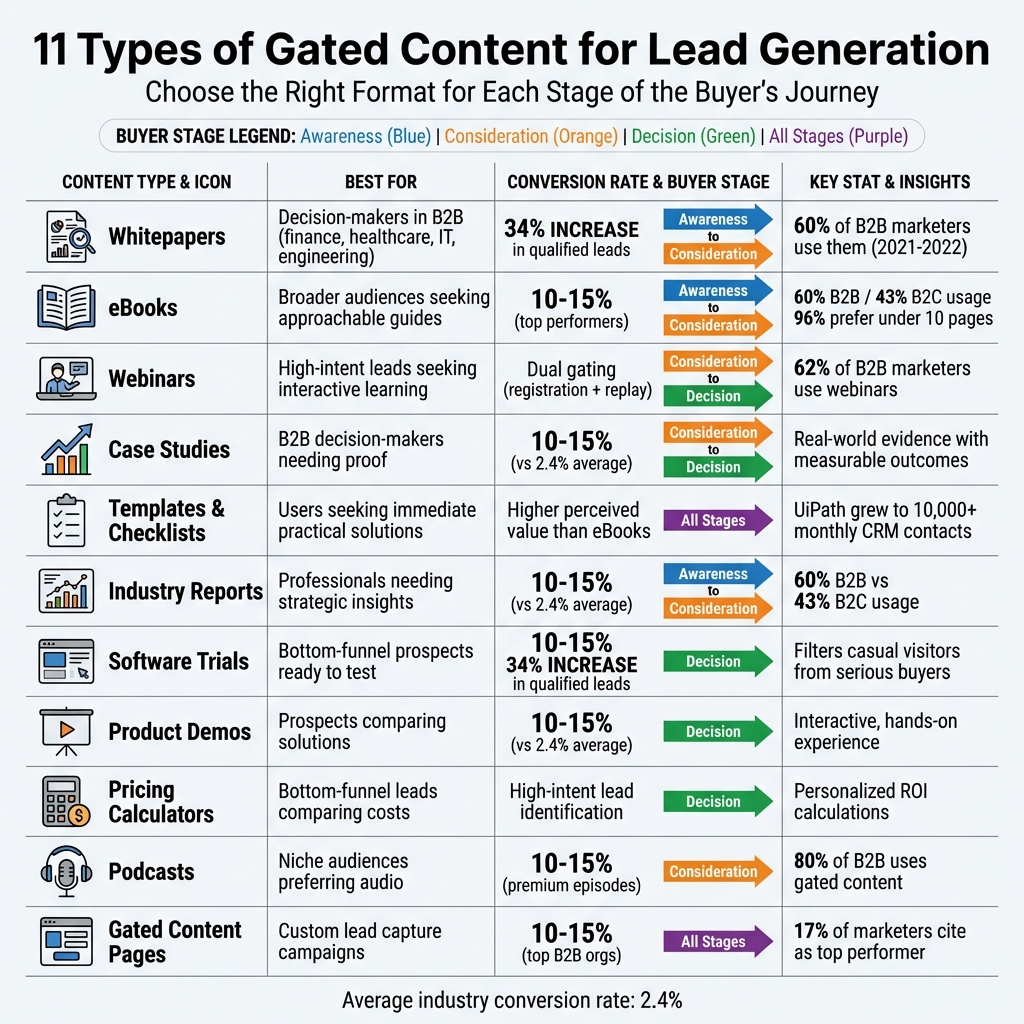
11 Types of Gated Content for Lead Generation Comparison Chart
Improve Lead Generation, Conversions, and Retention With Gated Content – | EP. #79
1. Whitepapers
Whitepapers are detailed, research-focused documents designed to tackle complex industry issues with technical expertise and original data. They’re particularly effective in B2B industries like finance, healthcare, IT, and engineering, where decision-makers rely on specialized knowledge to make informed choices. Between July 2021 and July 2022, nearly 60% of B2B content marketers incorporated whitepapers and eBooks into their strategies, compared to only 43% of B2C marketers. This highlights their role as a key tool for engaging professional audiences.
Lead Generation Potential
Whitepapers excel at attracting serious prospects rather than casual browsers. When someone takes the time to complete a form to access an in-depth resource, it signals genuine interest. Brands that use effective gated content strategies, like whitepapers, report an average 34% increase in qualified leads. This makes them a powerful tool for identifying and connecting with high-intent audiences.
Value Offered to the Audience
Beyond generating leads, whitepapers help establish credibility by offering deep insights. They provide a level of analysis, trend exploration, and technical solutions that aren’t easily found through a quick online search.
Using visual elements like infographics, charts, and professional layouts can make even the most complex data easier to understand and remember. Whitepapers are also evolving, moving from static PDFs to interactive lead magnets that include videos, clickable charts, and even quizzes. These features not only make the content more engaging but also enhance its appeal to serious prospects.
Integration Capabilities for Lead Collection
Whitepapers can be seamlessly integrated into your CRM for smarter lead management. By linking downloads to your CRM, you can automate lead scoring and create personalized follow-ups. Collecting essential details like job titles, company size, and industry helps qualify leads and tailor targeted email campaigns. Additionally, summarizing key whitepaper insights in ungated blog posts can drive more traffic to your gated landing page, increasing overall engagement.
2. eBooks
eBooks are powerful tools for capturing leads, especially during the awareness and consideration phases. Between 2021 and 2022, 60% of B2B marketers and 43% of B2C marketers used eBooks to gather contact information. Unlike whitepapers, which delve into detailed technical research, eBooks focus on providing approachable guides that help readers better understand their challenges and explore potential solutions.
Lead Generation Potential
eBooks, much like whitepapers, are effective at generating quality leads but tend to appeal to a broader audience. In 2023, 17% of marketers reported that gated content, including eBooks, was their highest-converting format. The best-performing B2B pages saw conversion rates between 10% and 15%. However, the emphasis has shifted from sheer volume to targeting the right audience. Fran Langham, Global Head of Demand Gen at Cognism, explains:
"It makes more sense to focus on the ‘who’ rather than the ‘how many’".
This shift encourages businesses to create eBooks that address highly specific, niche topics tailored to their ideal customers, rather than aiming for mass appeal.
Ease of Creation and Customization
Gone are the days when eBooks were limited to PDF lead magnets. Today, businesses are leveraging interactive formats like digital magazines, flipbooks, and scrollytelling, which are optimized for mobile use. Creating standout eBooks often involves collaborating with experts to include exclusive insights, quotes, or even video snippets. Another effective approach is repurposing successful blog posts into concise guides. Since 96% of users prefer eBooks under 10 pages, it’s best to prioritize delivering valuable, focused content over unnecessary length. These modern formats and strategies make eBooks highly engaging and versatile for various marketing efforts.
Value Offered to the Audience
eBooks help establish authority by offering deep insights that go beyond what a simple online search can provide. Tom Bangay, Senior Director of Content and Community at Juro, advises:
"If you’re gating your eBook, you need to ensure that what comes after the gate is good enough".
To build trust and demonstrate value upfront, consider offering a table of contents, a summary of key insights, or even a free sample chapter on your landing page before requesting contact details. Adding features like read-time indicators can also improve completion rates by setting clear expectations.
Integration Capabilities for Lead Collection
eBooks work seamlessly with CRM systems to automate lead scoring and trigger personalized follow-ups. To maximize conversions, keep lead capture forms simple – usually just a name and email are sufficient for top-of-funnel content. Once a user downloads your eBook, you can segment them into topic-specific email lists, enabling personalized nurture campaigns. Instead of pushing for an immediate sale, consider placing leads into "value loops", such as newsletters or podcasts, to continue delivering helpful content until they’re ready to make a purchase. Web-based eBook formats offer an added bonus: they allow you to track engagement metrics like time spent on each page, providing valuable insights into which topics resonate most with your audience.
3. Webinars
Webinars are one of the most effective types of gated content for capturing high-intent leads, especially those further along in the buyer’s journey. It’s no surprise that 62% of B2B content marketers include webinars in their lead generation strategies. Unlike static content, webinars offer real-time interaction with experts, making them a unique and engaging format.
Lead Generation Potential
One standout feature of webinars is their dual gating process. First, you collect lead information during registration for the live event. Then, you can gate the recording for those who missed it, allowing the webinar to keep generating leads long after it’s over. This extended lifespan adds value, especially since attendees are often more willing to share their details in exchange for expert insights and interactive demonstrations.
Flexible Creation and Customization
Webinars offer flexibility in how they’re created and delivered. They can be live, interactive sessions or pre-recorded, on-demand videos. Even the registration process can be a tool for customization. For example, asking registrants, “What do you hope to learn?” allows you to tailor content to specific audience needs while also qualifying leads. A great example of this was in April 2025, when Zapier partnered with Meta for an on-demand webinar about automating lead follow-ups. The gated replay included valuable extras like the full chat transcript, polls, and a live Q&A session, ensuring maximum impact.
Audience Value
Live webinars create a sense of urgency and exclusivity, encouraging more people to register. They also deliver in-depth coverage of complex topics through engaging formats like interactive demos and real-time Q&A sessions. This approach helps build trust and credibility. As Allisa Boulette, Content Marketer at Zapier, explains:
"Webinars are a strong fit for high-consideration products or complex services where live interaction helps build trust".
This kind of engagement not only educates your audience but also prepares them for a smoother integration with your CRM or product.
CRM Integration for Lead Management
The true power of webinars lies in their ability to integrate seamlessly with CRM systems, streamlining lead management. Platforms like Salesforce can automatically sync webinar data, trigger follow-up emails, segment leads based on topics, and even score them using metrics such as session duration or the number of questions asked. For educational webinars aimed at top-of-funnel prospects, a simple registration form asking for a name and email works well. On the other hand, bottom-of-funnel product demos might benefit from collecting more detailed information to better qualify leads.
4. Case Studies
Case studies are a powerful tool for attracting B2B decision-makers who want solid evidence before committing. Jessica Thiefels, Founder and CEO of Jessica Thiefels Consulting, explains it well:
"A CMO making an expensive purchasing decision is going to be more interested in a case study that shows what you do as a company rather than a checklist or guide."
Let’s break down why case studies work so well for lead generation, how they bring value to your audience, and how they can be seamlessly integrated into your lead collection efforts.
Lead Generation Potential
Case studies are especially effective during the consideration and decision-making stages of the buyer’s journey. They don’t just attract attention – they qualify leads who are already seriously weighing their options. In fact, targeted case studies can achieve conversion rates between 10% and 15% , which is a significant jump compared to the average industry rate of about 2.4% . These higher conversion rates highlight their ability to engage prospects who are closer to making a purchase.
Value Offered to the Audience
What makes case studies stand out is their ability to provide real-world proof. They show how your product or service has solved specific challenges for other businesses, offering measurable outcomes and actionable insights. For buyers comparing multiple solutions, a case study with clear metrics and tangible results can be the deciding factor. By demonstrating trustworthiness and delivering concrete evidence, case studies help prospects feel more confident in their decision-making.
Integration Capabilities for Lead Collection
Case studies can also play a strategic role in collecting valuable lead information. When gated, they can capture details like job titles, company size, and industry directly into your CRM. This data allows for tailored follow-ups that address the prospect’s specific pain points. For example, a case study about boosting email conversion rates could help segment leads for targeted outreach. Additionally, integrating with tools like Salesforce or HubSpot can automate follow-up actions, such as drip email campaigns featuring more social proof or product demos. This kind of automation makes case studies a natural fit within a broader content strategy designed to nurture leads effectively.
5. Templates and Checklists
Templates and checklists bring practical, ready-to-use solutions to the table, offering immediate value without the time commitment of reading eBooks or whitepapers. As Rebecca Riserbato from HubSpot puts it:
"The perceived value of a template is much higher than that of an ebook and a white paper, which means your audience is more likely to input their contact information to receive it."
Lead Generation Potential
Templates and checklists can be powerful tools for lead generation, often surpassing the average 2.4% conversion rate. They appeal to prospects who are actively seeking practical solutions. For instance, Shopify uses a gated business plan template to attract top-of-funnel leads. Visitors simply provide their email address to access a customizable Google Doc template designed to help them kickstart their business. Similarly, UiPath leveraged downloadable templates and other resources to grow from fewer than 2,000 monthly visitors in 2014 to over 2 million within seven years, generating more than 10,000 new CRM contacts every month.
Ease of Creation and Customization
Creating templates and checklists doesn’t require extensive research or writing – just a solid understanding of a specific audience problem. These resources are typically delivered as editable files, like spreadsheets or Google Docs, making them easy to customize. They also work well as content upgrades. For example, turning a popular blog post into a downloadable checklist summarizing key points is a simple way to capture leads from existing traffic.
Value Offered to the Audience
By simplifying tasks and saving time, templates and checklists deliver practical benefits. As the Leadpages team notes:
"Checklists are probably the simplest form of gated content, but they’re very effective… Because they’re easier to digest than other lead magnets some users might be more inclined to download them."
For example, a social media calendar can provide an instant, actionable tool that users can put to work right away.
Integration Capabilities for Lead Collection
Gating templates and checklists not only collects email addresses but also provides valuable segmentation data. The type of resource downloaded gives insight into the specific challenges a prospect is trying to solve, enabling more personalized follow-up campaigns. For top-of-funnel resources, keeping forms simple – like asking for just a name and email – reduces friction. For more advanced tools, such as RFP templates, requesting additional details like company size or industry can help qualify leads more effectively. Automation tools like Zapier make it easy to deliver these assets instantly while categorizing leads based on the type of template downloaded.
These ready-made resources are a seamless way to capture leads and nurture them, strengthening your overall gated content strategy.
6. Industry Reports
Industry reports boast conversion rates between 10% and 15%, far exceeding the average of 2.4% across industries. These reports stand out because they combine original research with expert analysis, offering professionals valuable insights for strategic decision-making. From July 2021 to July 2022, 60% of B2B content marketers used reports and whitepapers for lead generation, compared to just 43% in B2C. This strong reliance on data makes industry reports a standout option among gated content, often resulting in higher-quality leads.
Lead Generation Potential
What makes industry reports so effective? They provide exclusive information that professionals can’t easily find elsewhere. Take Salesforce’s "State of Marketing" report, which compiles insights from nearly 5,000 marketers worldwide, or StrataBeat’s 2025 B2B SEO Performance Report, which analyzed 300 B2B SaaS websites to uncover actionable data. These in-depth studies make the value exchange clear – readers are willing to share their information in return for such comprehensive insights. As Semrush explains:
"A report is a research-based piece of content that presents the data itself as well as an analysis of the findings".
Value Offered to the Audience
Industry reports empower professionals by delivering data-driven insights and a deeper understanding of emerging trends. These resources are particularly useful for business planning, as they provide original research and specialized knowledge that can’t be quickly found online. To maintain trust and credibility, ensure that only truly unique and valuable insights are gated – if the data is easily accessible elsewhere, it’s better to keep it ungated.
Integration Capabilities for Lead Collection
When users download a report, the information they provide – like job title, company size, or industry – can be integrated directly into CRM systems. This enables precise lead segmentation and personalized follow-ups. For high-value reports aimed at decision-makers, businesses can request more detailed information, as these users are often willing to exchange data for premium content. Additionally, AI tools can analyze which report topics generate the most downloads and score leads based on their engagement, helping sales teams determine the best time to follow up. This thoughtful approach to lead collection strengthens your overall gated content strategy.
sbb-itb-b3a7196
7. Software Trials
Software trials are a powerful form of gated content, designed to engage potential customers who are ready to make a purchase. These trials appeal to users with a clear intent to solve a specific problem, making them an effective tool for capturing bottom-funnel prospects. In fact, top B2B companies see conversion rates of 10% to 15% for gated trial offers – much higher than the average 2.4% for other types of gated content.
Lead Generation Potential
One of the standout benefits of software trials is their ability to filter out casual visitors. When someone signs up for a trial, they’re signaling genuine interest. For example, Crazy Egg’s 30-day trial requires just a website URL and an email address, creating a straightforward process for collecting contact information. This approach not only generates a list of qualified leads but also sets the stage for effective post-trial follow-ups. Companies using strategies like this have reported a 34% increase in qualified leads.
Value Offered to the Audience
Software trials let users experience the product firsthand, eliminating much of the uncertainty that comes with committing to a purchase. Instead of just reading about features, potential customers can explore them directly and see how they work for their specific needs. Take FluentBoards, for instance – a WordPress project management plugin. They offer a free trial gated by an email opt-in. Once users provide their email, the product downloads immediately, delivering instant value while also capturing a lead. This hands-on experience can turn casual interest into meaningful engagement, complementing other gated content strategies.
Integration Capabilities for Lead Collection
The data collected during trial signups can be seamlessly integrated into CRM systems, making it easier to track leads and personalize follow-ups. Infusionsoft (now Keap) takes this a step further with their "Choose Your Demo" page. They offer three gated options: a pre-recorded demo, a live webinar with Q&A, and a one-on-one session with a team member. Each option captures lead information through a simple subscription form. Additionally, AI tools connected to your CRM can analyze how users interact with the trial, identifying which features they engage with most and recommending the best times for sales outreach. To keep the process smooth, it’s best to keep forms simple – just asking for a name and email can significantly reduce barriers.
8. Product Demos
Product demos are tailored for prospects who are close to making a decision. Unlike content aimed at the top of the funnel, demos target those at the bottom who already understand their problem and are actively comparing solutions. Similar to software trials, demos offer an interactive, hands-on experience that helps move leads closer to conversion. This focused approach highlights your product’s value while also providing useful data on engagement.
Lead Generation Potential
Gated demos are a powerful tool for capturing high-intent prospects – those actively searching for a solution. For example, B2B companies often see conversion rates of 10% to 15% with gated demo content, compared to just 2.4% for other formats. By requiring users to provide basic information before accessing the demo, you can identify these engaged prospects and create direct opportunities for your sales team to follow up.
Value Offered to the Audience
Demos give potential customers a chance to see your product in action before making any financial commitment. They show how your solution tackles specific challenges, helping to build trust and establish credibility. Offering various formats – such as on-demand videos for quick access, live webinars with interactive Q&A, or personalized one-on-one sessions – ensures prospects can engage with the demo in a way that suits their schedule.
Integration Capabilities for Lead Collection
To maximize lead collection, keep demo request forms straightforward by only asking for essential details, like name and email. This reduces friction and improves completion rates. Once the form is submitted, provide immediate access via a "Thank You" page with a video player or download link. Integrating these forms with your CRM ensures lead data flows seamlessly, allowing your team to track engagement and personalize follow-ups. For more in-depth demos, you can ask for additional details, such as company size or job title, to better qualify prospects who show higher interest.
9. Pricing Calculators
Pricing calculators are designed for prospects at the bottom of the sales funnel – those actively comparing costs and ready to make a decision. Unlike top-of-funnel content like ebooks, these tools appeal to high-intent leads. By entering details such as company size or budget, users receive instant, personalized cost estimates or ROI calculations, making this a highly targeted resource.
Lead Generation Potential
These calculators are excellent for identifying serious buyers. By gating the tool – requiring users to provide contact information in exchange for insights – you can not only gather valuable leads but also segment them based on the data they input. This helps pinpoint prospects who are closer to a purchase decision.
Value Offered to the Audience
Pricing calculators take the guesswork out of complex pricing decisions. They provide instant, customized recommendations, saving users the hassle of manual comparisons. This quick and tailored experience encourages prospects to share their contact information. To further enhance the experience, consider offering interactive lead magnets vs PDF lead magnets for personalized results – it’s a small touch that can leave a big impression.
Integration Capabilities for Lead Collection
To maximize effectiveness, let users explore the calculator before asking for their details – this reduces the risk of abandonment. Keep the lead capture form simple, asking only for essential information like name and email. Once submitted, integrate the tool with your CRM to automatically store both the contact details and the user’s inputs. This gives your sales team valuable context for follow-ups. Additionally, sending results via automated email not only builds trust but also keeps your brand fresh in the prospect’s mind.
10. Podcasts
Most podcasts are free and designed to boost brand awareness, but there’s another way to use them: offering premium, gated episodes. These could include exclusive interviews or early releases, and they’re a smart way to attract high-intent leads – especially those who prefer audio content. This tactic works particularly well during the consideration stage of the buyer’s journey, when prospects are actively researching solutions and looking for in-depth insights.
Turning Listeners Into Leads
Gated podcasts don’t just grow your audience – they help you identify and engage with them. By requiring listeners to fill out a simple contact form before accessing premium episodes, you can capture details from people who are genuinely interested in your niche. This strategy transforms passive listeners into active prospects. According to data, 80% of B2B content marketing efforts involve gated content, with top organizations seeing conversion rates of 10–15% from these offers.
Why Listeners Value Gated Content
The secret sauce here is exclusivity. Subscribers get access to content they can’t find anywhere else – whether it’s early access to episodes, extended interviews, or in-depth discussions on complex industry topics. Audio content also fits perfectly into the lives of busy professionals, whether they’re commuting or multitasking. To entice potential subscribers, you can offer a short, ungated preview clip on your landing page. This gives them a taste of what’s behind the gate and helps build trust before asking for their details.
Streamlining Lead Collection
Keep it simple. Use short opt-in forms – just ask for a name and email address – to make the process quick and mobile-friendly. Once someone signs up, redirect them to a "Thank You" page with an embedded player or download link for the episode. Automate follow-up emails to deliver the podcast immediately, ensuring a seamless experience and keeping them engaged. Don’t forget to integrate this data into your CRM so you can segment listeners based on their interests and share personalized content related to the episode topic.
Ready to take things further? Learn how gated content pages via Subpage.co can elevate your lead generation strategy.
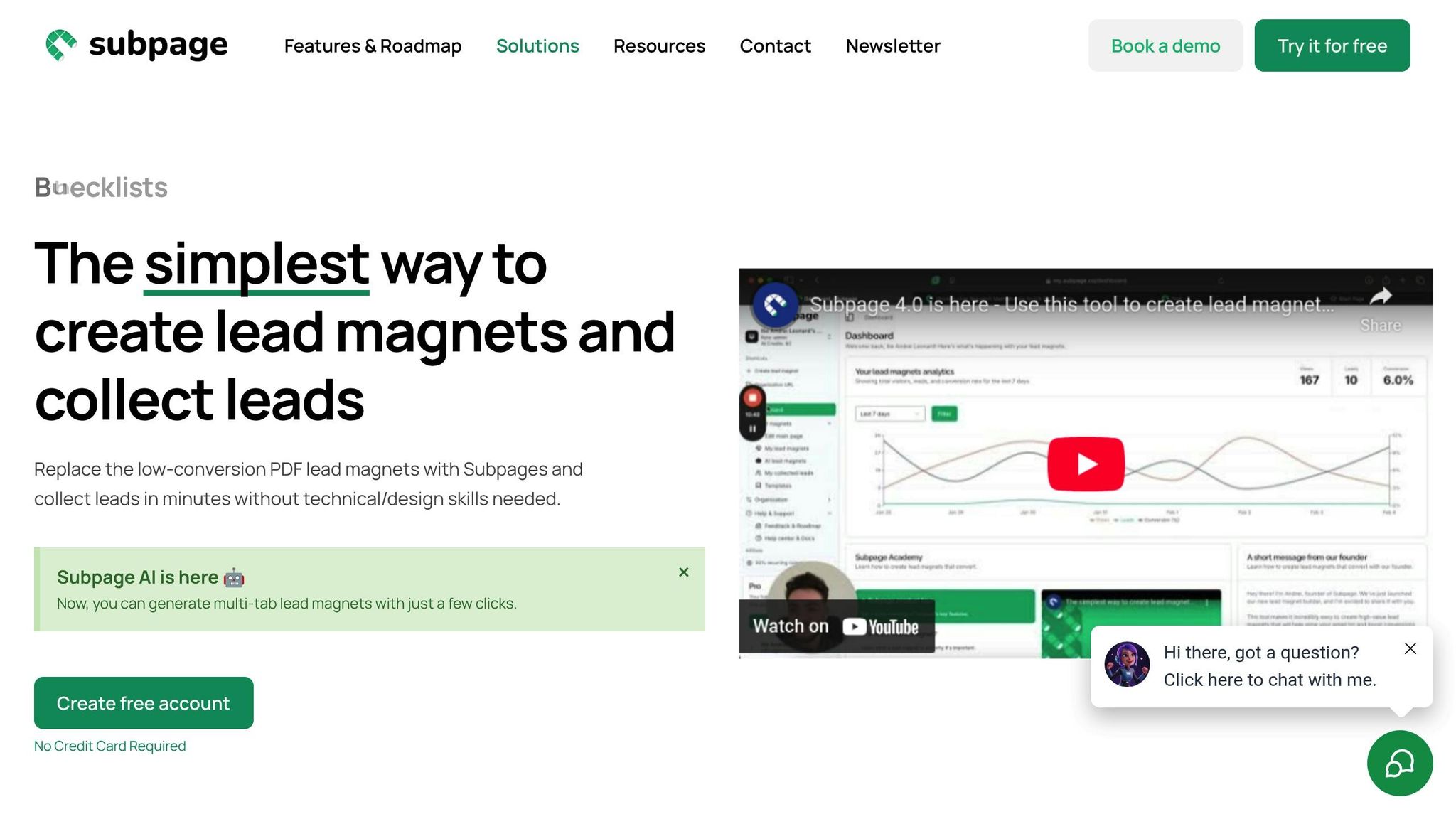
11. Gated Content Pages with Subpage.co
Lead Generation Potential
Gated content pages are a proven tool for generating leads, with 17% of marketers recognizing them as top performers and 10–15% conversion rates reported by leading B2B organizations. What sets these pages apart is their ability to automatically segment your audience. When a user downloads a specific resource, you can tag their interests and follow up with tailored content that addresses their unique needs. This combination of audience insight and targeted engagement makes gated content pages a powerful asset.
Ease of Creation and Customization
Subpage.co simplifies the creation process, removing the need for technical expertise. With its Notion-like editor, marketers can easily build professional-looking gated content pages without any coding or design skills. The platform provides pre-designed templates for resources like whitepapers, checklists, and reports, which can be customized using drag-and-drop tools. From text and colors to fonts and graphics, adjustments take just minutes. This means your team can quickly roll out new lead magnets without relying on developers or designers.
Value Offered to the Audience
Gated content pages do more than collect leads – they provide valuable resources in exchange for contact details. Whether it’s an in-depth industry report, a practical template, or a detailed whitepaper, the key is offering something your audience finds genuinely useful and hard to obtain elsewhere. Subpage.co enhances this process by allowing you to create multi-tab lead magnets with AI support, making it easy to present complex information in an engaging and accessible format that resonates with your prospects.
Integration Capabilities for Lead Collection
Subpage.co seamlessly integrates with popular CRM systems and email marketing tools like Mailchimp, Klaviyo, and Drip. This ensures that lead data flows directly into your CRM, automating follow-ups and delivering assets instantly. The platform also supports webhooks and includes built-in analytics dashboards, giving you clear insights into performance metrics and areas for improvement. Additionally, with Zapier integration, you can connect Subpage.co to virtually any tool in your marketing stack, creating a streamlined and efficient lead-generation workflow.
Conclusion
The 11 gated content types we’ve covered each serve a specific purpose and cater to different stages of the buyer’s journey. When used effectively, gated content can turn casual visitors into qualified leads, grow your email list quickly, and provide valuable data to fine-tune audience segmentation for personalized marketing campaigns. Research consistently shows that gated content is a reliable driver of high conversion rates.
To make the most of these formats, continuous testing is essential. Try experimenting with options like whitepapers, eBooks, demos, or free trials to discover which ones resonate most with your audience. Keep an eye on download metrics and identify any sticking points in your lead capture process to make improvements. Simplifying lead capture forms is another way to encourage higher conversion rates. And remember, the content you offer behind the gate should provide genuine value – something your prospects can’t easily find elsewhere.
As Chloe Addis, Head of Marketing at Headley Media, puts it:
"Great marketers are prioritizing their audiences’ experience. They’re making content readily available to them – only using gated content when it’s valuable or unique, or if they want to run dedicated lead generation campaigns".
To streamline your efforts, tools like Subpage.co can remove technical hurdles. With no-code editors, ready-to-use templates, built-in analytics, CRM integrations, and automated lead collection, platforms like this let you focus on creating content that delivers value while handling the technical side of things for you.
Start by selecting one or two content types that align with your audience’s interests and needs. Track the results, analyze the data, and refine your strategy based on what works. Over time, these insights will help you identify the topics and formats that drive the most engagement, allowing you to create a lead generation strategy that continually improves.
FAQs
How can I select the best gated content format for my audience?
To pick the best gated content for your audience, start by understanding their needs and where they are in the buyer journey. Top-of-funnel prospects often gravitate toward quick and easy formats like checklists, templates, or short guides. On the other hand, mid- to bottom-of-funnel leads are more likely to appreciate detailed resources like eBooks, case studies, or webinars that help them make well-informed decisions.
Think about the formats your audience prefers – whether it’s PDFs, videos, or interactive tools – and align the content’s complexity with their level of interest and effort. For instance, if you have access to unique data, a whitepaper or report might be a good fit. Meanwhile, a step-by-step checklist could be ideal for those seeking actionable guidance. Don’t forget to factor in your team’s resources: creating videos and webinars often requires more time and budget compared to simpler options like templates or worksheets.
After launching your gated content, monitor performance metrics such as conversion rates and lead quality to see what works best. Tools like Subpage.co can make it easier to create whitepapers, checklists, and other lead magnets without needing technical or design expertise, allowing you to test and fine-tune your strategy efficiently.
How can I effectively integrate gated content with my CRM system?
To connect gated content with your CRM smoothly, set up an automated workflow that captures lead details, updates records, and initiates follow-up actions without any manual input. For instance, when someone fills out a form to download a whitepaper or eBook, their details should instantly flow into your CRM, where their engagement with future campaigns can also be tracked.
Make sure form fields like name, email, and job title are properly mapped to the corresponding fields in your CRM for accurate data entry. Use real-time syncing to avoid delays or duplicate entries. Once the lead is added, apply consistent tags or segment them based on the content they accessed. This makes it easier to send personalized follow-ups, create targeted workflows, and generate detailed reports.
Tools like Subpage.co can make this process easier by providing built-in features for form submissions, field mapping, and analytics integration – no technical skills required. Don’t forget to collect consent and follow privacy regulations like GDPR or CCPA to ensure compliance and build trust.
How can I make my gated content truly valuable to potential leads?
To make your gated content truly worthwhile, aim to tackle a specific challenge your audience is grappling with. Resources like whitepapers, checklists, or templates are most effective when they provide practical, actionable insights that your prospects can put to use right away. Think step-by-step guides, relevant data, or tools that directly address their pain points.
Streamline the process to avoid frustrating your audience. Ask for only the basics – like their name and email – and ensure the content is easy to access once they’ve submitted their info. A clean, professional design, clear layout, and mobile-friendly format can elevate the experience, making your content feel polished and reliable. By focusing on relevance, ease of use, and delivering real value, you’ll create gated materials that not only attract quality leads but also foster trust and engagement over time.
Related Blog Posts
