

How Behavior-Based Segmentation Improves Lead Nurturing

Behavior-based segmentation focuses on what your leads do, not just who they are. By tracking actions like website visits, email engagement, and downloads, you can create personalized campaigns that align with each lead’s buying journey. This approach strengthens engagement, boosts conversions, and increases retention by delivering the right message at the right time.
Key Takeaways:
- Personalization Drives Results: Segmented email campaigns generate 100.95% more clicks than generic ones.
- Higher Engagement: Leads interacting with tailored content are more likely to convert.
- Real-Time Adjustments: Behavior-based segmentation updates automatically, adapting to changing lead actions.
- Proven Success: Companies like Showmax saw a 204% subscriber boost, while Too Good To Go achieved a 135% increase in purchases using this strategy.
By monitoring behaviors like pricing page visits or content downloads, you can identify high-intent leads and tailor outreach to their needs. This method ensures your marketing efforts stay relevant and effective.
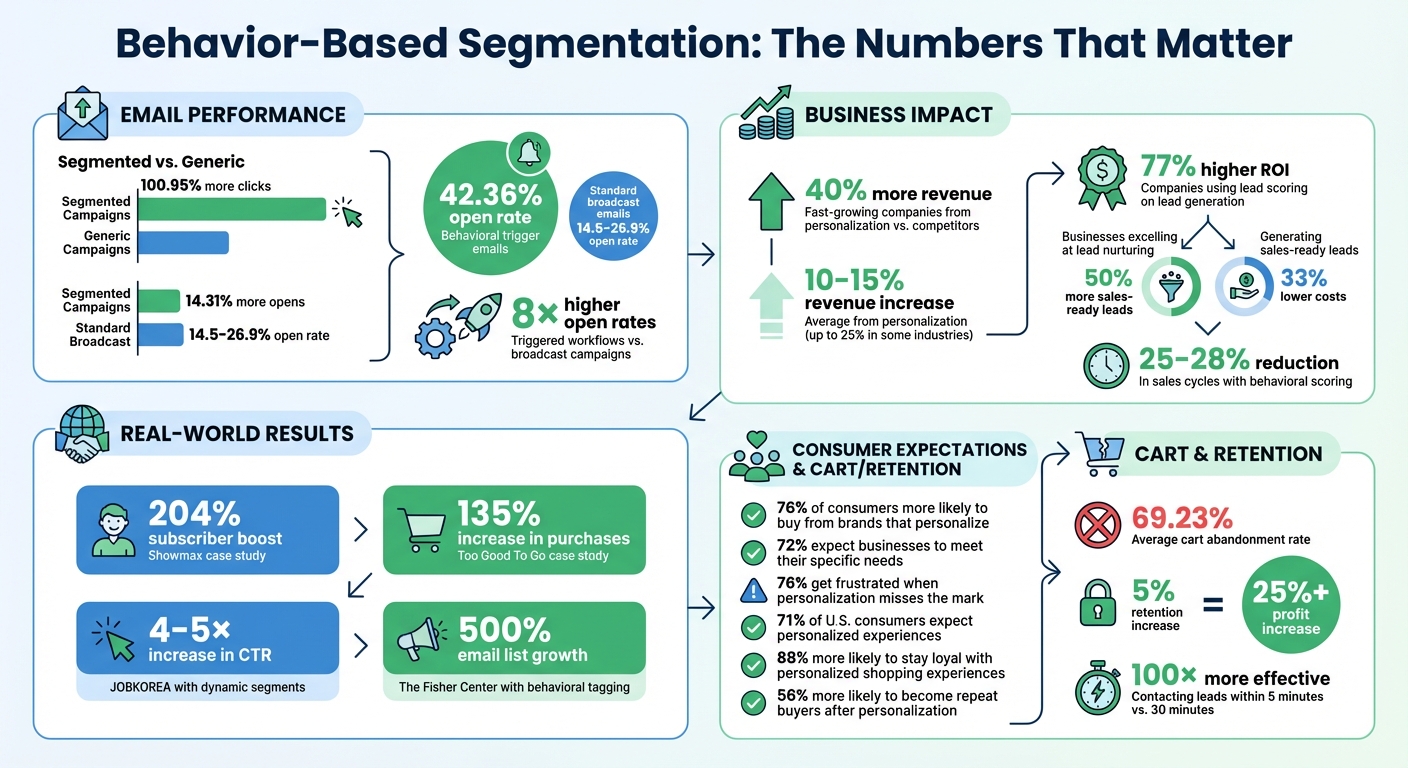
Behavior-Based Segmentation Statistics: Impact on Email Marketing Performance and Revenue
Why Behavior-Based Segmentation Matters for Lead Nurturing
Better Personalization
Behavior-based segmentation changes the game when it comes to connecting with leads. Instead of guessing their needs, you tailor your messages based on their actual actions. For instance, if someone downloads a whitepaper on email automation, it’s a clear signal they’re interested in related content like integration guides or pricing comparisons. That’s much more effective than basing your messaging solely on their job title.
Here’s the kicker: 76% of consumers are more likely to buy from brands that personalize their marketing, and 72% expect businesses to meet their specific needs and interests. On the flip side, 76% get frustrated when personalization misses the mark. By tracking behaviors – like which pages they visit, what they download, or how they interact with your emails – you can deliver exactly what they’re looking for, exactly when they need it. This kind of personalized approach doesn’t just grab attention; it builds stronger engagement over time.
Higher Engagement Rates
The difference between generic campaigns and segmented ones is huge. Segmented email campaigns achieve 14.31% more opens and 100.95% more clicks, while also reducing unsubscribes and spam complaints. Take JOBKOREA, for example. In 2025, they used dynamic segments based on user behavior and custom attributes. The result? A 4–5× increase in average click-through rates and a noticeable boost in conversions. Another great case is The Fisher Center, which used behavioral tagging to group donors by their donation history and interests. This strategy led to a 500% growth in their email subscriber list.
These examples show how focusing on real actions instead of assumptions can make your outreach far more effective. And because behavior-based segmentation adapts in real time, it ensures your campaigns stay relevant, keeping leads engaged and interested.
Real-Time Adjustments
Consumer behavior can shift overnight. A lead who ignored your emails last month might suddenly visit your pricing page several times in a week. Unlike static demographic data, behavior-based segmentation updates automatically as leads move through different stages of interest. This real-time adaptability is essential because acting on a lead’s peak interest can make all the difference in driving conversions.
Here’s a telling stat: fast-growing companies generate 40% more revenue from personalization efforts compared to their slower-growing counterparts. That’s the power of being able to adjust your strategy on the fly. When you can respond to changes in behavior as they happen, you’re not just keeping up – you’re staying ahead.
sbb-itb-b3a7196
Smarter Segmentation: Create Behavioral Tags in HubSpot That Actually Work
Types of Behavior-Based Segmentation
Now that you know how effective behavior-based segmentation can be, let’s dive into the main types you can use to refine your lead nurturing strategy. Each type focuses on different ways leads engage with your brand, allowing you to tailor your outreach more effectively.
Engagement-Based Segmentation
This method groups leads based on how often and intensely they interact with your brand. By tracking metrics like email opens, click-through rates, website visits, and time spent on specific pages, you can identify your most engaged leads – those ready for a sales conversation – and those who might need a nudge.
For instance, if a lead visits your pricing page twice within 48 hours, it’s a strong indicator they’re close to making a decision. In that case, you could send them a personalized offer or demo invitation within the hour. On the flip side, leads who’ve been inactive for 60 days can be flagged as "at risk" and targeted with a win-back campaign. Behavioral trigger emails like these have open rates of 42.36%, compared to the 14.5–26.9% range for standard broadcast emails.
"Segmented emails are simply more powerful than generic ones. Emails and campaigns focused around subscriber actions are more personal and will elicit a positive reaction from your list." – Whitney Blankenship, Content Marketing Manager, Drip
Many companies use lead scoring to prioritize these interactions. For example, you might assign +15 points for a pricing page visit, +10 for completing an ROI calculator, and -10 for 60 days of inactivity. Once a lead’s score reaches a threshold – say, one that indicates a 10–15% likelihood of closing – they’re automatically passed to your sales team.
It’s not just about how often they engage but also what content drives that engagement.
Content Interaction Segmentation
While engagement-based segmentation looks at the frequency of interactions, content interaction segmentation digs into the specifics of what leads are engaging with. This involves organizing leads based on the topics, formats, or resources they consume – like whitepapers, videos, or blog posts.
For example, a lead who downloads an advanced guide on marketing automation is on a very different journey than someone reading an introductory CRM overview. Tracking the specific topics your leads engage with allows you to tag them with precise interests and follow up with content that’s directly relevant. If one person watches 90% of your product demo video while another drops off after 30 seconds, you know who’s more likely to convert.
"Knowing what your leads are up to helps you understand them, what they’re interested in and how close they are to converting." – Whitney Blankenship, Content Marketing Manager, Drip
This strategy is especially helpful for identifying high-intent leads. A lead visiting a pricing page or downloading a technical whitepaper is much closer to making a decision than someone casually browsing your blog . You can even use "trigger links" in emails that automatically tag leads based on what they click, instantly segmenting them by their interests. In fact, 71% of U.S. consumers expect brands to personalize their experiences, and content interaction data helps you meet that expectation.
Purchase and Usage Behavior
Another approach is to segment leads by their buying habits and how they use your product. Are they spontaneous buyers who act on impulse, or do they take their time comparing options? Do they make frequent smaller purchases or occasional larger ones? How often do they engage with your product features?
These insights help you tailor your nurturing efforts. Spontaneous buyers might respond well to limited-time offers, while planned purchasers may need more educational content. 56% of shoppers say they’re more likely to become repeat buyers after receiving a personalized experience, and understanding purchase behavior makes this possible.
You can also use this segmentation to identify cross-selling and upselling opportunities. For example, heavy users of a basic plan might be ready for an upgrade, while light users might benefit from tutorials to maximize their current plan. If a customer regularly buys a product every three months, you can send a timely restocking reminder. The idea is to align your messaging with their buying and usage patterns.
How to Set Up Behavior-Based Segmentation
Once you’re familiar with the different types of behavioral segmentation, it’s time to put them into action. This involves gathering the right data, creating segments that update automatically, scoring leads to focus your efforts, and launching campaigns that respond to specific behaviors.
Collecting Behavioral Data
Start by collecting data that reveals how leads interact with your brand. This includes:
- Purchase behavior: Look for trial sign-ups, upgrade patterns, or sensitivity to pricing.
- Product usage frequency: Track daily logins versus occasional visits.
- Engagement metrics: Measure email opens, click-through rates, and CTA interactions.
- Customer journey stage: Identify whether someone is a prospect, a first-time buyer, or a churned customer.
"Knowing someone’s age, gender, or income only tells you what they might do. Behavioral segmentation shows you what your target audience actually does."
– Anubhav Verma, Associate Content Marketing Manager, Optimizely
Integrate tools like your CRM, analytics platforms, and data warehouse to centralize this information. Popular platforms include Drift or Intercom for conversations, Zendesk for support, and marketing automation tools. If you’re using gated content to capture leads, platforms like Subpage.co can help track downloads of whitepapers or checklists, giving you instant insights into content preferences.
To keep things manageable, start with one or two key segments, such as purchase frequency or feature usage. And don’t forget to comply with GDPR and CCPA regulations while handling data.
| Behavioral Segment | Data Points to Collect | Purpose |
|---|---|---|
| Usage Rate | Login frequency, feature adoption, session duration | Spot power users or churn risks |
| Purchasing Behavior | Average order value, discount usage, trial-to-paid rate | Adjust pricing and promotions |
| Journey Stage | Content downloads, webinar attendance, demo requests | Align nurturing content with readiness |
| Occasion | Purchase dates, seasonal trends, milestone events | Schedule marketing for peak intent |
| Benefits Sought | Quiz responses, filtered searches, feature clicks | Tailor messaging to specific needs |
With this data, you can create dynamic segments that automatically adjust based on lead behavior.
Creating Dynamic Segments
Dynamic segments are constantly updated as leads interact with your brand. They rely on triggers like repeated visits to your pricing page, demo requests, or whitepaper downloads. Marketing automation tools track these behaviors and shift leads between segments as they complete actions, such as scheduling a meeting.
Advanced tools take it further with predictive cohorts, using machine learning to identify leads most likely to take specific actions – like upgrading – within a set timeframe. AI-driven segmentation is also becoming more common, allowing real-time updates and personalized experiences across all channels.
Once your segments are live, the next step is determining which leads deserve the most attention.
Scoring and Prioritizing Leads
Not every lead is ready to buy, so lead scoring helps you prioritize. Effective scoring models blend behavioral signals with demographic data, typically weighing behavior at 60% and fit at 40%.
Assign higher scores to actions that show strong intent, like demo requests or multiple visits to your pricing page. Negative scoring can account for behaviors that disqualify leads. Define clear thresholds for MQLs (Marketing Qualified Leads) and SQLs (Sales Qualified Leads) to streamline the handoff to sales. Companies using lead scoring often see a 77% higher ROI on lead generation and up to 40% higher conversion rates compared to those relying only on demographic data.
Adjust scores based on inactivity. For example:
- After 30 days of no engagement, reduce the score by 20%.
- After 60 days, reduce it by 50%.
- After 90 days, reset the score to zero and move the lead to a re-engagement workflow.
Timing is crucial – contacting a lead within 5 minutes of them reaching an MQL threshold is 100× more effective than waiting 30 minutes.
"What prospects do reveals more about their readiness to buy than who they are."
– Maria, LeadSources.io
Launching Targeted Campaigns
With dynamic segments and prioritized leads in place, the next step is launching targeted campaigns. Triggered workflows outperform standard broadcast campaigns, achieving 8× higher open rates.
Design workflows that activate based on specific actions. For example:
- If someone downloads a case study from Subpage.co, follow up within 24 hours with a related resource or demo offer.
- If a lead visits your pricing page but doesn’t convert, send a personalized offer or a success story to nudge them forward.
Timing matters – leads who engage within 24 hours are 3–4× more likely to convert compared to those who wait a week.
Use progressive profiling to gather more information over time, and review scoring outcomes regularly to fine-tune your workflows. Businesses that excel at lead nurturing generate 50% more sales-ready leads at 33% lower costs. Behavioral scoring can also reduce sales cycles by 25–28% on average. Additionally, 88% of consumers are more likely to stay loyal to brands that offer a personalized shopping experience.
Measuring and Improving Your Results
Once you’ve implemented behavior-based segmentation, keeping an eye on its performance is crucial. Regularly tracking results ensures your lead nurturing efforts stay effective and aligned with your goals. Focus on engagement metrics like open rates, unique opens, and click-through rates (CTR) to gauge how well your segmented content connects with your audience compared to generic messaging. For conversions, pay attention to ROI, attributed revenue, and Customer Lifetime Value (CLV). Retention metrics, such as churn, unsubscribe rates, and bounce rates, will help you assess the long-term health of your segments.
Tracking Key Metrics
Start by monitoring engagement metrics, then dive into conversion rates and revenue to understand the financial impact. Look at email opens, clicks on trigger links, and interactions with CTAs. Beyond email, track behaviors like cart abandonment, page views, and general user activity. This can help identify both high-value users and those at risk of churn. For context, the average cart abandonment rate across industries is 69.23%. Even small retention improvements can have a big impact – boosting customer retention by just 5% can drive profits up by more than 25%. Once you’ve collected this data, use it to refine your approach through testing.
Using A/B Testing
A/B testing is a powerful tool for optimizing your behavioral segments. For example, 77% of companies test their websites, and 60% test landing pages. Start by forming a clear hypothesis – like testing if adding social proof increases conversions by 15%. Keep external factors, such as ad spend or email send times, consistent during the test to ensure reliable results. Aim for a sample size large enough to achieve 95% statistical confidence. However, avoid over-segmenting your audience, as this can dilute your insights. Begin with simple segments, such as purchase frequency or usage patterns, and expand gradually.
"Segment A/B testing empowers marketers to refine their strategies by delivering targeted experiences that resonate with specific audience groups." – Gaurav Rawat, Nudge
Refining Based on Performance
Use the insights from A/B testing to continuously fine-tune your segmentation strategy. Transition from static lists to dynamic segments that update in real time based on live behavioral data. Regularly audit your segments – a "power user" today might become inactive over time. Trigger links can help by automatically tagging subscribers or moving them into new workflows based on their clicks, allowing for instant adjustments. Watch out for over-segmentation, which can stretch your resources too thin. Consolidating your data in a centralized system is key to avoiding fragmented insights and ensuring better decision-making.
Conclusion
Behavior-based segmentation takes the guesswork out of lead nurturing, turning it into a strategy grounded in real data. By monitoring actions like visiting pricing pages, downloading content, or abandoning carts, you can tailor your messaging to match each lead’s position in their journey. This approach doesn’t just improve engagement – it drives results. In fact, personalization can increase revenue by 10% to 15% on average, with some industries seeing gains as high as 25%.
Shifting from static demographic lists to dynamic, automatically updating segments ensures your messaging stays relevant as customer behaviors evolve. With 71% of U.S. consumers expecting personalized experiences and 76% feeling frustrated when brands fail to deliver, meeting these expectations is no longer optional – it’s a must to stay competitive.
To get started, identify 5–10 key behavioral triggers that consistently lead to conversions in your business. Then, map these actions to specific stages of the customer journey. Leverage first-party data from your website and apps to create segments that respect privacy while offering meaningful relevance. Tools like Subpage.co can simplify this process, allowing you to build gated content and lead magnets without technical expertise, while tracking how prospects engage with your materials to refine your strategy.
It’s worth noting that 88% of consumers are more likely to stay loyal to brands offering personalized shopping experiences. Moreover, the fastest-growing companies generate 40% more revenue from personalization than their competitors. By focusing on real behaviors rather than assumptions, you can seize this opportunity instead of letting it pass you by.
FAQs
What behaviors should I track first for segmentation?
Tracking customer behavior is all about understanding the choices they make and how they interact with your brand. Pay attention to important actions like page visits, engagement with your content, and purchase patterns. These insights can reveal customer preferences, helping you create campaigns that resonate with your audience.
How do I avoid over-segmenting my lead list?
Balancing the level of detail in your audience segments is key to avoiding over-segmentation. Stick to criteria that make a real difference, such as demographic or behavioral data, rather than creating overly specific groups that only add complexity.
It’s also smart to review your segments regularly. If you notice similar groups that aren’t delivering unique insights or results, consider merging them. This keeps your process efficient and manageable.
By focusing on data-driven, impactful segments, you can simplify your lead nurturing efforts and eliminate unnecessary complications.
How can I connect behavioral segments to my CRM and automation tools?
When you use automated lead segmentation based on user actions – like page visits or content interactions – you can seamlessly connect behavioral segments to your CRM and automation tools. This setup enables your CRM to trigger personalized workflows while keeping segments updated in real time, ensuring you’re always working with the latest data.
Email automation tools can also tap into this behavioral data to create targeted, relevant messaging. The best part? Your campaigns stay effective without the need for constant manual updates.
Related Blog Posts
