

How to Align Brand Messaging Across Platforms
Consistency in brand messaging is essential to build trust and recognition. When your communication feels cohesive across platforms, customers are more likely to trust your brand, leading to repeat business and stronger visibility. Here’s the key takeaway: Brands with consistent messaging are 3.5 times more likely to achieve strong visibility and can see revenue increases of up to 23%.
Key Steps to Align Brand Messaging:
- Define Your Core Identity: Establish your mission, values, and voice. These elements act as your brand’s foundation, much like effective lead magnets build a foundation for customer relationships.
- Develop a Clear Voice and Tone: Maintain a consistent personality (voice) while adjusting tone for different contexts.
- Craft Messaging Pillars: Identify 3–5 key themes that represent your brand across all channels.
- Create Practical Brand Guidelines: Document rules for messaging, tone, and visuals. Make them accessible and easy to use.
- Adapt Messaging for Each Platform: Tailor your tone and content to fit the unique style and audience of each platform.
- Monitor and Refine: Conduct regular audits and gather feedback to ensure your messaging stays on track.
Quick Fact:
- 88% of customers are more likely to buy again from a brand they trust.
- Consistent visuals, like using the same colors, can boost recognition by 80%.
By following these steps, you can ensure your brand speaks with one voice, no matter where your audience finds you.
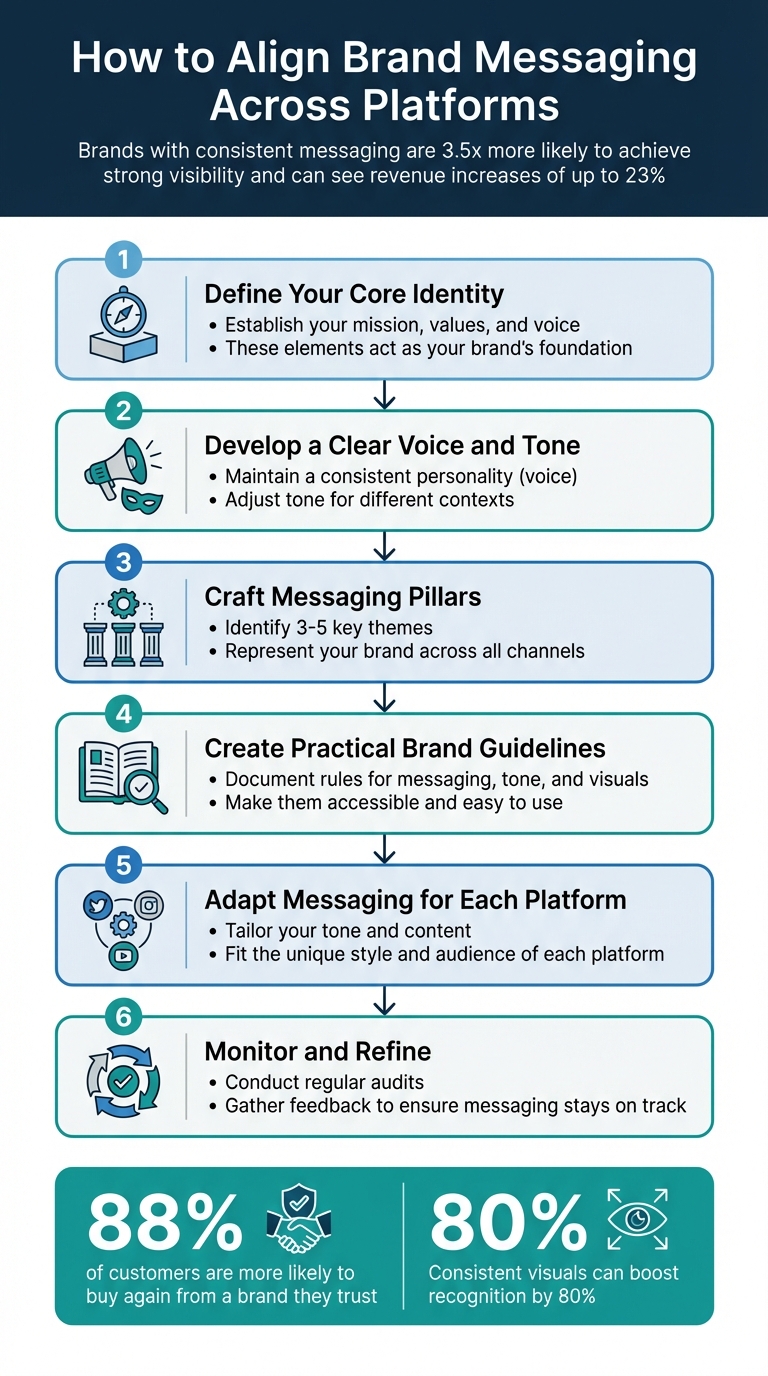
6 Steps to Align Brand Messaging Across Platforms
The Power of Consistency in Branding: How to Stay Memorable
sbb-itb-b3a7196
Define Your Core Brand Identity
Before you can ensure consistent messaging across platforms, you need to pinpoint who you are as a brand. Your core identity is the foundation of all your content. Instead of creating different personas for various channels, focus on maintaining a single, unified identity that adapts in tone and delivery without losing its essence.
Think of your brand identity as your business’s DNA. It’s made up of your mission, values, promise to customers, and the personality that shines through in your communication. When these elements are clearly outlined, your team has a reliable guide for producing content that feels consistent, no matter where it appears. In fact, 90% of U.S. consumers believe trust is crucial when choosing brands to buy from. That trust begins with a brand that knows itself. To get there, establish your mission, voice, and messaging pillars to ensure consistency.
Establish Your Mission and Values
Your mission reflects your "why" – the deeper purpose behind your business beyond just making money. Your values are the 3–5 principles that guide how you operate and communicate. These aren’t just lofty ideas; they’re practical guidelines that keep your messaging on track, no matter the platform.
Start by defining the problem you solve and who you solve it for. Then, outline the values that shape how you approach that problem. Are you transparent? Customer-focused? Forward-thinking? These principles should influence every decision your team makes, from the tone of a tweet to the language used in a whitepaper. Bridgette Ugarte from EnticEdge sums it up well:
"Consistency is the key to not only creating an authentic and noticeable brand presence across all platforms, but also to creating internal company alignment!"
Document your mission and values in a way your team can easily reference. Keep it concise and actionable. When everyone understands these principles, they can create content that aligns with your brand – even when tailoring messages for different platforms or audiences.
Develop a Clear Brand Voice and Tone
Your brand voice is your personality – it’s the constant, recognizable way your brand "speaks." Your tone, on the other hand, adjusts depending on the situation. While your voice remains steady, your tone shifts to fit the context.
To define your voice, pick 3–5 personality traits that describe how you want to sound. Be specific. For example, instead of saying "professional", you might choose "confident but humble" or "smart but approachable." Then, create "do" and "don’t" lists for each trait to provide clarity. For instance, if your voice is "smart but approachable", you might say "Here’s how the algorithm spots patterns you might miss" instead of "Our proprietary machine learning paradigm leverages advanced heuristics".
| Voice Attribute | Do (On-Brand) | Don’t (Off-Brand) |
|---|---|---|
| Smart but Approachable | "Here’s how the algorithm spots patterns you might miss." | "Our proprietary machine learning paradigm leverages advanced heuristics." |
| Confident but Humble | "We’ve helped 500+ companies improve their data strategy." | "We’re the world’s leading revolutionary AI platform." |
| Direct but Friendly | "Let’s look at your specific challenge." | "Users may wish to consider examining their use case." |
Next, map out how your tone changes across different scenarios. For example, your tone might be more formal in compliance documents but casual on social media. Laura M. Browning from HubSpot explains it well:
"I see voice as the overarching guidelines… But the tone might change in different scenarios – you can be informative in a blog post and a customer email, but the tone of the blog post might be more detached and instructive, and the tone of a customer email might be more personal and descriptive".
Create straightforward tone guidelines your team can easily follow. Include word lists – terms you love and ones you avoid. This removes ambiguity and ensures your voice stays consistent, even when adapting to different platforms.
Craft Key Messaging Pillars
Messaging pillars are the key themes and phrases that consistently represent your brand across all channels. While your voice defines how you communicate, these pillars define what you say.
Identify 3–5 key messages that highlight your unique value. These should answer questions like: What sets you apart? What benefits do you offer? What problems do you solve? Avoid overused buzzwords like "excellence" or "innovation." Instead, focus on actionable statements like "reimagining everyday technology for real people".
Brands that stick to consistent messaging can see up to 23% higher revenue compared to those with scattered communication. Your pillars should be adaptable for different audiences while staying true to your core identity. For example, a message like "We turn complex data into clear decisions" could emphasize "integration capabilities" for technical teams and "ROI and outcomes" for business leaders.
Document these pillars alongside your voice guidelines and train your team to apply them across all touchpoints. Whether it’s ad copy, social posts, customer support scripts, or internal memos, these pillars act as your brand’s compass. When everyone understands the key messages, your brand feels consistent – whether someone finds you on Instagram, in their inbox, or on your website. With your core identity in place, you’re ready to create brand guidelines that ensure this consistency across every platform.
Create Brand Guidelines
Once you’ve nailed down your core identity, it’s time to bring everything together in one place. Brand guidelines act as your go-to manual – a practical resource that keeps everyone on the same page, from marketing to customer support.
Consistency is key to driving revenue. Brands that maintain consistent messaging across all channels see 23% higher revenue compared to those that don’t. Yet, while 85% of companies have brand guidelines, fewer than 33% actually enforce them. The solution? Make your guidelines accessible and easy to use. As Chandler Supple, Co-Founder & CTO at River, explains:
"Brand guidelines must be practical reference documents, not decorative presentations. Focus on answering real questions teams have daily."
When done right, these guidelines eliminate confusion, speed up content creation, and ensure your brand feels cohesive – like one voice adapting to different situations, not a lifeless script. The next step? Define clear rules for messaging.
Document Messaging Rules
Your brand guidelines should include clear instructions for messaging, tone, and phrasing standards. These rules aren’t about stifling creativity – they’re about creating a framework that simplifies decision-making and ensures consistency.
Start with specific writing standards. Should your team use active voice? What tone works best for blog posts versus emails? Outline approved phrases and banned jargon. For instance, if your brand voice is "smart but approachable", you might approve a phrase like "Here’s what this means for you" while avoiding corporate buzzwords like "leveraging synergies" or "best-in-class solutions."
Use "Right vs. Wrong" examples to clarify expectations. Instead of just saying "be conversational", show what that looks like:
- Right: "We’ll walk you through the setup in under 5 minutes."
- Wrong: "Users may wish to consult the comprehensive onboarding documentation."
These examples make it easier for your team to align with your brand voice.
You should also include a word list that highlights preferred terms versus those to avoid. For example, your brand might prefer "folks" over "customers" or "build" instead of "create." Document these choices so new team members don’t have to guess. Finally, establish checkpoints in your content creation process to review for brand voice before anything goes live.
Include Platform-Specific Adjustments
Your core brand identity should remain steady, but how you express it will vary depending on the platform. Your guidelines should outline which elements are fixed (like your mission, values, and logo) and which can adapt to different contexts (such as tone, vocabulary, and content length).
Create platform-specific rules for each channel. For example, your brand might embrace humor and emojis on TikTok but stick to a polished tone on LinkedIn. Here’s a simple framework:
| Platform | Tone Adjustment | Content Focus | Key Constraint |
|---|---|---|---|
| Professional, approachable | Thought leadership, industry insights | Formal but not robotic | |
| TikTok | Authentic, energetic | Behind-the-scenes, personality-driven | Values authenticity over polish |
| Personal, direct | Storytelling, comprehensive updates | Requires clear calls to action | |
| Website/Blog | Polished, authoritative | Expertise, SEO-focused content | Long-form with clear hierarchy |
For example, a message like "We simplify complex data" might appear as a detailed case study on your website, a concise post on LinkedIn, or a fun, behind-the-scenes TikTok video. The core idea stays the same, but the delivery adapts to the platform.
If your brand produces video content, include specific guidelines for video formats. Detail standards for intro sequences, pacing, transitions, and text overlays for short-form platforms like TikTok versus long-form platforms like YouTube. These adjustments ensure your brand feels cohesive across all formats.
Make Guidelines Accessible to Your Team
Even the most well-crafted guidelines are useless if your team can’t access or use them. Say goodbye to clunky PDFs and opt for web-based, searchable tools or digital asset management (DAM) systems that keep approved assets and rules updated in real time.
Integrate these guidelines into the platforms your team already uses – embed them in Figma libraries, Google Docs templates, or your CMS. Include ready-to-use templates for emails, social posts, and presentations—or even content-focused lead magnets—to simplify content creation.
Assign a marketing leader as the brand steward to keep the guidelines up to date. Treat this as a living document, revisiting it quarterly to add new FAQs, adjust positioning, or update visual standards.
Instead of lengthy workshops, host quick, focused training sessions. For example, run 30-minute sprints on how to adapt brand messaging for LinkedIn versus TikTok. When your team knows the rules and can access them easily, consistency becomes second nature. With these steps in place, you’ll be ready to maintain a cohesive brand across all platforms.
Implement Consistency Across Platforms
Now it’s time to put your brand guidelines into action. Consistency doesn’t mean every post has to be flawless – it’s about making uniformity the standard.
Brands that achieve this reap measurable benefits. For example, consistent messaging across platforms can lead to 23% higher revenue compared to brands that lack uniformity. The key is building a system that helps your team stay aligned with your brand while maintaining efficiency. A unified visual style is essential to reinforcing your messaging.
Maintain Visual Uniformity
Your visual identity is one of the first things people notice – it’s a powerful tool for building recognition. In fact, keeping your colors consistent can boost brand recognition by up to 80%. That’s why locking down your visual elements is critical.
Identify and document 3–5 core visual elements that will appear everywhere. These should include your logo, primary and secondary color codes (in HEX, RGB, and Pantone), a typography hierarchy (limit this to 2–3 fonts), spacing rules, and image treatment guidelines. These aren’t just suggestions – they’re essentials. Documenting exact specifications ensures no one has to guess. For instance, a shade of blue that’s “close enough” on Instagram but doesn’t match your website creates inconsistency, not familiarity.
Store all approved assets – logos, fonts, and graphics – in a Digital Asset Management (DAM) system like Brandfolder or Frame.io. This ensures your team always uses the latest files and avoids outdated or off-brand materials.
Even smaller details like employee email signatures or legal disclaimers deserve attention. High-volume touchpoints like these should align with your brand. Tools like Crossware can centrally manage email signatures, ensuring every employee uses the same fonts, logos, and formatting without needing manual updates.
Use Templates for Efficiency
Templates are a practical way to maintain consistency while speeding up content creation. They’re not about stifling creativity but about giving your team a solid starting point. Pre-approved templates for social media, emails, and landing pages ensure every piece of content aligns with your brand.
For example, create a master email template system that locks down key elements like headers, footers, and calls to action. Allow customization only in specific sections, like body copy, so your team can tailor messages without disrupting the design. The same principle applies to landing pages: provide a library of pre-approved components – buttons, icons, layouts – that teams can mix and match.
Make it a habit to review and update your templates regularly. This ensures they stay in sync with your current brand tone, visuals, and any new legal requirements.
Use Tools for Content Creation
Consistency in design and messaging often comes down to having the right tools. Instead of starting from scratch with every new asset, use platforms that simplify production while keeping your brand intact.
For marketing materials like whitepapers, checklists, or business cases, platforms like Subpage.co make the process easier. They let you create professional assets without needing design expertise, while also offering built-in lead collection, analytics, and integrations. This ensures your materials stay on-brand while delivering value.
Pair Subpage with design tools like Figma or Canva and writing tools like Grammarly to maintain both visual and tonal consistency. For multichannel campaigns, platforms like PushEngage allow you to manage email, SMS, and push notifications from one dashboard, ensuring all your messages stay synchronized.
With the right tools and templates, consistency becomes almost automatic.
Adapt Messaging for Different Platforms
Consistency in messaging doesn’t mean repeating the same words across every platform. Each channel has its own style, audience preferences, and way of engaging. The challenge is to stay true to your core brand personality while adapting your tone to fit the unique vibe of each platform.
"Real consistency is about maintaining your core brand personality while adapting to each channel’s unique context and audience expectations."
– PushEngage
Think of your brand voice as your personality – it stays the same. Your tone, however, is how that personality comes across in different settings. For example, a brand that’s “helpful and witty” on Instagram should keep that same vibe on LinkedIn, but the way it’s expressed will naturally shift to suit the platform. The goal? Speak the language of each channel while staying recognizable as you.
Once your brand guidelines are in place, tweak your messaging to connect with each platform’s audience in a way that feels natural and authentic.
Optimize for Social Media Platforms
Social platforms are anything but one-size-fits-all. What works on LinkedIn may fall flat on TikTok. Here’s how to fine-tune your approach for each:
- LinkedIn: Use a professional and authoritative tone. Share thought leadership, industry insights, and detailed analysis. Longer-form content that sparks meaningful discussions thrives here.
- X (Twitter): Keep it short, sharp, and clever. Inject personality, engage in real-time conversations, and respond to trends with timely, relevant commentary.
- Instagram: Focus on visuals and storytelling. Pair eye-catching images with captions that evoke emotion and encourage interaction – polls, questions, and other features can help build community.
- TikTok: Embrace playfulness and authenticity. Use trending sounds, share behind-the-scenes moments, and create content that feels relatable and human.
Treat each platform like its own publication, with distinct rules for tone, structure, and visuals. To keep things cohesive, establish 4–6 universal "Voice Pillars" (like Helpful, Witty, or Empathetic) that guide your messaging across all channels. Then, adjust the expression of those pillars to fit each platform’s culture.
Tailor Content for Email Campaigns
Email offers a more personal way to connect with your audience. Unlike the quick pace of social media, it’s a space for deeper storytelling and detailed communication.
Brand recognition is a major factor in email success. In fact, 68% of consumers say they’re more likely to open an email if they recognize the brand, even more so than being drawn in by the subject line. That means every detail – from the sender name to the design – should immediately reflect your brand.
Here are a few tips to make your emails stand out:
- Use a familiar sender name, like a friendly employee or a specific newsletter title, to add a personal touch.
- Display your verified logo in the inbox using BIMI (Brand Indicators for Message Identification). This can increase open rates by 21% and boost purchase likelihood by 34%.
- Design your email header with a clear logo and call-to-action, ensuring your brand is instantly recognizable.
- Write in a conversational tone. For example, instead of “Refer to documentation,” say, “Here’s how to fix that.”
Align your email campaigns with your social media promotions, but present the content differently. For instance, you might feature the same product or deal but use user-generated content from social channels to build trust and social proof.
Don’t forget design details. Ensure your emails look great in dark mode and reflect your brand’s style. These small adjustments help maintain consistency while embracing email’s more intimate nature.
Adjust for Website and Landing Pages
Your website is often the first place people interact with your brand, so the messaging here needs to strike a balance between professionalism and approachability. It should be clear, confident, and welcoming.
Different visitors come to your site with different goals. For example:
| Audience Type | Key Message Focus | Example |
|---|---|---|
| Technical Teams | Integration & Capabilities | "Our API processes 1M+ data points in real time." |
| Business Leaders | ROI & Outcomes | "85% of customers see positive ROI within 90 days." |
| End Users | Speed & Ease of Use | "Get insights in three clicks, not three days." |
To address these varied needs, create 3–5 messaging pillars that consistently reflect your core themes. Modular landing page templates can help ensure your brand’s voice and visuals stay consistent while still being scalable.
When writing web copy, provide your team with clear “Do/Don’t” guidelines. For instance, say, “Let’s figure this out together” instead of the colder, “Please contact our support team for assistance.” Your website should combine engaging storytelling with SEO-optimized language to maintain your brand voice while improving search visibility.
Finally, ensure every touchpoint – from product descriptions to checkout pages – feels aligned with your brand. A warm, engaging social media presence paired with a cold, impersonal website creates a disconnect. Regular brand audits (every 6–12 months) can help you catch and fix any inconsistencies.
Monitor, Audit, and Refine Messaging
Once you’ve set up your brand guidelines, it’s crucial to keep an eye on how they’re being implemented. Platforms and audiences change over time, and even the most well-crafted guidelines can start to drift.
"Inconsistency erodes trust. When your website sounds professional but your social media sounds like a different company… audiences notice."
– TeamBench
To maintain alignment, regular reviews are key. You don’t have to tackle everything at once. Start small with monthly spot checks on 10 random pieces of content. Then, conduct quarterly audits focusing on specific channels or departments. Finally, an annual full audit ensures a comprehensive review across all platforms and content types.
Conduct Regular Audits
Audits are the backbone of keeping your messaging on track. Depending on your needs, you can choose from:
- Full Audits: Done annually, these cover everything – your website, social media, emails, sales materials, and support content.
- Focused Audits: Conducted quarterly, these target a specific channel or department.
- Event-Based Audits: Triggered by major changes like a rebrand or product launch.
Before diving into an audit, gather your reference materials: brand voice guidelines, visual identity standards, terminology lists, and messaging frameworks. These documents act as your benchmark for evaluating content.
Next, create an inventory of your content and select a representative sample for review. For instance:
- Website: Evaluate at least 20 key pages, including the homepage, landing pages, blog posts, and legal pages.
- Social Media: Review the last 30 posts on each platform.
- Email: Examine 10 recent messages across categories like promotional, transactional, and nurture campaigns.
| Content Type | Recommended Sample Size |
|---|---|
| Website | 20 pages minimum (Home, Landing, Blog, Legal) |
| Social Media | Last 30 posts per platform |
| 10 recent emails across different types | |
| Support | 15 help articles or FAQs |
| Sales | 5 current decks and proposals |
While reviewing, look for patterns. Are inconsistencies more common in certain channels or teams? Address the most visible gaps first – like high-traffic landing pages, active sales materials, or frequently updated social media profiles.
Use Analytics Tools
Audits identify problems, but analytics reveal their impact. Track both leading indicators (e.g., content compliance rates) and lagging indicators (e.g., branded search volume or Net Promoter Scores) to measure how well your messaging is performing.
One helpful metric is the Cross-Channel Index, which highlights the gap between your best and worst-performing platforms. A large gap could indicate that your brand voice is inconsistent on certain channels. Another tool is the Brand Voice Consistency Score, which evaluates factors like tone, vocabulary, structure, and readability.
For lead generation, platforms like Subpage.co can show which messaging resonates most with your audience. Use these insights to identify high-performing content, pinpoint areas for improvement, and adjust your strategy accordingly.
To streamline the process, consider automated tools that flag or block off-brand content before it goes live. For smaller content volumes (fewer than 20 pieces per month), manual reviews may suffice. But as your production scales, automation becomes indispensable. Pair these tools with regular audits to ensure your messaging stays sharp.
Gather Feedback from Your Audience
Beyond internal audits and analytics, your audience’s perspective is invaluable. They’re the ultimate judge of your messaging, and ensuring your brand voice resonates with them is key to building trust.
Start with brand recognition surveys. Ask customers if they can identify your brand based solely on messaging – without visual cues like your logo. This simple test can reveal whether your voice stands out. Additionally, track Net Promoter Scores by channel to uncover any weak spots in your brand experience.
Social listening is another powerful method. For example, in January 2025, Innocent Drinks demonstrated their commitment to staying on-brand by closely monitoring comments and replies on X (formerly Twitter). This allowed them to tweak campaigns quickly while maintaining their "cheeky and friendly" tone.
Don’t forget internal feedback. Your sales and customer service teams interact with customers daily and often have valuable insights. Create a space for them to share feedback on how your messaging is received. Reviewing support tickets and chatbot transcripts can also highlight recurring issues or confusion.
Finally, A/B testing is a great way to refine your messaging. Experiment with different tones – like "helpful and straightforward" versus "confident and approachable" – to see which resonates better. Use the data to guide adjustments, as effective messaging evolves alongside your audience and market.
Conclusion
Keeping your brand messaging consistent across platforms isn’t just a one-time task – it’s an ongoing effort that delivers measurable results. Brands with consistent messaging are 3.5 times more likely to achieve strong visibility, can see revenue increases of 10% or more, and even simple visual consistency can boost brand recognition by up to 80%.
Start by defining your brand’s core identity – your mission, values, and voice – and document these in clear, accessible guidelines. Apply these standards across all channels, tailoring them to fit each platform, and conduct regular audits to ensure nothing falls out of alignment. Trust is a key driver of repeat business, and companies with high trust levels can outperform their competitors by as much as 400% in market value.
To make this process easier, consider leveraging tools to streamline execution. For example, Subpage.co offers templates and an intuitive editor to create branded lead magnets like whitepapers or checklists – no design skills required. With options for custom branding and built-in analytics, it’s a practical way to maintain a professional and consistent voice across your marketing materials.
Focus on one impactful channel to begin with. Audit your messaging there, refine it, and then expand to other platforms. Every aligned touchpoint builds trust, and over time, that trust becomes a powerful asset.
FAQs
How do I define my brand voice vs. tone?
Your brand voice represents the consistent personality and style your brand uses to communicate across all platforms. Think of it as the foundation of your brand’s identity in writing. On the other hand, tone adjusts that voice to suit different situations, audiences, or channels.
To nail down your brand voice, start by identifying the core traits and values that define your brand. Once you have those, create clear guidelines to ensure consistency. While your tone might shift depending on the context – whether you’re addressing a formal audience or engaging on social media – it should always stay true to your brand voice. This keeps your communication both genuine and aligned.
What should I include in brand guidelines?
To ensure your brand feels cohesive and recognizable everywhere, it’s essential to define clear guidelines for your voice, tone, key messaging, and visual identity. Here’s how you can do it:
Voice and Tone Guidelines
Your brand’s voice is its personality. Is it friendly and conversational? Professional and authoritative? Define this clearly, and pair it with tone variations for different scenarios. For example:
- Voice: Confident and approachable.
- Tone:
- Friendly for social media posts.
- Professional but warm for customer support emails.
- Inspirational for marketing campaigns.
Messaging Guidelines
Be specific about the language your brand uses – and avoids. Include examples to guide your team:
- Preferred Language: Use inclusive, positive, and action-oriented words.
- Example: "Discover how we can help you achieve your goals."
- Do’s:
- Keep sentences concise and easy to understand.
- Use active voice for clarity and engagement.
- Don’ts:
- Avoid jargon or overly technical terms unless necessary.
- Never use humor at the expense of professionalism.
Visual Identity Standards
Visual elements are the face of your brand. Consistency here ensures your brand is instantly recognizable. Outline the following:
- Logos: Provide approved versions for different uses (e.g., full-color, monochrome, or scaled-down). Include guidelines on spacing and placement.
- Colors: Specify your color palette with HEX, RGB, or CMYK codes to ensure accuracy.
- Typography: List the fonts your brand uses, with details on size, weight, and spacing for headings, subheadings, and body text.
Why It Matters
When your team has a clear framework for communication and design, it ensures every interaction – whether it’s a tweet, an email, or a billboard – feels like it’s coming from the same place. A unified brand presence builds trust and recognition, making it easier to connect with your audience.
How can I measure message consistency across channels?
To ensure your message stays consistent, consider using tools like analytics platforms and AI-driven monitoring systems. These can help track how well your messaging aligns across different channels and identify areas for improvement. Setting up a brand messaging framework and using content management systems are also great ways to keep everything on the same page. Make it a habit to review performance metrics and gather audience feedback regularly. This will help you spot any inconsistencies and fine-tune your approach, so your brand’s voice remains steady and unified across all platforms.
Related Blog Posts
