

Checklist for Creating an Ideal Customer Profile

An Ideal Customer Profile (ICP) helps you focus on businesses that are most likely to benefit from your product while providing the highest return. Companies with a clear ICP experience better win rates, higher revenue, and improved efficiency. Here’s how to create and refine your ICP:
- Analyze your top customers: Identify patterns in profitability, retention, and product usage. Look for shared traits like industry, company size, and tech stack.
- Gather detailed data: Collect firmographics (e.g., revenue, location), technographics (e.g., software used), and behavioral insights (e.g., buying triggers).
- Distinguish ICP from buyer personas: ICP targets companies, while buyer personas focus on decision-makers within those companies.
- Test and improve: Use past sales data to validate your ICP and refine it regularly to align with market changes.
- Document and share: Create an easy-to-access ICP document for your team, focusing on 5–7 key attributes and disqualification criteria.
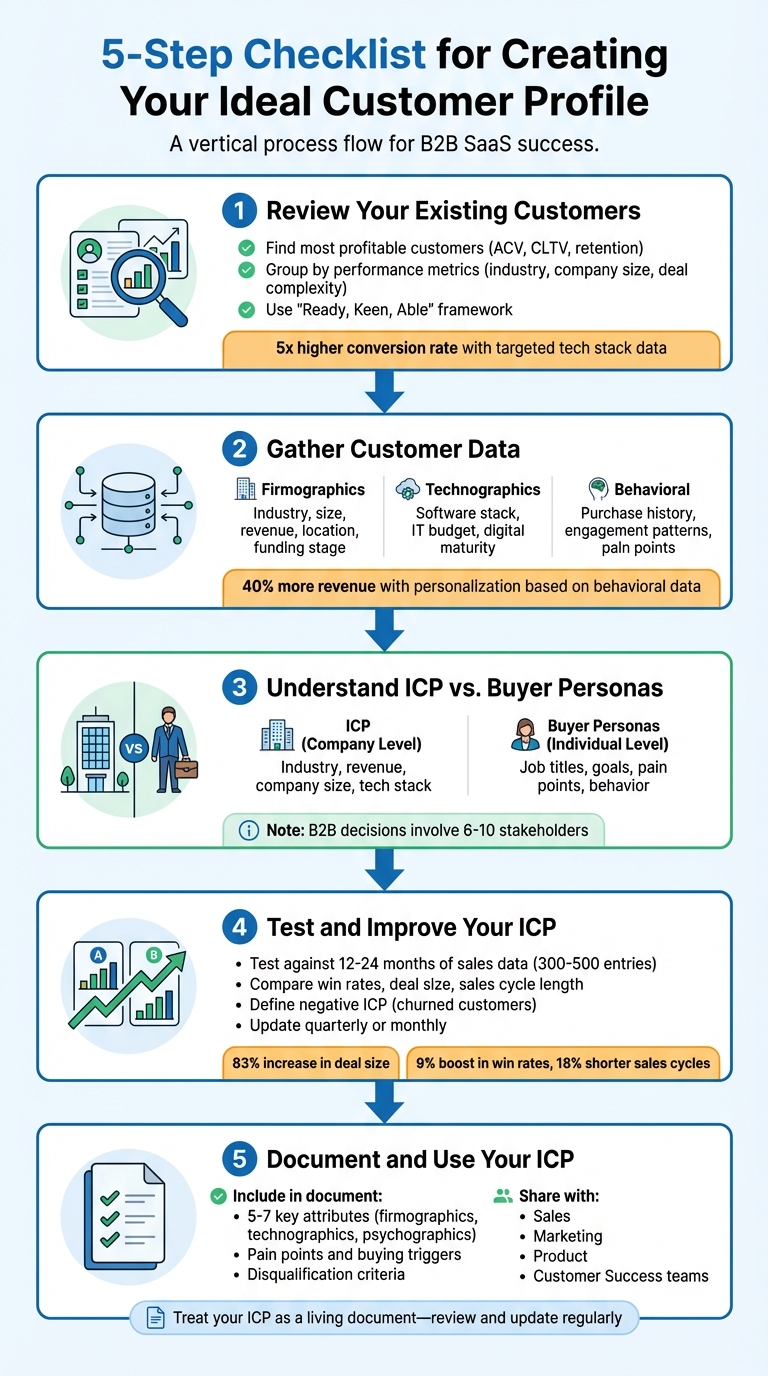
5-Step Process for Creating an Ideal Customer Profile (ICP)
How to Define Your Ideal Customer Profile (ICP)
sbb-itb-b3a7196
Step 1: Review Your Existing Customers
Your current customers hold the key to understanding what drives success for your business. By analyzing your current accounts, you can uncover patterns and insights that will guide your future strategies.
Find Your Most Profitable Customers
Begin by pinpointing the customers who bring the greatest value to your business. This isn’t just about revenue – dig deeper into metrics like Annual Contract Value (ACV), Customer Lifetime Value (CLTV), retention rates, sales cycle length, and Customer Acquisition Costs (CAC). High product adoption is another strong indicator of potential for renewals, upsells, and even referrals.
"These aren’t always the accounts you can sign the fastest – they’re the accounts most likely to stay with you the longest." – Tracy Eiler, CMO at InsideView
For instance, Edward Moores, Data Strategy Manager at Sage, discovered that using specific technographic data led to a 5x higher conversion rate from lead to opportunity for accounts that matched their targeted technology stack.
To refine your target list, apply the "Ready, Keen, Able" framework, which evaluates need, perceived value, and budget. At the same time, identify "bad fit" traits, such as incompatible technology stacks or unsupported regions, so you can avoid pursuing profiles that are unlikely to succeed.
Once you’ve identified your top-performing accounts, segment them to find the shared characteristics that make them successful.
Group Customers by Performance Metrics
Take the traits identified in your profitable accounts and use them to group customers based on performance. Export 12–24 months of CRM data into a spreadsheet and include metrics like industry, company size, deal complexity, and support ticket volume for each account. Organize this data to highlight recurring characteristics among your best-performing customers.
Don’t stop at revenue metrics. Consider efficiency and loyalty indicators like Net Revenue Retention (NRR) and referral activity. Additionally, differentiate between new customer acquisitions and expansion accounts, as these groups often display distinct patterns and behaviors.
Step 2: Gather Customer Data
After spotting patterns among your top customers, the next step is to dig deeper and collect specific data points that will shape your Ideal Customer Profile (ICP). This is where observations turn into actionable insights. Focus on three main areas: company details, individual characteristics, and technology paired with behavioral insights.
Company Information
Start by gathering firmographic details that define your ICP. This includes the basics like industry, company size, and annual revenue. Geographic data is equally important – note where the company is headquartered, its regional presence, and any language requirements that might affect how you deliver your services.
Financial health is another key factor. Look at growth rates, market position, and funding stages (seed, Series A-D, IPO). Companies that are scaling quickly or have just secured funding often signal they’re ready to make a purchase. Also, map out organizational structures, such as department sizes and the typical hierarchy of buying committees.
Technographics – or the technologies a company uses – are increasingly useful. Take note of their current software stack, IT budgets, and overall digital maturity. This helps you pinpoint how your solution fits into their operations.
Individual Characteristics
While company data tells you which organizations to target, individual characteristics help you figure out who within those organizations will champion your solution. Document specific job roles like Engineering Manager, Social Media Manager, or Operational Manager, and note their level of decision-making authority. Separate these roles into categories: Economic Buyer (controls the budget), Influencer, Gatekeeper (manages access), and End-user.
Demographics like age, education, and income are a starting point, but psychographics – values, beliefs, and attitudes – offer deeper insights. These traits help explain why someone might choose your brand. Identify pain points specific to each role. For example, compliance issues, transparency gaps, or operational inefficiencies often drive their decision-making.
"Our initial target audience was a developer building with Node.js who was very security-conscious." – Ben Williams, former VP of Product, Snyk
Technology and Behavior Data
Behavioral data gives you a window into how customers interact with your brand and make purchasing decisions. Start by analyzing your CRM and ERP systems for patterns in email engagement, product usage, and purchase history. Use web analytics to identify which website pages prospects visit most often and how they interact with lead magnets or gated content.
But don’t stop at digital data. Conduct customer interviews using methods like the Diver Survey to uncover what triggers their buying decisions. Ask what challenges they faced when they started looking for a solution and which influencers or platforms they trust. Your sales and customer success teams can also provide firsthand insights into objections and factors that influenced past deals.
Here’s a compelling stat: companies that use personalization based on behavioral data generate 40% more revenue than those that don’t. By blending technology usage patterns with behavioral insights, you’ll build a complete picture of how your ideal customers discover, evaluate, and ultimately choose solutions like yours.
Step 3: Understand ICP vs. Buyer Personas
You’ve collected customer data – now it’s time to distinguish between Ideal Customer Profiles (ICPs) and buyer personas. While these two terms are often confused, they serve entirely different purposes. Your ICP pinpoints which companies you should target, while buyer personas identify the specific individuals within those companies who influence purchasing decisions.
Here’s a simple way to think about it: the ICP is like the address on an envelope, while the buyer persona is the person you’re writing to at that address. If you don’t have the correct address, even the most personalized message will never reach the right person. This separation is crucial because targeting individuals at companies that lack the budget or need for your product wastes time and resources. Keeping these roles distinct ensures your efforts are focused where they matter most.
How ICP and Buyer Personas Differ
Your ICP operates at the company level. It focuses on firmographics – such as industry, revenue, company size, and location – and technographics like software stacks or IT budgets. This information helps you identify and qualify leads at the top of your sales funnel using targeted lead magnets.
On the other hand, buyer personas zero in on individual decision-makers. They capture details like job titles, personal goals, pain points, and purchasing behavior. Buyer personas are used throughout the sales process to tailor messaging, create targeted content, and address objections effectively. In B2B scenarios, where buying decisions often involve 6 to 10 stakeholders, you’ll likely need multiple personas for one ICP.
"Personas tell you who you’re speaking to. ICPs tell you which companies are worth speaking to in the first place. Mix them up, and you waste time on prospects who’ll never convert." – Kiran Shahid, Content Strategist, HubSpot
A real-world example helps illustrate this distinction. Zapier, for example, targets fast-growing companies with 50–500 employees that use multiple disconnected software tools and lose at least 10 hours each week to manual data entry. That’s their ICP. Within these companies, they focus on specific buyer personas, such as:
- Operations Managers dealing with daily manual data entry issues.
- Marketing Ops Specialists struggling with lead routing inefficiencies.
- Customer Success Managers tasked with keeping customer records up to date.
This layered strategy allows them to tackle the same problem from multiple perspectives, tailoring their approach to meet the needs of each decision-maker.
Step 4: Test and Improve Your ICP
To ensure your Ideal Customer Profile (ICP) is effective, you need to test it against actual sales data from the past 12–24 months. Pull a dataset of closed-won and closed-lost deals – aiming for at least 300–500 entries – from your CRM to get statistically sound insights. Then, compare critical metrics like win rate, deal size, and sales cycle length between accounts that align with your ICP and those that don’t. This process connects your initial research to actionable adjustments.
It’s equally important to define a "negative ICP" by identifying patterns among customers who churn quickly, require excessive support, or have drawn-out sales cycles. A great example comes from HubSpot’s CEO Brian Halligan, who reflected on a costly mistake in 2012: “By not deciding on one of these personas, we paid a gigantic, invisible ‘optionality tax.’” HubSpot initially targeted both small businesses (under 10 employees) and larger firms (up to 1,000 employees), which diluted their strategy. Once they narrowed their focus, their approach became much more effective.
Look for Patterns in Your Data
Dive deeper into your data with a lift analysis to uncover which attributes – like industry, company size, or tech stack – positively influence key metrics. For instance, New Breed, led by Guido Bartolacci, revamped its ICP using performance data and achieved an 83% increase in average deal size in just one year. Similarly, Troops.ai refined its ICP to sharpen its messaging, which boosted its opportunity rate from under 5% to 14%. This improved targeting allows you to create more effective lead generation magnets that resonate with your high-value segments. These examples show how quantifying attributes can drive results far better than relying on gut instinct.
Don’t overlook technographic data – the software and tools your most successful customers already use. Edward Moores, Data Strategy Manager at Sage, introduced an Ideal Customer Technology Profile (ICTP) that highlighted specific tech stack attributes. This adjustment led to a conversion rate 5x higher for sales-qualified opportunities. If your product integrates with certain platforms or replaces outdated systems, including this information in your ICP can give you a serious edge.
Update Your ICP Regularly
Markets evolve, products improve, and customer needs shift – so your ICP should never remain static. Plan to review your profile quarterly, or even monthly if your market moves quickly. By early 2025, 98% of revenue leaders had plans to update their ICP, and 47% had already made changes by mid-January. Keep an eye on warning signs like rising customer acquisition costs, increased churn, or struggles within your sales team to close deals – these are clear indicators that your ICP may need a refresh.
Testing changes in real time can also provide valuable insights. Run A/B tests on prospect lists by splitting them into two groups – one that matches your updated ICP and a control group – and track differences in meeting rates, win rates, and acquisition costs. For example, a B2B SaaS team reviewed two years of win/loss data and identified three key attributes that boosted win rates by 9% and shortened sales cycles by 18%. They then shifted 15% of their budget to target these segments, reducing CAC payback by 3.1 months within two quarters. This proves that treating your ICP as a dynamic, evolving tool – not a static document – can deliver measurable results.
Step 5: Document and Use Your ICP
Make sure to document your Ideal Customer Profile (ICP) in a format that’s easy for your team to access and understand. A clear ICP doesn’t just guide your efforts; it directly impacts your success by improving win rates and driving higher campaign revenue. The goal? Align your team’s focus on the accounts that matter most. To do that, your ICP document needs to include the right details and be shared with the right people.
Build a Clear ICP Document
Your ICP document should cover the essentials, such as:
- Firmographics: Think industry, company size, revenue, employee count, and location.
- Technographics: Include their tech stack, IT spending habits, and digital maturity level.
- Psychographics: Highlight their goals, values, and the jobs they aim to get done.
- Pain Points: What challenges are they trying to solve?
- Buying Triggers: Key events that signal they’re ready to buy.
- Buying Committee Roles: Identify Champions, Decision-makers, Influencers, and Blockers.
Keep it simple by focusing on the 5 to 7 most critical attributes. This ensures the profile remains practical and easy to use. A well-crafted ICP zeroes in on long-term, high-value accounts.
Don’t forget to include disqualification criteria – those red flags that indicate a prospect isn’t worth pursuing. For example, a newly appointed CFO or a company with a limited budget might be signs to move on. Format your ICP as a quick-reference guide, like a scannable one-pager, so your sales team can easily pull it up during calls or while preparing outreach lists.
Share Your ICP with Subpage.co
Once your ICP is ready, it’s time to share it with your key teams: sales, marketing, product, and customer success. Instead of using outdated PDFs, consider using a tool like Subpage.co to create an interactive version of your ICP. Subpage’s user-friendly editor allows you to migrate your document from Google Docs and organize it into multi-tab layouts, making it easy for your team to find what they need quickly.
You can even use Subpage’s partial page gating feature. This lets you share a quick ICP overview upfront while requiring contact information for full access. It’s a smart way to boost engagement and capture high-quality leads. To take it further, automate CRM handoffs with Zapier or Webhooks. This ensures your sales team can score and prioritize accounts in real time, turning your ICP into a dynamic tool that keeps everyone aligned on targeting the best leads.
Conclusion
Every step in the checklist, from studying your top customers to thorough testing and documentation, plays a role in shaping an effective Ideal Customer Profile (ICP). Crafting an ICP isn’t a one-and-done task – it’s a continuous process. By analyzing your best customers, collecting data, distinguishing between ICPs and buyer personas, and testing your findings, you create a foundation for smarter targeting and improved conversion rates. The measurable results, as highlighted throughout this guide, speak for themselves.
Since markets and customer behaviors are always evolving, your ICP should evolve too. Treat it as a living document. Schedule quarterly reviews to keep it aligned with current market trends, and make updates ahead of product launches or strategic shifts. For instance, New Breed saw an 83% increase in deal size within a year by refining its ICP. That’s the kind of impact a well-maintained ICP can deliver.
A streamlined ICP also ensures team alignment across departments. Focus on 5 to 7 key attributes and make the profile easily accessible to everyone. When sales, marketing, product, and customer success teams are on the same page about who you’re targeting and why, you’ll avoid wasting time and resources on poor-fit leads. This alignment not only accelerates deal closures but also boosts revenue and conversion rates. By following this checklist, your team will consistently zero in on the right accounts and achieve better results.
FAQs
What’s the fastest way to find my ICP?
To pinpoint your Ideal Customer Profile (ICP) quickly, start by examining your best-performing customers. Identify the common characteristics and key market signals that suggest they’re primed to buy. Once you’ve nailed down this profile, integrate it into your sales and marketing efforts to sharpen your focus and improve outcomes.
How do I define a negative ICP?
A negative Ideal Customer Profile (ICP) outlines the kind of customers or companies a business intentionally avoids. These are prospects that are unlikely to convert, generate little to no profit, or could disrupt operations. For example, traits like high churn rates, minimal revenue potential, or frequent operational headaches can help pinpoint these undesirable profiles. By steering clear of such prospects, businesses can channel their time and resources into leads that are more likely to deliver value, boosting efficiency and sharpening their customer acquisition strategy.
How often should I update my ICP?
Updating your Ideal Customer Profile (ICP) every quarter helps keep it in sync with shifting market trends and changing customer behaviors. By doing this regularly, you ensure your strategies stay on track and continue to resonate with your audience.
Related Blog Posts
