

How to Measure Lead Generation from Influencers
Influencer marketing isn’t just about visibility anymore – it’s about driving measurable results like leads and sales. To track lead generation from influencers effectively, you need clear goals, proper tracking, and data analysis. Here’s what you need to know:
- Set Clear Objectives: Define specific goals like email sign-ups, demo requests, or whitepaper downloads. For instance, aim for 300 qualified leads at a CPL (Cost Per Lead) of $40.
- Track Metrics: Key metrics include total leads, CPL, lead-to-customer conversion rates, and Customer Lifetime Value (CLV). Use tools like UTM parameters, custom links, and dedicated landing pages for precise tracking.
- Analyze Performance: Evaluate influencers based on lead quality, not just volume. For example, focus on MQL (Marketing Qualified Leads) and SQL (Sales Qualified Leads) rates to identify top-performing creators.
- Improve Campaigns: Adjust offers, refine targeting, and optimize landing pages based on data to boost results.
Influencer Marketing: Harnessing the Power of Influence for Lead Generation
Setting Goals and KPIs for Influencer Campaigns
Before diving into influencer partnerships, it’s crucial to define your goals. Vague objectives like "getting more leads" or "increasing awareness" won’t cut it. Without clear, measurable goals, you can’t gauge success or fine-tune your campaigns. The best influencer campaigns are built on specific, measurable objectives that align with your sales funnel and business model.
Choosing Your Lead Generation Objectives
Your lead generation goals should reflect where potential customers are in their buyer journey. Common influencer-driven objectives include:
- Growing your email list
- Increasing free trial or demo signups
- Driving gated content downloads
- Boosting webinar or event registrations
To make these goals actionable, set clear, time-bound targets like:
- "Gain 2,000 U.S. email subscribers from influencer traffic within 30 days."
- "Achieve 300 qualified free-trial signups at a cost per lead (CPL) of $40 or less in one quarter."
- "Generate 800 downloads of a gated whitepaper via influencer-specific landing pages."
Your specific objectives will depend on your business model and sales cycle. For SaaS or high-ticket B2B companies, where sales cycles are longer and involve multiple decision-makers, mid-funnel goals like gated content downloads or webinar registrations often make sense. These businesses benefit from nurturing leads over time before closing a sale. On the other hand, ecommerce or lower-ticket B2C brands often prioritize email and SMS list growth or direct signups, such as newsletter opt-ins with discounts. These leads can quickly convert into sales, making CPL and immediate revenue easier to track.
When setting objectives, calculate your target CPL range based on your customer acquisition costs (CAC) and Customer Lifetime Value (CLV). For example, if your current CAC is $150, and the CLV is $600, your influencer campaign goals should aim for a CPL and conversion rate that keeps your CAC within this range.
Tools like Subpage (https://subpage.co) can simplify lead generation. Subpage allows you to create lead magnets – like whitepapers or checklists – without needing technical or design skills. Each influencer can have a unique gated content page with integrated lead capture, making it easy to track downloads and collect valuable contact information.
Once you’ve nailed down your objectives, the next step is identifying the metrics that will measure your campaign’s success.
Lead Generation Metrics to Track
With clear goals in place, you’ll need to track the right metrics to monitor progress. Four key metrics form the foundation of any influencer lead generation strategy:
- Total leads: This is the number of unique leads – form fills, signups, downloads – generated by influencer traffic during a specific period. It gives you a snapshot of how many prospects are entering your funnel.
- Cost per Lead (CPL): This metric shows how efficiently you’re acquiring leads. Calculate it by dividing your total influencer campaign cost by the number of leads generated. For example, if you spend $5,000 on an influencer campaign that brings in 250 leads, your CPL is $20.
- Lead-to-customer conversion rate: This figure reveals the quality of your leads by showing what percentage turn into paying customers. It’s calculated as:
(Customers from influencer leads ÷ Total influencer leads) × 100.
A low CPL won’t mean much if those leads don’t convert into revenue. - Customer Lifetime Value (CLV): This metric measures the long-term revenue potential of your influencer-acquired customers. A common formula is:
CLV = Average order value × Average purchases per year × Average customer lifespan (years).
For instance, if a customer spends $100 per order, makes three purchases annually, and stays active for four years, their CLV is $1,200.
Influencer marketing often delivers strong returns, with an average ROI of $5.78 for every $1 spent. But tracking these core metrics ensures your campaigns are optimized for profitability.
Beyond these foundational metrics, supporting KPIs can help diagnose performance issues:
- Marketing Qualified Leads (MQLs) and Sales Qualified Leads (SQLs): These differentiate raw leads from those that meet your engagement or fit criteria.
- Landing page conversion rate: This shows how well your offer resonates with influencer-driven visitors. If traffic is high but conversions are low, your landing page or offer may need improvement.
- Click-through rate (CTR): This measures how effectively the influencer’s content drives traffic to your landing page. Low CTRs might indicate weak calls-to-action or unengaging content.
By analyzing these metrics together, you can identify where drop-offs occur. For instance, a low CTR might point to issues with influencer content, while a low landing page conversion rate could highlight problems with your site or offer. If MQL or SQL numbers are low, your audience targeting or messaging might need adjustment.
Aligning KPIs with Funnel Stages
Not every KPI matters equally at each stage of your funnel. To effectively measure lead generation, focus on stage-specific KPIs that connect early indicators to eventual lead volume and revenue.
- Awareness stage: Metrics like reach, impressions, unique viewers, and engagement rate (likes, comments, shares) are critical here. These numbers show whether your content is reaching enough of the right audience. For example, a B2B SaaS company might work with LinkedIn or YouTube creators to target 200,000 impressions with a 3% engagement rate over six weeks.
- Consideration stage: At this point, clicks, CTR, time on site, and content engagement metrics (like video watch time or saves) become important. Early soft conversions, such as gated content downloads, also matter. You might aim for 5,000 influencer-driven landing page visits with a CTR above 1.5% and a 20% landing page conversion rate.
- Conversion stage: Metrics like form completions, signups, gated downloads, and lead-to-customer conversion rate take center stage. Financial metrics like CPL, CAC, revenue, and ROI also come into play. For instance, a B2B SaaS campaign might target 1,000 new leads (e.g., case study downloads) with a CPL under $45, a 4% lead-to-customer conversion rate, and a projected CLV of $1,200 per customer.
Matching KPIs to each funnel stage ensures you’re evaluating influencer efforts fairly. For example, it wouldn’t make sense to judge a creator focused on awareness by their ability to drive immediate conversions if that wasn’t the campaign’s goal.
To define what good performance looks like, use unit economics. Start with your average CLV (e.g., $900 per customer) and current CAC ($225). Then work backward from your lead-to-customer conversion rate to set a target CPL. If 10% of influencer leads convert and you need to keep CAC at $225 or below, your CPL should be around $22.50. This approach allows you to directly compare influencer campaigns to other acquisition channels. For instance, if your influencer CPL is $18 and the leads convert as well as those from other channels, your influencer program is delivering cost-effective, high-quality leads.
Setting Up Tracking for Influencer Attribution
Without proper tracking, it’s tough to know which influencer, platform, or campaign is actually driving results. To connect the dots, you need a structured approach to tagging links, organizing landing pages, and syncing your tools.
Using UTM Parameters and Custom Links
UTM parameters are essential for tracking influencer performance. These tags, added to your URLs, help your analytics platform trace each lead back to a specific influencer, platform, and piece of content.
A well-structured UTM link includes five key components:
- utm_source: Identifies the platform (e.g., Instagram, YouTube, LinkedIn).
- utm_medium: Specifies the channel type, like "influencer" or "creator", to separate traffic from paid ads or organic sources.
- utm_campaign: Names the broader initiative, such as "q1_saas_trial" or "2025_whitepaper_launch."
- utm_content: Pinpoints the individual influencer (e.g., creator_sarah_jones) or specific asset (e.g., reel_march15).
- utm_term: Optional, but useful for segmenting by audience type or messaging (e.g., angle_discount or segment_enterprise).
For instance, if you’re running a B2B campaign with LinkedIn influencers promoting a case study, you might give Sarah Jones a link like:
https://yoursite.com/case-study?utm_source=linkedin&utm_medium=influencer&utm_campaign=q2_leadgen&utm_content=creator_sarah_jones
and Mike Chen a similar link with utm_content=creator_mike_chen. When someone clicks Sarah’s link and downloads the case study, your analytics platform logs the session under her UTM parameters. This way, you can compare performance – perhaps Sarah drives more downloads, while Mike generates higher-quality leads.
To keep things organized, use a URL builder or spreadsheet to create and document your links. Always test UTM links to ensure they work and track properly in your analytics tool.
For platforms with limited space, like Instagram bios, use a link shortener (e.g., Bitly), but double-check that all UTM parameters remain intact after redirection.
Each influencer should have unique links for every placement. For example, if an influencer shares a link in their feed, Stories, and bio, assign different utm_content values (e.g., creator_sarah_jones_feed, creator_sarah_jones_story, and creator_sarah_jones_bio) to see which placement performs best.
Once UTM tracking is in place, set up dedicated landing pages to strengthen attribution.
Creating Separate Landing Pages and Forms
While UTMs track where visitors are coming from, separate landing pages and forms give you even more control over the user experience and lead capture process. Plus, they act as a backup when UTM tracking fails due to ad blockers or cookie restrictions.
For example, if you’re working with multiple influencers, you could create tailored landing pages for each one. A fitness influencer’s audience might respond to a headline like, "The Meal Prep System 10,000+ Busy Professionals Use", while a productivity creator’s audience might prefer, "Save 5 Hours Per Week with This Planning Framework." Unique pages also allow you to A/B test elements – like video testimonials versus written case studies – to see what resonates most.
Managing multiple pages can be time-consuming, but there’s a workaround. Use a shared landing page with unique UTMs and hidden form fields. Many form builders (like HubSpot, Typeform, or Webflow) let you map UTM parameters into hidden fields. For example, if someone visits Sarah’s UTM-tagged link (utm_content=creator_sarah_jones), the form can auto-fill a hidden "Influencer" field with "Sarah Jones." This data flows into your CRM, ensuring accurate attribution even if other tracking methods fail.
Alternatively, for high-value campaigns, you could create duplicate forms – one for each influencer. While this requires more setup, it ensures precise tracking for campaigns where every lead counts.
Next, consider using a tool like Subpage to simplify gated content tracking.
Using Subpage for Gated Content
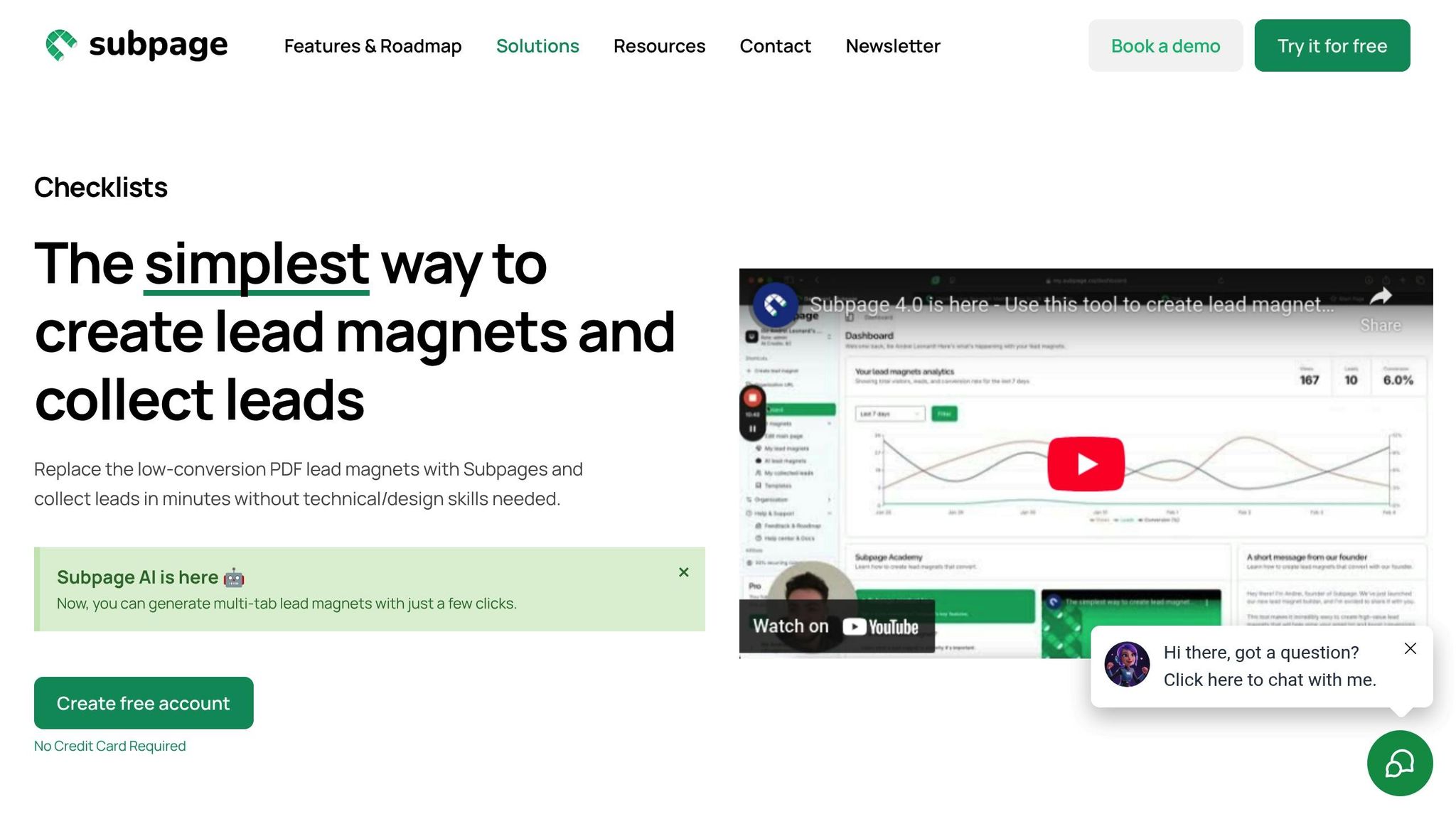
Gated content – like whitepapers, templates, or case studies – is a great fit for influencer campaigns because it provides value while capturing lead data. Subpage (https://subpage.co) makes it easy to create landing pages with built-in lead capture and attribution features.
With Subpage, you can use hidden fields and query parameter capture to ensure each lead is tied to its source. For example, if you send an influencer a UTM-tagged link such as:
yoursubpage.com/sales-playbook?utm_source=linkedin&utm_medium=influencer&utm_content=creator_sarah_jones
Subpage records those parameters with every lead submission. You can configure the form to include hidden fields like "Source", "Medium", "Campaign", and "Influencer", so every lead is properly attributed.
Subpage also offers an analytics dashboard to track page views, conversion rates, and total leads. Paired with your UTM data, this lets you filter performance by influencer to see who’s driving the best results. Plus, Subpage integrates with CRMs and marketing tools via webhooks and Zapier, so influencer-generated leads flow directly into your systems. Automations can tag leads by influencer, assign them to campaigns, or alert sales teams about high-value prospects (e.g., leads from companies with 100+ employees).
For example, let’s say you’re a B2B SaaS company offering a "2025 Customer Success Benchmarks Report" to mid-market leaders. You could create the report in Subpage and design a form to capture details like name, email, and company size. Each lead would then be attributed to the influencer who drove them to your page.
sbb-itb-b3a7196
Measuring and Analyzing Lead Generation Metrics
Once you’ve set up tracking, it’s time to measure how well your influencer campaigns are performing. But raw numbers alone won’t give you the full picture – you need to dig deeper. By calculating key metrics, evaluating lead quality, and tying everything back to revenue, you can see what’s working and where to focus your efforts.
Tracking Lead Volume and Quality
Not all leads are created equal. An influencer might bring in 500 leads, but if only 30 are ready to talk to sales, you’ve got a quality issue. That’s why it’s important to track three lead categories: total leads, Marketing Qualified Leads (MQLs), and Sales Qualified Leads (SQLs).
- MQLs: These are leads that meet specific criteria, like engagement and demographics, suggesting they’re more likely to convert. For instance, if you’re a B2B SaaS company targeting mid-market businesses, an MQL might be someone who downloaded a whitepaper, works at a company with 100+ employees, and holds a director-level title. These criteria should align with your Ideal Customer Profile (ICP) and be defined in your CRM.
- SQLs: These leads are further along in the funnel and ready for direct sales engagement. They’ve requested a demo, asked for pricing, or scheduled a consultation. The sales team has vetted them and determined they’re worth pursuing.
For example, an influencer generating 500 leads might only produce 6% SQLs, while another generating 200 leads results in 12% SQLs. This highlights the importance of focusing on lead quality, not just volume.
To effectively track these metrics, tag every lead in your CRM with the influencer’s name, campaign, and date. As leads progress – from MQL to SQL to customer – you’ll be able to attribute results to specific influencers. Regularly exporting and analyzing this data lets you calculate MQL (MQLs ÷ total leads × 100) and SQL (SQLs ÷ total leads × 100) rates over time.
If you’re using tools like Subpage for gated content (e.g., whitepapers or checklists), you can track these metrics directly through its analytics dashboard. Use UTM parameters in hidden form fields to filter leads by influencer, then sync the data to your CRM to monitor how those leads move through the funnel.
Calculating Conversion Rates and Costs
Once you’ve tracked your leads, it’s time to evaluate how efficiently they convert and whether the costs are justified.
- Lead Conversion Rate: This measures the percentage of visitors or clicks that turn into leads. The formula is (number of leads ÷ number of influencer-driven visitors) × 100. For example, if 50 people click through an influencer’s post and 10 fill out your form, the conversion rate is 20%. A higher rate signals that your messaging resonates with the influencer’s audience.
- Cost per Lead (CPL): This shows how much you’re spending per lead. Calculate it by dividing the total campaign cost by the number of leads generated. For instance, if you spend $5,000 and generate 250 leads, your CPL is $20 ($5,000 ÷ 250). Comparing CPL across influencers helps you pinpoint who delivers the most cost-effective results. For example, if one influencer’s CPL is $15 while another’s is $40, the first one is more efficient – assuming lead quality is comparable.
- Cost per Acquisition (CPA): This metric goes a step further by measuring the cost to acquire a paying customer. To calculate CPA, divide the total campaign cost by the number of new customers. For instance, if a $5,000 campaign results in 25 customers, the CPA is $200 ($5,000 ÷ 25). This is particularly useful for assessing the overall effectiveness of your influencer partnerships.
- Lead-to-Customer Conversion Rate: This metric evaluates lead quality and funnel efficiency. Divide the number of customers by the number of leads to calculate this rate. For example, if 25 of 250 leads convert to customers, the conversion rate is 10% (25 ÷ 250 × 100). Comparing this rate across influencers helps you prioritize those who bring in higher-quality leads. An influencer generating 100 leads with a 15% conversion rate might be far more valuable than one generating 300 leads with only a 3% conversion rate.
Keep in mind that these metrics can vary depending on your industry, product, and campaign specifics. For B2B companies with longer sales cycles, customers may not appear until weeks or months after a lead is captured. Tracking these metrics over time – and benchmarking them against historical data or other marketing channels – provides more meaningful insights.
Measuring Revenue and ROI
At the end of the day, influencer campaigns need to drive revenue, not just leads. To measure success, you’ll need to connect influencer-generated leads to actual revenue.
The basic ROI formula is: (Revenue Generated – Campaign Cost) ÷ Campaign Cost × 100. For example, if a $10,000 campaign generates $57,800 in revenue, the ROI is 478%. On average, influencer marketing delivers $5.78 in revenue for every $1 spent, though results will vary depending on factors like campaign strategy, influencer selection, and audience alignment.
To track revenue sources, use tools like UTM parameters, promo codes, and unique landing pages. In Google Analytics, you can filter by the UTM parameters associated with each influencer to see how much revenue their traffic generated. Promo codes can also be tracked within your e-commerce platform or CRM to attribute sales directly to specific influencers.
For B2B companies, where lead generation is often prioritized over immediate sales, ROI can be estimated by multiplying the number of leads by their average value. For instance, if 10% of leads typically convert to customers and the average deal size is $5,000, each lead is worth $500. So, if an influencer campaign generates 100 leads at a cost of $8,000, the estimated revenue is $50,000 (100 × $500), resulting in an ROI of 525% [($50,000 – $8,000) ÷ $8,000 × 100].
However, immediate sales figures don’t always capture the full picture. Customer Lifetime Value (CLV) provides a more comprehensive view by measuring the total profit a customer brings over their entire relationship with your business. For instance, if a campaign costs $10,000 and generates 100 customers, the initial ROI might seem modest. But if each customer has a CLV of $500, the true value of the campaign is $50,000 – yielding a 5:1 return.
To track CLV, work with your finance or sales teams to calculate the average revenue per customer over their lifetime, subtracting the cost to serve them. Then, tag customers in your CRM by the influencer who referred them and monitor their spending over time. This helps you identify which influencers bring in customers with the highest long-term value.
Improving Influencer Campaigns Based on Data
Once you’ve tracked your influencer campaigns, the next step is to use that data to improve lead quality and lower costs. By analyzing what works, fixing inefficiencies, and refining your strategy, you can turn one-off influencer efforts into a consistent and scalable acquisition channel.
Start by evaluating the performance of both your influencers and the content they create to uncover areas for improvement.
Comparing Influencer and Content Performance
Not all influencers deliver the same results, even if their follower counts or engagement rates seem comparable. To identify your top performers, compare key metrics such as CTR (click-through rate), landing page conversion, CPL (cost per lead), cost per MQL/SQL, and revenue per lead. Use rate-based metrics to normalize results for audience size, ensuring fair comparisons.
Rank your influencers by a mix of lead quality (e.g., MQL/SQL rates, close rates) and efficiency (e.g., CPL, ROI) – not just by engagement or impressions. For instance, a smaller LinkedIn creator generating 50 leads at $15 CPL with a 40% MQL rate could be far more valuable than a larger Instagram creator delivering leads at $5 CPL but only a 5% MQL rate. The LinkedIn creator’s leads are eight times more likely to qualify, often leading to better sales and stronger ROI.
It’s also crucial to evaluate content formats across influencer campaigns. Use UTM tags to track both the influencer and the type of content, such as utm_content="creatorA_reel" versus utm_content="creatorA_story". Once you aggregate the results, you might find that TikTok-style short videos generate high CTRs but lower-quality leads, while long-form YouTube reviews or LinkedIn text posts produce fewer clicks but much higher MQL and SQL rates.
This data can guide your strategy. If carousel posts consistently outperform single-image posts for lead generation, ask your influencers to focus on that format. If one platform delivers leads at a much lower cost, allocate more of your budget there.
Finding and Fixing Funnel Problems
With performance data in hand, take a closer look at your funnel to spot where prospects are dropping off. Map out each step: impressions → clicks → landing page views → form starts → completions → MQL/SQL → customer. Calculate the conversion rate at each stage, and focus on areas with significant drop-offs.
- Low CTR despite high impressions suggests an issue with the content or call-to-action. The influencer’s post may not be compelling enough to drive clicks. To address this, test stronger calls to action, improve thumbnails, and tailor offers to the influencer’s audience. For example, "Free US-focused tax checklist for freelancers" is likely to perform better than a generic "Download our guide." Also, give influencers multiple ways to share links, like swipe-ups, pinned comments, or link-in-bio placements.
- Low landing page conversion despite high CTR indicates a disconnect between the influencer’s post and your landing page. The page might lack a clear value proposition or have confusing messaging. Simplify your forms, ensure mobile optimization (most US audiences browse on smartphones), and align the page’s message with the influencer’s content. Adding social proof, like customer testimonials or logos, can also help.
- Strong conversions but poor MQL rates often point to targeting issues. If the leads don’t match your Ideal Customer Profile, either adjust the influencer’s brief to target a better audience or offer a more niche lead magnet that appeals to decision-makers.
Review your funnel performance weekly or biweekly to quickly identify whether you need to adjust creative elements, targeting, landing pages, or follow-up strategies. These insights will help refine your future goals and KPIs for influencer campaigns.
Improving Lead Magnets and Offers
Your lead magnets play a critical role in attracting high-quality leads. If certain offers aren’t performing well, use funnel data to refine them.
For example, if you’re hosting lead magnets like whitepapers or checklists on Subpage, analyze metrics like page views, form completion rates, and traffic sources segmented by influencer or campaign. This will show you which lead magnets resonate most with specific audiences.
Experiment with different formats to improve both conversion rates and lead quality. If a generic ebook is converting but bringing in low-quality leads, try a more specialized asset. For instance, instead of "The Complete Guide to Marketing", offer something like "ROI Calculator for US SaaS Marketing Teams" or "B2B Influencer Brief Template." These targeted resources naturally attract decision-makers while filtering out less relevant leads.
If your conversion rate is solid but lead quality needs improvement, consider lighter, more actionable formats like checklists, templates, or short videos with clear, outcome-focused titles. Platforms like Subpage make it easy to test variations without requiring extensive design or development work.
You can also experiment with elements on your gated content pages, such as headlines, benefit-focused descriptions, and form fields (e.g., asking only for an email versus requesting additional details like company name or job role). Track which combinations yield the best results in terms of both conversion rates and lead quality.
Because Subpage integrates with CRM and marketing tools, you can track whether leads from specific influencer campaigns convert into MQLs, SQLs, and customers. This helps you identify not just which offers drive the most downloads, but which ones bring in leads that actually close.
Over time, prioritize lead magnets that generate higher MQL and SQL rates, even if they bring in fewer overall leads. A resource that delivers 100 qualified leads is far more valuable than one that generates 300 unqualified ones.
Many marketers recommend a regular optimization schedule: monitor key metrics weekly, make deeper adjustments monthly, and conduct strategic evaluations quarterly. Weekly reviews should focus on CTR, conversion rates, and CPL by influencer and content type to catch early issues. Monthly, analyze MQL/SQL rates and revenue per lead, and adjust briefs, offers, or lead magnets based on test results. Quarterly, evaluate ROI across all influencers and platforms, renegotiate contracts, update your ideal creator profile, and set new lead generation goals.
Conclusion
When it comes to measuring lead generation from influencers, it’s not about counting likes or comments. The real focus should be on creating a system that ties influencer efforts directly to meaningful business outcomes – leads, qualified prospects, and revenue. The difference between guessing and knowing lies in three key practices: setting clear goals, implementing precise tracking, and consistently improving through data-driven insights.
Before kicking off any influencer campaign, it’s critical to establish specific, measurable goals and KPIs. Without these, your performance data is just noise. Define targets like lead volume, cost per lead (CPL), MQL conversion rates, and ROI. For instance, you might aim to generate 300 demo requests in 30 days while keeping your CPL under $120. These benchmarks guide every decision – from selecting influencers and crafting content to setting budgets – and provide a clear way to measure success. This groundwork ensures every campaign is built on a solid foundation.
Accurate tracking is non-negotiable. Use UTM parameters and unique links to attribute results correctly. Set up dedicated landing pages or forms for each influencer or campaign to compare performance effectively. Promo codes or affiliate links can help capture conversions that don’t happen through direct clicks, while lead-source fields in forms can catch attribution that might otherwise go unnoticed. Without these tools, you’re essentially working in the dark.
For U.S. marketers running gated content campaigns, platforms like Subpage make this process easier. They allow you to quickly create lead magnets like whitepapers or checklists, set up influencer-specific gated content pages, and integrate analytics to send leads directly into your CRM for nurturing. This approach simplifies the process of implementing best practices, such as using dedicated landing pages and precise tracking, without requiring technical expertise.
Once your tracking is in place, shift your focus to both lead quantity and quality. Monitor total leads while also tracking how many convert into MQLs, SQLs, and paying customers. Evaluate conversion rates at every funnel stage and tie revenue back to individual influencers to calculate ROI. For example, if you spend $10,000 on a campaign and generate $40,000 in revenue, that’s a 300% ROI. The goal is to prioritize influencers and channels that consistently deliver profitable customers, not just a high volume of leads.
The real value of measurement lies in its ability to drive action. Think of influencer lead generation as a continuous optimization cycle. Start with clear goals, launch campaigns with robust tracking, and monitor performance weekly and monthly. Identify any bottlenecks in your funnel, adjust your influencer strategy and content formats, and document lessons learned for future campaigns. Keep an eye on metrics like click-through rates, conversion rates, and CPL weekly to spot early issues. Analyze MQL and SQL rates monthly to refine your offers and lead magnets, and evaluate ROI quarterly to adjust contracts and set new goals.
Avoid common mistakes along the way. Don’t rely solely on engagement metrics like likes and comments unless they’re tied to actual conversions. And don’t treat influencer marketing as a one-off tactic. Its true value lies in consistency – shifting budgets to top-performing influencers, fixing weak spots in your funnel, and refining offers based on real conversion data.
The best influencer lead-generation programs are built on strategy, not vanity metrics. They rely on intentional attribution systems, prioritize lead quality over quantity, and calculate ROI with a focus on long-term customer value. When these principles are in place, influencer marketing evolves from a risky experiment into a scalable, data-driven channel that drives measurable growth.
FAQs
How can I evaluate which influencers are generating the most valuable leads?
To measure how well influencers are helping you generate high-quality leads, focus on tracking key performance indicators (KPIs) such as conversion rates, cost per lead (CPL), and engagement metrics like clicks and shares. Tools like unique tracking links, promo codes, or UTM parameters can make it easier to directly tie leads back to individual influencers.
Beyond that, dig deeper into the quality of the leads by looking at metrics like lead-to-customer conversion rates or the average deal size. Platforms like Subpage simplify this process by offering tools to create lead magnets, gather leads, and monitor performance – all without needing technical expertise. Keeping a close eye on these metrics will help you pinpoint which influencers are delivering the most valuable results for your marketing efforts.
How can I set up UTM parameters to effectively track influencer campaign results?
To effectively monitor how influencers are performing, setting up UTM parameters is a must. Consistency in naming each UTM field is key to making your data easy to interpret. For instance, in the utm_source field, include the influencer’s name or handle. Use the utm_medium field to specify ‘influencer’ or ‘social,’ and ensure the utm_campaign field reflects the name of the campaign, so you can connect results directly to your marketing efforts.
Always test your UTM links before sharing them to confirm they work properly and lead users to the correct landing page. If you’re using gated content, tools like Subpage can simplify collecting leads and offer detailed insights to track conversions. By pairing UTM tracking with analytics, you’ll gain a clear understanding of how each influencer is contributing to your lead generation objectives.
How can I boost the conversion rate of landing pages driven by influencer campaigns?
To boost the conversion rate on influencer-driven landing pages, focus on creating content that seamlessly matches the influencer’s tone and audience. The page should feel like a natural continuation of their promotion, with clear and engaging calls-to-action (CTAs) that guide visitors toward the next step.
Consider using gated content – such as whitepapers, checklists, or business cases – to encourage visitors to share their contact information. Tools like Subpage make it simple to create these resources without needing technical expertise, saving time and effort.
Keep an eye on metrics like click-through rates, bounce rates, and form submissions to pinpoint areas that need improvement. Experiment with different elements – headlines, CTAs, visuals – to figure out what connects most effectively with your audience.
Related Blog Posts
