

How Content Builds Trust With Leads

Trust drives buying decisions. Nearly 81% of consumers need to trust a brand before purchasing, and 71% stop buying when trust is broken. Content marketing builds this trust by offering helpful, honest, and consistent information rather than pushy sales tactics.
Key takeaways:
- First impressions matter: High-quality, transparent content shows expertise and reliability.
- Consistency is essential: Regular publishing builds confidence in your brand.
- Transparency wins: Address pricing, limitations, and comparisons openly to build credibility.
- Social proof works: Reviews, testimonials, and user-generated content enhance trust.
- Lead magnets convert: Offer actionable resources to engage and nurture leads.
The result? Trusted brands see higher sales, better customer retention, and stronger advocacy. Focus on creating content that solves problems, communicates openly, and delivers real value over time.
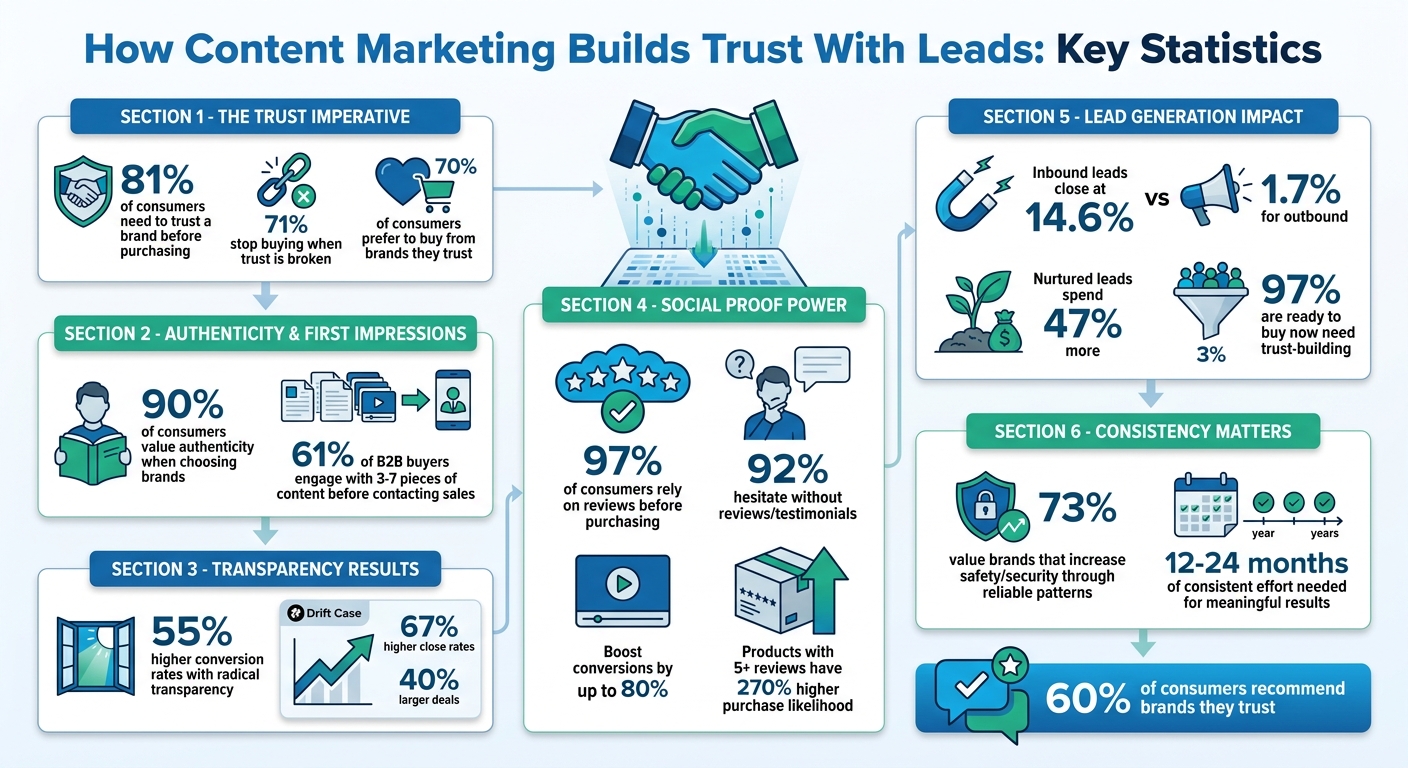
How Content Marketing Builds Trust: Key Statistics and Impact
How Great Content Builds Trust & Sales | Marketing Management
sbb-itb-b3a7196
1. Why Content Forms the Basis of Trust
Your content is often the first thing people encounter when learning about your business. It answers essential questions – what you do, who you serve, how you solve problems, and why you’re worth trusting. These first impressions happen fast, and the quality of your answers can either build confidence or erode it.
1.1. First Impressions Matter
Nine out of ten consumers value authenticity when choosing which brands to support. Before someone reaches out to you directly, they’re likely exploring your blog posts, watching your videos, or scrolling through your social media. These moments shape their perception of your brand and influence whether they decide to engage further.
High-quality content does more than inform – it reflects expertise. For example, long-form content builds trust because it takes time and effort to create. A shallow, keyword-heavy article might take minutes to write, but a detailed guide that thoroughly addresses a topic requires hours of research and refinement. People can sense the difference, and that effort speaks volumes about your credibility.
This initial impression lays the groundwork for deeper trust, which grows through consistent, high-quality content.
1.2. Building Credibility Through Quality Content
When you publish well-researched, thoughtful content, you position your brand as reliable and knowledgeable. This builds "brand authority", where people see your business as a trusted source of information – not just another company trying to make a sale.
Quality beats quantity. A single, in-depth article that fully answers a question is far more effective at building trust than multiple shallow posts. Search engines and AI tools now prioritize content that demonstrates expertise, not just keyword stuffing.
Transparency is another crucial factor. For example, in 2018, Drift CEO David Cancel launched a "What We Got Wrong" series, openly discussing three years of product missteps. The result? A 67% increase in close rates and 40% larger deals. This honesty didn’t damage their reputation – it strengthened it.
By committing to transparency and depth, your content can stand out as more educational and trustworthy, creating a clear distinction from traditional advertising.
1.3. Content Marketing vs. Advertising
Here’s a key difference: traditional advertising says, “Buy our product now!” Content marketing says, “Here’s how to solve your problem.” That distinction matters because 81% of consumers need to trust a brand before making a purchase. Advertising often feels pushy or transactional, while content marketing focuses on education and solutions.
| Advertising | Content Marketing |
|---|---|
| "We’re the best in the business" | "Here are your options, honestly compared" |
| "Limited time offer!" | "Let us help you make the right decision" |
| Focuses on features and benefits | Focuses on education and transparency |
Content marketing also enables "radical transparency". This means addressing topics like pricing, product limitations, and even honest comparisons with competitors. Brands that take this approach see 55% higher conversion rates than those that avoid such openness. When you’re willing to say, “This product might not be right for you,” it shows integrity – and that resonates with the right audience.
By prioritizing transparency and problem-solving over hard selling, you build on the trust established through meaningful first impressions and high-quality content.
"Content isn’t about selling to the 3% who are ready to buy – it’s about earning the trust of the 97% who will choose you when the time comes." – Viineet Naag, Marketer
2. The Importance of Consistency and Transparency
Building trust isn’t something you achieve overnight – it’s a process that requires repeated, reliable actions over time. When your audience sees you consistently show up and communicate openly, they begin to trust that you’ll follow through on bigger commitments. In fact, 73% of people value brands that increase their sense of safety and security through reliable patterns. This trust grows from a foundation of quality content and dependable, ongoing engagement. This foundation is often strengthened by content-focused lead magnets that provide immediate value.
2.1. Content Consistency Builds Trust
Consistency is what separates dependable brands from unreliable ones. Publishing content on a predictable schedule – whether weekly, biweekly, or monthly – signals commitment. For example, something as simple as a regular newsletter can reassure leads that you’ll also deliver on larger promises.
On the flip side, inconsistent publishing can quickly erode trust. Irregular updates make a brand seem unreliable, undoing all the effort you’ve put into building credibility. Trust isn’t built in a day – it accumulates over time. Every consistent action adds a layer of credibility, but stopping and starting resets all that progress.
Here’s an important insight: it often takes 12–24 months of consistent effort to see meaningful results, like improved pricing power or increased word-of-mouth referrals. The key is to commit to a schedule you can realistically maintain. Publishing one high-quality article every month is far better than churning out erratic weekly posts. Your audience needs to know when to expect content – and that it will always meet their expectations.
While consistency forms the foundation, transparency is what truly strengthens the trust you’re building.
2.2. Transparency in Content and Communication
Once you’ve established consistency, transparency takes trust to the next level. Being reliable shows your audience you’re dependable; being transparent shows them you’re honest.
Transparency means addressing the topics others shy away from – pricing, product limitations, honest comparisons, and more. This approach, often called "radical transparency", involves tackling what’s known as "the Big Five" topics: cost/price, problems/limitations, comparisons, reviews, and best-in-class alternatives. Brands that embrace this strategy often see higher conversion rates compared to those that avoid these conversations.
A great example of this is from 2018, when Drift CEO David Cancel shared a "What We Got Wrong" series, detailing three years of product missteps. The series generated 87,000 views in just 30 days and led to 34 enterprise sales conversations. Even more impressive, these prospects had a 67% higher close rate and closed deals that were 40% larger than average. Instead of damaging their reputation, this honesty showed that Drift prioritized accuracy and integrity over self-promotion.
"Consistency without transparency creates distance; transparency without consistency creates confusion." – Subtext
Transparency also means communicating in a way that feels genuine and approachable, not bogged down by corporate jargon. And when mistakes inevitably happen, own up to them quickly. Use the same straightforward tone you use for successes, and your audience will appreciate your honesty and accountability.
3. Creating Content That Delivers Real Value
To build trust with your audience, your content needs to go beyond surface-level promises and offer something genuinely useful. When your content solves real problems for your audience, it turns curiosity into loyalty. In fact, 70% of consumers prefer to buy from brands they trust. And that trust begins with providing content that delivers clear, tangible benefits.
The marketing world has shifted its focus from aggressive sales tactics to trust-based strategies. The most successful brands today prioritize education and problem-solving over hard sells. As marketing strategist Viineet Naag explains:
"Content isn’t about selling to the 3% who are ready to buy – it’s about earning the trust of the 97% who will choose you when the time comes".
This means rethinking what it takes to create content that truly matters.
3.1. What Makes Content High-Value
High-value content stands out because it offers insights that aren’t easily found elsewhere. The concept of information gain – sharing original data, fresh perspectives, or deeper insights – can make your content more appealing to both readers and search engines. The goal is to create something that feels genuinely different from the competition.
One effective strategy is Asymmetric Content Depth (ACD). Instead of churning out frequent but shallow posts, ACD focuses on creating in-depth, comprehensive pieces – what some call "Mega-Nodes" – that tackle complex problems thoroughly. This approach prioritizes quality over quantity, avoiding the pitfall of "trust decay", which happens when repetitive or superficial content weakens your authority.
But depth alone won’t cut it. Your content must also be actionable. It’s not enough to explain concepts; you need to bridge the gap between understanding and execution. For example, instead of just discussing the importance of email segmentation, provide a ready-to-use framework that readers can implement immediately.
Another way to add value is by addressing potential objections directly within your content. If your audience often worries about implementation time, address that concern upfront. This shows that you understand their challenges and aren’t afraid to tackle them head-on.
Finally, consider the idea of the "Transparency Tax" – giving away high-value resources for free. Sharing your expertise openly may feel risky, but it attracts serious leads who appreciate your knowledge and may lack the time or resources to execute it themselves. This transparency builds credibility and signals confidence in your abilities.
3.2. Using Multiple Formats to Engage Leads
People consume content in different ways, and each stage of the buyer’s journey benefits from specific formats. Interestingly, 61% of B2B buyers engage with 3 to 7 pieces of content before ever reaching out to a sales representative. This means you need to connect with them through multiple touchpoints.
| Content Type | Funnel Stage | Primary Purpose |
|---|---|---|
| SEO Blog Post | Awareness (TOFU) | Attract organic traffic and build interest |
| Checklist / eBook | Consideration (MOFU) | Provide actionable tools in exchange for contact info |
| Case Study | Decision (BOFU) | Showcase real-world results and success stories |
| Live Webinar | MOFU → BOFU Bridge | Foster direct interaction and answer questions |
Practical tools like checklists and worksheets are particularly effective. For example, BamBam CRM, a SaaS company, spent $600 in 2025 to create a "Deal-Scoring Worksheet." That one asset captured 2,300 email leads in just three months and cut their customer acquisition costs by 42%. The reason? It solved a specific problem immediately – no fluff, just practical value.
For more complex topics, whitepapers and eBooks allow you to dive deep and establish authority for leads still in the research phase. On the other hand, case studies act as proof, showing how your solutions have worked in real scenarios.
Don’t overlook the power of repurposing. A single successful blog post can be turned into a video, podcast, or social media series, extending its reach without requiring you to start from scratch. Tools like Subpage (https://subpage.co) make it easy to create varied lead magnets, from checklists to gated content, ensuring you meet your audience where they are.
3.3. Storytelling as a Trust-Building Strategy
While diverse formats are essential, storytelling adds an emotional layer that makes your content memorable. Sharing personal experiences – whether triumphs or setbacks – humanizes your brand and helps your audience relate to you.
A simple narrative structure can keep readers engaged. Use this four-part flow: set the scene (setup), introduce the problem (challenge), explain how you addressed it (solution), and share the outcome (results). This format works because it mirrors how people naturally process and remember stories.
Long-form content is especially effective for storytelling because it requires effort to create, signaling authenticity. For instance, unpolished screen recordings or behind-the-scenes glimpses feel more genuine than overly polished content. Audiences can tell when something is authentic, and they reward that honesty with trust.
"People may forget what you said or did, but they’ll never forget how you made them feel".
This emotional connection turns casual readers into loyal advocates. In fact, nearly 60% of consumers recommend brands they trust. By combining actionable insights, varied formats, and emotionally engaging storytelling, you can create content that not only informs but also builds lasting trust with your audience.
4. Using Social Proof to Enhance Credibility
Once you’ve built credibility with quality content and open communication, social proof becomes a powerful tool to strengthen trust with potential customers. Why? Because no matter how good your content is, people trust what others say about you more than what you say about yourself. Social proof – whether reviews, testimonials, or user-generated content – provides real-world validation. In fact, 97% of consumers rely on reviews before making a purchase, and 92% hesitate if no reviews or testimonials are available.
But not all social proof carries the same weight. Vague praise won’t do much to sway potential leads. What works is specificity – feedback that highlights clear problems solved and measurable results achieved. Let’s dive into how to make the most of testimonials, reviews, and user-generated content.
4.1. Testimonials and Reviews
While both testimonials and reviews are forms of social proof, they serve different purposes. Reviews are typically posted on third-party platforms like Google or Yelp. They’re uncontrolled, which makes them feel authentic, especially when there’s a variety of feedback. Testimonials, on the other hand, are carefully curated to address specific objections and highlight success stories at key decision points.
The most effective testimonials follow a simple format: they describe the customer’s initial problem, explain how your product or service helped, and share the results. For instance, instead of a generic "This tool is amazing!", a strong testimonial might say: "We reduced customer churn by 5.1% in three months after implementing their email segmentation framework." Testimonials like this are 2.3 times more persuasive than vague compliments.
Interestingly, a perfect 5.0-star rating can sometimes backfire, as it might seem fake. Ratings in the 4.2 to 4.7 range are often more believable and convert better. Also worth noting: products with at least five reviews have a 270% higher purchase likelihood compared to those with none.
Video testimonials take things to the next level. They capture emotion, tone, and body language – elements that text alone can’t convey. Research indicates that video testimonials can boost conversion rates by up to 80%, and on pricing pages, they can increase plan selection rates by 18% to 32%.
"Your marketing copy says you’re great. Your testimonials prove it. That’s not a small difference. It’s the entire difference." – Credibly Team
Timing is everything when asking for testimonials. The best time is right after a customer achieves a milestone or has a standout experience with your product or service. Instead of a generic "Can you leave us a review?", ask targeted questions like: "What was the problem?", "How did we help?", and "What specific results did you see?" These prompts naturally lead to detailed, persuasive testimonials.
Lastly, always include full attribution. A testimonial with a name, title, company, and photo carries far more weight than something anonymous like "Sarah K." Transparency builds trust.
Now that we’ve covered testimonials and reviews, let’s explore how user-generated content (UGC) adds another layer of authenticity.
4.2. User-Generated Content Accelerates Trust
Unlike curated testimonials, user-generated content (UGC) is organic – created by customers without any prompting. This includes posts, comments, photos, and videos. UGC influences 79% of consumers’ buying decisions, and featuring it can boost conversion rates by up to 166%.
What makes UGC so effective is its raw authenticity. While polished, professionally produced content can sometimes feel staged, unfiltered posts from real users come across as genuine. This is why brands are leaning into "selfie-style" videos and casual social media mentions over highly produced marketing materials.
To make the most of UGC, start by auditing what’s already out there. Check platforms like Twitter/X, LinkedIn, Reddit, and review sites like G2 or Capterra for mentions of your brand. You might discover glowing feedback you didn’t know existed.
Want to encourage more UGC? Try running contests or challenges that invite customers to share their experiences using a branded hashtag. Just make sure to get explicit permission before reposting their content – a quick direct message works wonders for maintaining trust.
Don’t shy away from addressing negative feedback publicly. Responding professionally shows accountability and can actually enhance trust. Interestingly, a mix of ratings – including a few critical ones – can make your overall social proof more believable than a wall of perfect scores.
With authentic user experiences in hand, the next step is learning how to display social proof effectively to drive conversions.
4.3. Best Practices for Displaying Social Proof
Where you place social proof can make or break its impact. Position it at key decision points – like pricing pages, checkout sections, or near CTAs – to maximize conversions. For example, placing social proof within 150 pixels of a CTA button can increase click-through rates by 12% to 22%.
Using a variety of social proof types – such as customer counts, logo bars, and industry-specific testimonials – can make your message more compelling. People resonate most with proof from others like them. For instance, if you’re targeting manufacturing companies, highlight testimonials from other manufacturers. This tailored approach can boost conversions by up to 40%.
| Placement | Typical Conversion Lift | Best Proof Type |
|---|---|---|
| Adjacent to Pricing | 18–32% | Video testimonials, ROI-focused quotes |
| Below the Hero Section | 15–25% | Specific-result testimonials, Logo bars |
| Near CTA Buttons | 12–22% | Short reassurance quotes, Star ratings |
| Signup/Checkout Page | 8–15% | Security badges, short trust snippets |
Keep your social proof fresh. 73% of consumers only trust reviews written within the last month. Regularly update testimonials and follow the 3–5 rule: display three to five high-quality testimonials on key pages. Too few might seem inadequate, while too many can overwhelm.
Finally, address the growing skepticism around online reviews. Trust in reviews has dropped dramatically – from 79% in 2020 to 42% in 2025 – due to fake and AI-generated content. Combat this by using "Verified Buyer" badges and, where possible, linking to reviewers’ LinkedIn profiles. These signals reassure potential customers that the feedback is genuine.
"The right testimonial in front of the right person at the right moment is worth more than a hundred randomly placed quotes." – Credibly Team
5. Converting Trust Into Engagement With Lead Magnets
Once you’ve built trust through consistent, high-quality content and social proof, it’s time to deepen engagement. This next step involves lead magnets – carefully crafted resources that capture contact information while continuing to provide value. The key here? Preserve the trust you’ve earned as you guide prospects further down your funnel.
5.1. What Are Lead Magnets and Why They Work
A lead magnet is a free resource offered in exchange for a prospect’s name and email address. The concept works because of the principle of reciprocity – when you provide something of value upfront, people often feel compelled to return the favor. However, generic offers don’t cut it. A strong lead magnet addresses one specific problem your prospect is facing right now.
Here’s an important stat: while only 3% of your target market is actively buying, the other 97% need time to build trust before they’re ready to make a purchase. Lead magnets help nurture this larger group, positioning your brand as the trusted expert they’ll turn to when the time comes.
Lead magnets are also highly effective for conversions. Did you know inbound leads close at a rate of 14.6%, compared to just 1.7% for outbound leads? Plus, leads that are nurtured tend to spend 47% more than those that aren’t.
The next step? Choosing the right format to maximize opt-ins at every stage of the buyer’s journey.
5.2. Types of Lead Magnets That Work
Not all lead magnets are created equal. The most effective formats have shifted over time, moving away from lengthy eBooks and whitepapers toward tools that deliver immediate results. The format you choose should match your prospect’s stage in the buying journey.
- Awareness Stage: At this stage, prospects respond best to checklists, cheat sheets, and resource lists. These quick, actionable formats boast an 11.4% opt-in rate. Avoid long guides or whitepapers – they’re too much, too soon.
- Consideration Stage: Templates, comparison sheets, and swipe files perform well here, achieving an average opt-in rate of 14.8%. These resources help prospects evaluate their options without overwhelming them.
- Decision Stage: ROI calculators and vendor scorecards are ideal, with conversion rates reaching 18.2%. These tools give prospects the confidence to make a final decision.
For example, in early 2024, BamBam CRM, a SaaS company based in Utah, created a gated "Deal-Scoring Worksheet" for just $600. This single lead magnet captured 2,300 email addresses and cut their customer acquisition cost by 42% in one quarter. Similarly, the "Unstoppable" team, a two-person B2B operation, generated over 14,000 leads by starting with simple checklists and evolving them into detailed guides. Their landing page conversion rates ranged from 40% to 80%.
| Funnel Stage | Best-Performing Formats | Avg. Opt-In Rate | What to Avoid |
|---|---|---|---|
| Awareness | Checklists, Cheat Sheets, Resource Lists | 11.4% | Long Guides, Whitepapers |
| Consideration | Templates, Comparison Sheets, Swipe Files | 14.8% | Infographics, Quizzes |
| Decision | ROI Calculators, Vendor Scorecards | 18.2% | Generic eBooks |
The takeaway? People don’t want another PDF to skim – they want tools they can use right away. Create lead magnets that encourage action, not just reading.
5.3. Tools for Creating Lead Magnets
Creating professional lead magnets no longer requires design expertise or weeks of effort. Modern platforms make it simple to produce high-quality gated content in hours.
One standout tool is Subpage.co, which offers a Notion-like editor specifically for creating lead magnets. From whitepapers to checklists and business cases, Subpage lets you design content without any technical skills. It comes with pre-designed templates, so you can quickly customize materials to fit your brand. Features include custom branding, domain linking, and lead collection via forms, pop-ups, or widgets – all in one place.
What makes Subpage especially useful is its focus on speed and simplicity. The interface is easy to use, so you can go from idea to published lead magnet in no time. It even includes built-in analytics to track performance and integrations with tools like Zapier, allowing you to send leads directly to your CRM or email marketing software.
- Free Plan: Includes up to 5 lead magnets, 7 days of analytics, and a custom subdomain.
- Premium Plan: For $19 per month, you get unlimited lead magnets, analytics, and lead storage, plus whitelabel branding and full integrations.
A smart way to start? Identify your top-performing blog posts using analytics. Then repurpose that content into downloadable formats – turn a detailed post into a checklist or combine related articles into a guide. This ensures your lead magnet aligns with topics your audience already cares about.
Keep your lead capture forms short. Research shows that forms with three fields or fewer significantly boost conversion rates. Stick to essentials like name and email to reduce friction.
Finally, be upfront about what happens next. Clearly explain what users will receive and how their information will be used. As Jamie Pagan from Leadfeeder advises:
"If visitors feel disappointed after downloading, you’ll lose trust – and they won’t open your follow-up emails".
Conclusion
Building trust with leads isn’t something you can achieve overnight – it’s a long-term investment that delivers real results. Research shows that trusted brands benefit from higher purchase rates, the ability to charge premium prices, and enthusiastic recommendations from their customers. This underscores the importance of a consistent and strategic content plan.
Here’s the bottom line: content builds relationships, relationships build trust, and trust drives revenue. But trust doesn’t happen because of a single blog post or campaign. It’s the result of delivering consistent, meaningful content over time. As Kim Kovelle, Content Manager at Zoe Marketing & Communications, wisely states:
"Trust isn’t built with one article – it takes a steady stream of useful content".
Instead of focusing only on the 3% of your audience actively looking to buy, aim to engage the other 97% – the ones who aren’t ready to make a decision yet. By offering valuable insights, being transparent, and providing authentic social proof, you’ll position your brand as their go-to choice when they are ready.
Start small. Take a top-performing blog post and turn it into a downloadable checklist. Stick to a realistic publishing schedule. Interact with your audience by responding to comments or sharing behind-the-scenes updates. Remember, consistency beats perfection every time. Tools like Subpage.co (https://subpage.co) can help you transform your best content into lead magnets, using various lead magnet ideas, reinforcing the trust you’ve worked hard to build.
Every blog post, every honest interaction, and every resource you create strengthens the foundation of trust. It’s a process that builds over time, layer by layer. By focusing on being genuinely helpful, you’ll naturally pave the way for sales to follow.
FAQs
How do I prove my content is trustworthy?
Creating content that people trust starts with focusing on quality, relevance, and consistency. Your material should highlight your expertise while genuinely addressing your audience’s needs. When your content feels thoughtful and authentic – not rushed or shallow – it helps position your brand as a dependable authority in your field. Over time, this builds lasting confidence in your business.
How often should I publish to build trust?
Consistency and quality matter more than frequency when it comes to publishing content. By regularly sharing meaningful, relevant content across platforms like your website, social media, and email, you can build authority and trust. Sticking to a steady schedule not only enhances transparency but also strengthens your connection with the audience over time.
What lead magnet should I offer first?
To grab your audience’s attention and earn their trust, kick things off with a lead magnet that solves a problem they care about. Think checklists, step-by-step guides, or toolkits packed with actionable solutions. The key here is to make the content clear, to the point, and useful – something they can immediately apply to their lives or work.
Avoid falling into the trap of offering something too generic or surface-level. People are picky when it comes to sharing their contact information, so your resource needs to feel worth it. When done right, a well-crafted lead magnet not only helps your audience but also positions you as a reliable expert in your field.
Related Blog Posts
