

Common Lead Magnet Testing Mistakes

I don’t call a lead magnet test a win just because it gets more sign-ups. I set a pass/fail rule before launch, change 1 element at a time, and check whether those leads take the next step.
Here’s the checklist I use to avoid false winners:
- Plan before testing: Record a baseline, choose a business-linked metric, define customer fit, and set sample size and duration.
- Check the data: Verify submissions, tracking events, and CRM records. Review results by device and traffic source.
- Look beyond downloads: Check email clicks, qualified leads, opportunities, and revenue – not just opt-ins.
- Keep variants consistent: Use shared content-focused lead magnets via Subpage.co templates, route traffic externally, and check data-retention limits before launch.
My rule: <u>check the data and lead quality before choosing a winner</u>. If the result is unclear, I keep testing rather than guess.
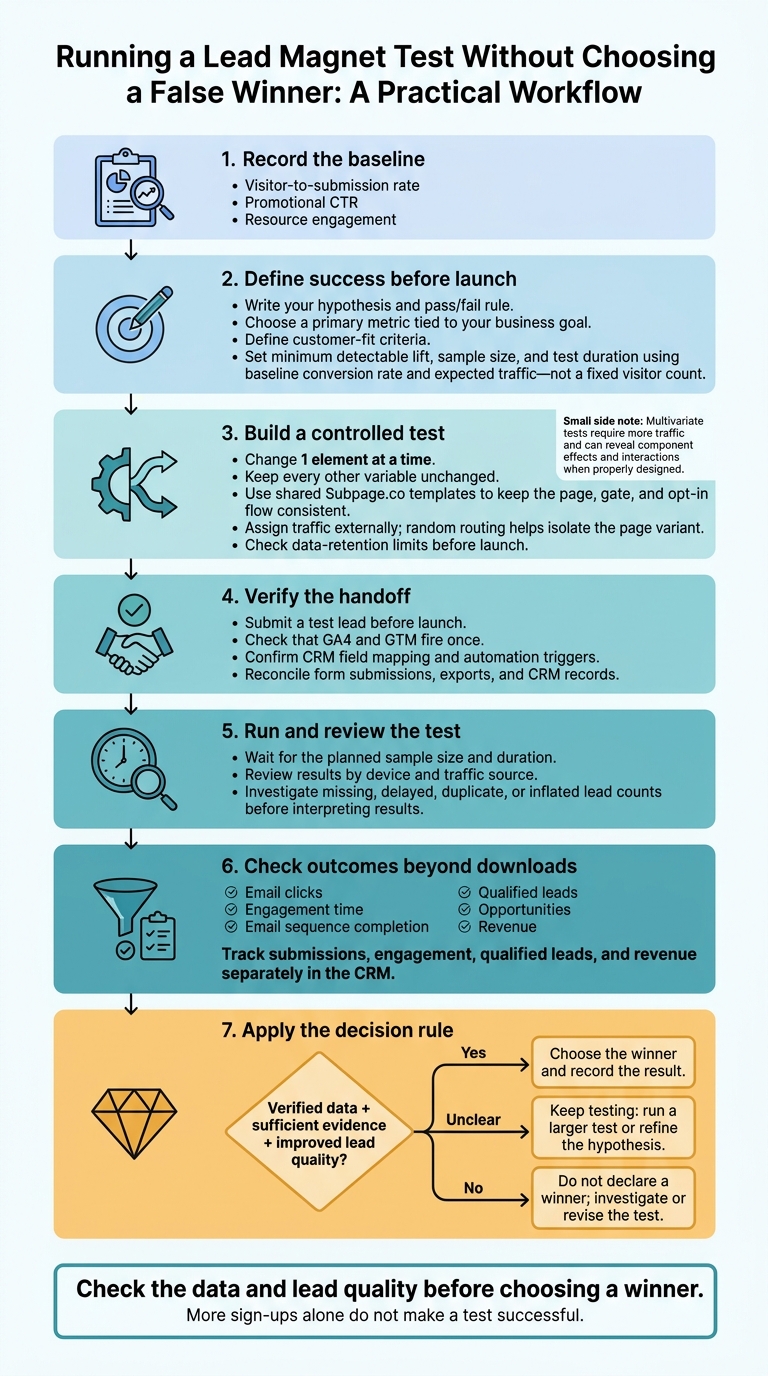
Lead Magnet Testing: Avoid False Winners
Test Design Mistakes
Once you’ve chosen your metric, check the test setup. Poor design can hide what caused the result.
Record your baseline first: visitor-to-submission rate, promotional CTR, and resource engagement. Track submissions, engagement, qualified leads, and revenue separately in the CRM.
Changing Too Many Things at Once
When you change several things at once, you can’t tell which change drove the result. Keep every variable unchanged except the one you’re testing. Use multivariate tests only when you have enough traffic to support the added complexity.
Single-variable tests are easier to interpret. Multivariate tests need more traffic but can show how page elements work together.
| Test design | Interpretability | Traffic | Best use |
|---|---|---|---|
| Single-variable test | Isolates the effect of one change | Generally lower | Testing interactive vs PDF lead magnets |
| Multivariate test | Can identify component effects and interactions when properly designed | Generally higher | Testing combinations of page elements |
Either approach needs enough time and traffic to produce a valid result.
Ending Tests Too Soon
Use your baseline conversion rate and expected traffic to set the minimum detectable lift, sample size, and test duration. Let those requirements determine how long the test runs – not a fixed visitor count.
Before launch, submit a test lead to check that CRM fields and automation triggers work. A broken CRM handoff can skew downstream results.
sbb-itb-b3a7196
Measurement Mistakes
Bad measurement can make the wrong variant look like the winner.
Overlooking Device and Traffic Differences
Break down results by device and traffic source. A hard-to-use page or form can affect mobile conversions. Cold SEO and social traffic often need more trust before visitors opt in. If overall metrics drop, check individual steps by source to find the segment that’s falling behind.
Relying on Faulty Conversion Tracking
Count verified submissions. Send a test submission, then check that GA4 and GTM fire once, CRM fields map correctly, and exports match form submissions. Tracking problems usually stem from integration, mapping, permissions, deduplication, API limits, or timing delays.
| Symptom | Possible cause | Fix |
|---|---|---|
| Missing or delayed leads | Integration, mapping, permissions, API limits, or timing delays | Reconcile form, export, and CRM records |
| Duplicate or inflated counts | Duplicate events or deduplication issue | Audit GA4 and GTM event firing and CRM deduplication rules |
Even accurate counts can mislead you if you’re measuring the wrong outcome.
Putting Opt-Ins Ahead of Lead Quality
Choose a primary metric tied to your business goal, and define customer-fit criteria before launch. A high opt-in rate doesn’t make a test successful unless it brings in qualified leads. Track engagement time, email sequence completion, opportunities, and revenue to see what happens beyond the download.
Prepare and Track Test Variants With Subpage.co
Keep the build standard the same for every variant. Use Subpage.co to build effective lead magnets with shared templates. This helps prevent unintended changes to the page, gate, and opt-in flow.
Once the pages are ready, keep traffic routing separate from page creation. Assign traffic externally and analyze results outside Subpage.co. Random routing helps isolate the page variant as the only difference.
After launch, transfer verified leads to your CRM through exports or integrations, then check lead quality there.
Check data-retention limits before launch so your test and follow-up data remain available. If you need inspiration for your next variant, consider these lead magnet ideas to drive signups.
Conclusion: Use a Consistent Testing Process
Good tests give clear answers. Bad tests name false winners. Change one element at a time, wait for enough data, and pick a winner only if lead quality improves. Apply that rule to every test.
Follow the same process each time: set a baseline, write your hypothesis and decision rule, and run a controlled test. Then validate the data, check lead quality, and record the result. Keep the review steps consistent so you can compare tests.
If the data doesn’t point to a clear result, don’t make a change yet. Run a larger test or refine your hypothesis.
FAQs
How do I calculate my test’s sample size?
Use a free online sample size calculator. Enter your baseline conversion rate, desired minimum detectable effect (typically 10–20%), a 95% confidence level, and 80% statistical power.
Next, estimate how many days your test will take:
Test duration (days) = (Sample Size per Variation × Number of Variations) ÷ Daily Traffic
Subpage.co’s analytics can help you track conversion rates and visitor data throughout the test.
What if more sign-ups mean fewer qualified leads?
More sign-ups don’t always mean better leads. A lead magnet that’s too broad – or a form that draws the wrong audience – can lower lead quality. Build the offer around one specific, urgent outcome and match it to the right funnel stage. At the top of the funnel, ask only for a name and email address.
Track lead-to-customer conversions and next-step conversions, not just sign-ups. If those leads don’t move forward, high volume wastes effort and ad spend.
How long should I track leads after testing?
Run lead magnet A/B tests for at least 14 days to account for weekly traffic changes. Keep the test running until you also reach your precalculated sample size and statistical significance. Avoid checking results daily or stopping early – both can increase false positives.
For general monitoring, wait 30 days before making changes. If performance is still below 15% after 30 days and at least 200 visitors, review your offer or landing page.
Related Blog Posts
