

Ultimate Guide to Cross-Channel Content Strategy

If your blog, email, social posts, and ads don’t work together, you’re leaving leads on the table. I’d sum up this guide like this: pick one goal, map each channel to one job, build one core message, route traffic to one lead page, and track every touchpoint. That matters because buyers often need 6–8 touches before they convert, and people who use more than one channel can spend about 30% more than single-channel buyers.
Here’s the short version:
- Multichannel = you publish in many places
- Cross-channel = those places work together
- Each channel should have one clear role
- One main asset should feed the rest of the campaign , often by creating effective lead magnets
- Gated content should turn attention into leads
- UTMs, CRM data, and multi-touch attribution should connect results back to pipeline
- Testing should focus on message, sequence, and CTA
In plain English: this is a system for turning scattered content into a repeatable lead flow.
A simple way to think about it:
| Area | What I’d focus on |
|---|---|
| Goal | Pipeline, lead quality, or lower cost per lead |
| Journey | Awareness → consideration → conversion |
| Channels | Blog for search, social for reach, email for follow-up, landing pages for sign-ups |
| Content | One anchor asset turned into posts, emails, and ads |
| Lead flow | Every channel points to one offer or next step |
| Tracking | UTMs, form data, attribution, assisted conversions |
| Testing | Subject lines, landing page copy, channel order, retargeting timing |
The core idea is simple: don’t publish more – connect what you already publish.
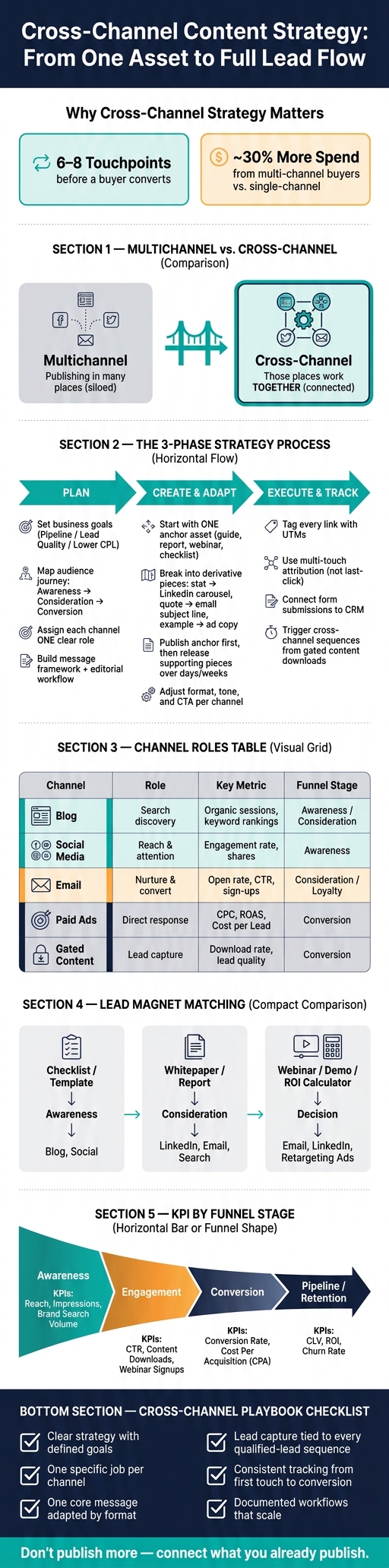
Cross-Channel Content Strategy: From One Asset to Full Lead Flow
How to Build a Multi-Channel Content Engine That Actually Works | Field Notes
This engine relies on high-converting content-focused lead magnets to capture and track interest across every touchpoint.
sbb-itb-b3a7196
Plan the Strategy Before You Create Content
Build the operating plan before you start drafting assets. If you skip this step, teams end up making content without agreeing on what success means or who owns each part.
Set business goals, content outcomes, and channel KPIs
Use your goals and channel roles to turn the plan into numbers you can track. Start with the business goal, then connect it to a content outcome and the KPIs for each channel.
If the goal is pipeline growth, the content outcome is more qualified leads. If the goal is a lower cost per lead, the outcome is better conversion rates so paid spend goes further.
Then match KPIs to each channel based on its place in the funnel. Awareness channels like LinkedIn or YouTube should be tracked by reach and engagement rate. Consideration channels like a blog should be tracked by organic sessions, time on page, and keyword rankings. Conversion channels like email or landing pages should be tracked by click-through rate, sign-ups, and demo bookings.
Traffic alone doesn’t tell the whole story. Measure each channel by how much it helps drive qualified leads. Lead capture should tie top-of-funnel metrics back to pipeline results.
Map the audience journey and assign each channel a role
Give each channel one job. That keeps the plan clear and makes measurement much easier. Use the roles you set earlier to define the metrics each channel needs to hit.
| Channel | Best-fit Content Types | Key Metrics | Journey Stage |
|---|---|---|---|
| Blog | Long-form guides, case studies | Organic sessions, keyword rankings | Awareness / Consideration |
| Social Media | Short videos, carousels, hooks | Reach, engagement rate, shares | Awareness |
| Newsletters, personalized offers | Open rate, CTR, attributed sign-ups | Consideration / Loyalty | |
| Conversion Pages | interactive vs. PDF gated assets, demo sign-ups | Conversion rate, lead volume | Conversion |
| AI Discovery | Structured content, clear definitions | AI visibility score, sentiment | Awareness / Discovery |
Once every channel has a clear role, lock the handoffs into one editorial calendar. That’s how you keep work moving instead of letting pieces drift from one person to the next.
Build a message framework and editorial workflow
Formats and tone will shift from channel to channel, but the core message should stay the same. If it doesn’t, different team members will start pulling in different directions, and people will spot the mismatch fast.
Put this into a voice guide. Spell out tone, vocabulary, and sentence structure. Show clear on-brand and off-brand examples so no one has to guess.
Then anchor the campaign around one core asset. From there, turn it into lead-capture pieces and nurture content. Build an editorial calendar that shows when the anchor piece and each derivative asset will go live across channels. Assign clear ownership at every step – writer, reviewer, publisher – so nothing gets stuck during a handoff.
Create once, adapt fast, and schedule every derivative asset around the same launch.
Adapt One Core Idea for Every Channel
Once your editorial calendar is set and each channel has a clear job, the next step is execution. Posting the same message everywhere leaves a lot on the table. Each channel has its own strengths, so the goal is to turn one core idea into content that fits each one.
Turn anchor assets into channel-specific content
Start with one strong anchor asset: a long-form guide, a research report, a webinar, or a detailed checklist. That piece becomes the main source for everything that follows.
Then break it into smaller parts: the main thesis, key data points, expert quotes, and real examples. You can pull out each part and reshape it on its own. One stat might turn into a LinkedIn carousel. The same stat could also become an email subject line. That takes a lot of the guesswork out of production and helps your team keep moving without starting from zero every time.
"The real competitive advantage lies in how you distribute it. Multi channel content publishing transforms a single piece of content into a strategic asset." – Trysight.ai
Publish the anchor asset first. Then release the supporting pieces across secondary channels over the next few days or weeks. That creates momentum instead of dumping everything at once.
Adjust format, tone, and CTA by channel
The core message stays the same. What changes is the wrapper around it: length, structure, tone, and CTA. A blog post builds trust through depth. A LinkedIn post wins attention with a strong opening line. An email gets clicks with a direct, personal tone. A paid ad drives conversions with urgency and simple copy.
CTA placement should match how people use the channel, not just where they are in the funnel. Here’s a simple reference point for shaping anchor content by platform:
| Channel | Content Format | Message Angle | Length / Structure | CTA Approach |
|---|---|---|---|---|
| Blog | Long-form article | Clear / Educational | 1,500–3,000 words; H1/H2 headers | Inline link or content upgrade |
| Short-form post or carousel | Professional insight / Opinion | 150–400 words; line breaks every 1–2 sentences | Link in first comment | |
| Newsletter / Nurture | Personal / Conversational | 400–800 words; single column | One clear CTA button | |
| Paid Ads | Retargeting display | Direct offer / Urgency | Minimal text, headline-focused | Direct and specific – e.g., "Download the Report" |
Once each version is live, watch which channel pairings lead to the most conversions.
Use gated content to connect channels to lead capture
Use adapted content to move prospects from attention to opt-in. Social posts, blog articles, and email campaigns should all lead to one conversion page. That page has one job: trade a high-value asset for contact information.
The handoff to the landing page should feel smooth. The design, headline, and tone need to match the source channel closely enough that the visitor feels like they’re continuing the same conversation, not walking into a different one. Use Subpage.co to build gated pages, collect leads, and track performance.
Use this table to match the right lead magnet to the right stage and channel:
| Lead Magnet Type | Best Funnel Stage | Ideal Promotion Channels | Data to Collect |
|---|---|---|---|
| Whitepaper / Report | Consideration | LinkedIn, Organic Search, Email | Name, Email, Job Title, Company |
| Checklist / Template | Awareness | Blog, Social Media | Name, Email |
| Business Case / ROI | Decision | Retargeting Ads, Sales Email | Name, Email, Budget, Timeline |
| Webinar / Demo | Consideration / Decision | Email, LinkedIn, Partner Sites | Name, Email, Company, Top Challenge |
With third-party cookies deprecated, first-party data matters more in cross-channel planning. Every gated download tells you something: a topic caught someone’s interest. Feed that data back into your email sequences and paid retargeting so the conversation keeps moving.
From here, connect publishing, attribution, and reporting in one workflow.
Execute, Track, and Manage Cross-Channel Campaigns
Publishing across multiple channels works best when you have a clear way of working. When the workflow is connected, teams can move from the first draft to post-launch updates without drifting into silos.
Build a connected workflow from idea to launch
Start with the anchor asset, the derivative pieces, and the channel roles already defined in your plan. Then move each asset through one shared path: brief, draft, design, approve, publish, promote, update. Shared ownership at each step helps keep work moving, so nothing gets stuck during a handoff.
Use one shared calendar and one brand voice doc to keep every channel aligned.
Once that workflow is running, tracking shows which steps are helping move leads forward.
Set up tracking and attribution across channels
Without proper tracking, it gets much harder to tie content engagement to qualified leads. Tag every link with UTMs so source, medium, and campaign data flow into your CRM.
The table below shows how each channel should be tracked and what job it plays in the funnel:
| Channel | Tracking Mechanism | Primary Metrics | Attribution Role |
|---|---|---|---|
| Blog | UTM Parameters / Cookies | Organic Sessions, Time on Page, Scroll Depth | Top-of-funnel discovery & SEO anchor |
| Tracking Pixels, Tagged Links | Open Rate, CTR, Conversion Rate | Mid-funnel nurturing & direct conversion | |
| Platform Analytics / UTMs | Reach, Engagement Rate, Profile Visits | Professional reach & brand authority | |
| Paid Ads | Conversion Pixels / UTMs | CPC, ROAS, Cost per Lead | Direct response & acquisition |
| Gated Content | Form Submissions / Lead Tags | Download Rate, Lead Quality | Lead capture & intent signal |
That makes it easier to connect each touchpoint to lead capture and revenue.
Use multi-touch attribution by default. Last-click hides the earlier touchpoints that helped do the work. The average customer journey now involves 6 to 8 touchpoints before a purchase is completed, so giving all the credit to the final channel paints the wrong picture. A multi-touch attribution model gives you a clearer view of which channels are pulling their weight at each stage.
Use tools that support lead collection and reporting
The right tools cut down the technical lift, so your team can spend more time on content instead of setup. For gated assets, in particular, you need a tool that lets you build a branded page, collect leads through a form or pop-up, and export that data to downstream tools without developer work.
Subpage.co lets you build gated pages, collect leads, and sync data to downstream tools without developer work. Those reports feed the KPI review that comes next.
Measure Results, Improve Performance, and Scale What Works
Once tracking is live, use the data to figure out what’s driving leads and what deserves more budget. The key is to judge each channel by its role in the funnel, not just by raw volume.
Choose the KPIs that match each funnel stage
Match each KPI to the stage it reflects. Focus on the numbers that show whether a channel is bringing in qualified leads or pushing them closer to conversion.
| Funnel Stage | Representative KPI | Primary Channels Involved | Typical Content Types |
|---|---|---|---|
| Awareness | Reach, Impressions, Brand Search Volume | Social Media, Display, Video, PR | Short-form video, blog posts, infographics |
| Engagement | CTR, Content Downloads, Webinar Signups | Email, Organic Social, Content Marketing | Whitepapers, case studies, newsletters |
| Conversion | Conversion Rate, Cost Per Acquisition (CPA) | Paid Search, Retargeting, Gated Content | Landing pages, demo requests, pricing pages |
| Pipeline / Retention | Customer Lifetime Value (CLV), ROI, Churn Rate | Email, CRM, Loyalty Programs | Re-engagement emails, tutorials, loyalty offers |
Track assisted conversions too, not just last-click wins. Awareness channels often drive assisted conversions, so cutting them because they don’t close the final click can shrink future pipeline.
Once you have a baseline, start testing what actually moves more leads: the message, the sequence, or the conversion point.
Test messaging, sequencing, and conversion points
Run small tests on a regular basis instead of waiting for quarterly reviews. Start with the variables most likely to move results: email subject lines, CTA copy on landing pages, and the order channels appear in. For example, test paid ads before email versus email before paid. Also look at how one channel affects the next, not just how each one performs on its own.
Holdout testing – withholding a specific channel from a control group – is one of the cleanest ways to measure whether a channel is driving incremental lift or simply taking credit for conversions that would have happened anyway.
For gated content, treat every download as a trigger. If someone downloads a whitepaper, that action should start a defined cross-channel sequence, like a follow-up email paired with matching social retargeting ads. Then test the timing and message at each step, and write down what works.
When a pattern keeps winning, turn it into a playbook your team can use again and again.
Conclusion: Build repeatable cross-channel playbooks
The goal is a system your team can hand off, scale, and improve over time. Document the anchor asset, sequence, CTA, and timing that led to conversion. Once a flow proves it can work – for example, Webinar Signup → Email Nurture → LinkedIn Ad – automate it and reuse it. Move budget toward the channel mixes that show the strongest multi-touch contribution, not just the last click.
A strong cross-channel playbook should cover the basics:
- A clear strategy with defined goals
- A specific job for each channel
- One core message adjusted by format
- Lead capture tied to every qualified-lead sequence
- Consistent tracking from first touch to conversion
- Documented workflows that don’t live only in someone’s head
Build that setup once, and future launches become faster and easier to manage.
FAQs
How is cross-channel different from multichannel?
Multichannel marketing uses several channels. But those channels often run on their own, with different goals or messages.
Cross-channel marketing links those channels together, so data and messaging work in sync.
Put simply, multichannel is about being present in more places. Cross-channel is about giving customers one connected experience across those places.
What should my first anchor asset be?
Your first anchor asset should be a long-form piece, like a blog post, webinar, or guide.
This main asset becomes the base of your cross-channel content strategy. It makes it much easier to turn key ideas into social posts, emails, or short videos. A strong blog post, for example, can lead to several spin-off pieces.
How do I measure cross-channel ROI?
Measure cross-channel ROI with metrics that show how your channels work together to drive conversions and revenue. Use customer journey analytics to follow how people move from one channel to another, spot the paths that lead to results, and find the points where they drop off.
It also helps to use multi-touch attribution so credit isn’t given to just the last click. That gives you a clearer view of what each channel contributes. Then look at customer lifetime value and cross-channel engagement to understand long-term impact and make smarter budget shifts.
Related Blog Posts
