

Ultimate Guide to Lead Magnets for Email Sign-Ups
If you want more email sign-ups, offer one small thing that solves one clear problem fast. That’s the big idea. Short lead magnets like checklists, templates, quizzes, and calculators often beat long guides because people want a fast win, not homework.
Here’s the article in plain English:
- I should make the offer narrow, useful right away, and tied to the next step I want the reader to take.
- I should keep the form short – email only is usually the safest choice.
- I should match the format to the reader’s stage:
- Awareness: checklists, cheat sheets, quizzes
- Consideration: templates, swipe files, short guides
- Decision: calculators, case studies, webinars, audits
- I should promote the offer where intent is already high, like inside related blog posts and on landing pages.
- I should track more than downloads:
- Opt-in rate
- Open rate
- Click-through rate
- Unsubscribes
- Lead-to-customer rate
A few numbers stand out. Targeted lead magnets inside related blog posts often convert at 5%–12%, with top results hitting 15%–25%. Quizzes can reach 25%–40%. And since 82%+ of landing page traffic now comes from mobile, a clunky phone experience can kill sign-ups fast.
The article’s main point is simple: the best lead magnets are not the longest ones. They are the ones that solve one problem, fit the page, and move people into a short follow-up email flow.
| Format | Best Use | Typical Conversion Range |
|---|---|---|
| Quiz / Assessment | Early to mid funnel | 25%–40% |
| Checklist / Cheat Sheet | Top of funnel | 20%–34% |
| Template / Swipe File | Mid funnel | 20%–35% |
| ROI Calculator | Bottom of funnel, often B2B | 25%–35% |
| Ebook / Long Guide | Mid funnel | 10%–20% |
| Case Study / Webinar | Bottom of funnel | 10%–20% |
If I had to boil the whole guide down to one rule, it would be this: promise one outcome, make sign-up easy, deliver fast, and keep testing what gets used and what leads to sales.
28 High-Converting Lead Magnet Ideas to Grow Your Email List
When choosing your format, consider how interactive lead magnets vs PDF lead magnets impact your conversion rates.
sbb-itb-b3a7196
What Makes a Lead Magnet Convert Well
Use this checklist before you build or promote anything. Before you pick a format, run the offer through these five checks.
5 Criteria to Check Before You Launch
Think of this as a quick filter. If your lead magnet fails even one of these, tighten it up before you put traffic behind it.
- Solves one urgent, narrow problem. Pick one pressing problem and solve it all the way. A lead magnet called "The 15-Minute SEO Audit Checklist That Finds $10K in Quick Wins" is far more persuasive than "A Guide to SEO."
- Delivers value fast. Aim for a quick win, not a long study session. Checklists and templates do well here because people can use them right away.
- Looks worth an email address. Clean design and a clear payoff make the exchange feel fair.
- Asks for name and email only at the top of the funnel. Every extra form field cuts conversions.
- Leads straight into your paid offer or next email step. The sign-up should point somewhere, not sit in a dead end.
Mistakes That Lower Opt-In Rates
Most low conversion rates come from a mismatch between the offer and the audience, not the format.
Broad topics are usually the main problem. When a resource tries to help everyone, it tends to click with no one. Broad topics weaken intent and drag down opt-in rates.
Weak headlines come next. If you describe the format instead of the result, people have no reason to care. "Free PDF" says almost nothing. "Cut Your Onboarding Time in Half" gives a clear payoff. The same idea applies to your CTA button. Using "Submit" has been shown to decrease conversions by about 3% compared to action-based phrasing like "Send Me the Checklist".
Another common mistake is mismatching the offer to the page. Someone reading a beginner blog post about email marketing probably isn’t ready for a 40-page whitepaper on advanced automation. The format and depth should fit where the reader is in the journey. Targeted lead magnets placed inside relevant blog posts often convert at 5–12%, and top performers reach 15–25%.
Then there’s mobile experience, which gets ignored far too often. More than 82% of landing page traffic now comes from mobile devices. If the page loads slowly or the form is annoying to tap, sign-ups disappear fast.
Once the offer clears these checks, match it to the right content-focused lead magnet format and funnel stage.
Lead Magnet Formats and How to Choose One
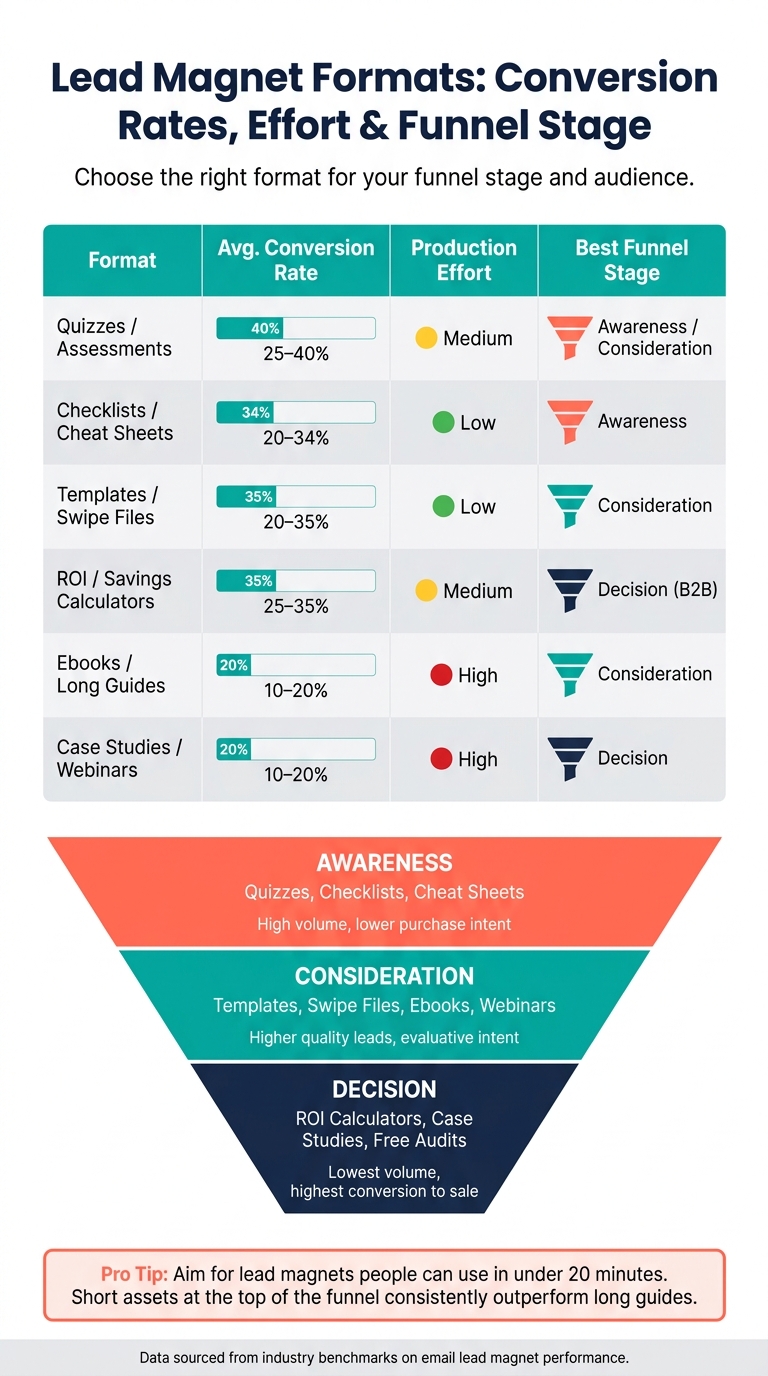
Lead Magnet Formats: Conversion Rates, Effort & Funnel Stage
Format is a business choice, not just a making-stuff choice. What you pick changes how people judge the offer before they opt in, how long it takes you to put together, and whether it fits where they are in the buying journey.
A 60-page ebook can look impressive. But a one-page checklist often converts better because it promises a fast win.
Formats That Convert Well
Use the five checks above to narrow your options.
| Format | Avg. Conversion Rate | Production Effort | Best For |
|---|---|---|---|
| Quizzes / Assessments | 25–40% | Medium | Awareness / Consideration |
| Checklists / Cheat Sheets | 20–34% | Low | Awareness |
| Templates / Swipe Files | 20–35% | Low | Consideration |
| ROI / Savings Calculators | 25–35% | Medium | Decision (especially B2B) |
| Ebooks / Long Guides | 10–20% | High | Consideration |
| Case Studies / Webinars | 10–20% | High | Decision |
The pattern is pretty clear: short, low-effort assets tend to work well at the awareness stage. Later-stage buyers usually want tools that help them make a case, like calculators and webinars.
A good rule of thumb: aim for lead magnets people can use in under 20 minutes.
How to Match Format to Funnel Stage and Audience
The best format depends on what your reader is trying to do right now.
Awareness-stage visitors are still naming the problem. That’s why checklists, cheat sheets, and quizzes work so well. They help people size up their situation fast.
Consideration-stage prospects are comparing paths. Here, templates, swipe files, and comparison sheets can do a lot of the heavy lifting. They cut friction and help people move from “I’m looking” to “I’m testing.”
Decision-stage leads are closer to a yes, but they often need proof or internal buy-in. Case studies, ROI calculators, and webinars fit that moment better.
Your business model matters too:
- B2B, especially SaaS, tends to lean toward templates, whitepapers, industry reports, and ROI calculators tied to business outcomes
- B2C tends to get better response from quizzes, product-fit assessments, and discount-based offers
Once you’ve picked the format, the next job is simple: build the offer and make the opt-in feel easy.
How Subpage.co Fits Into the Creation Process
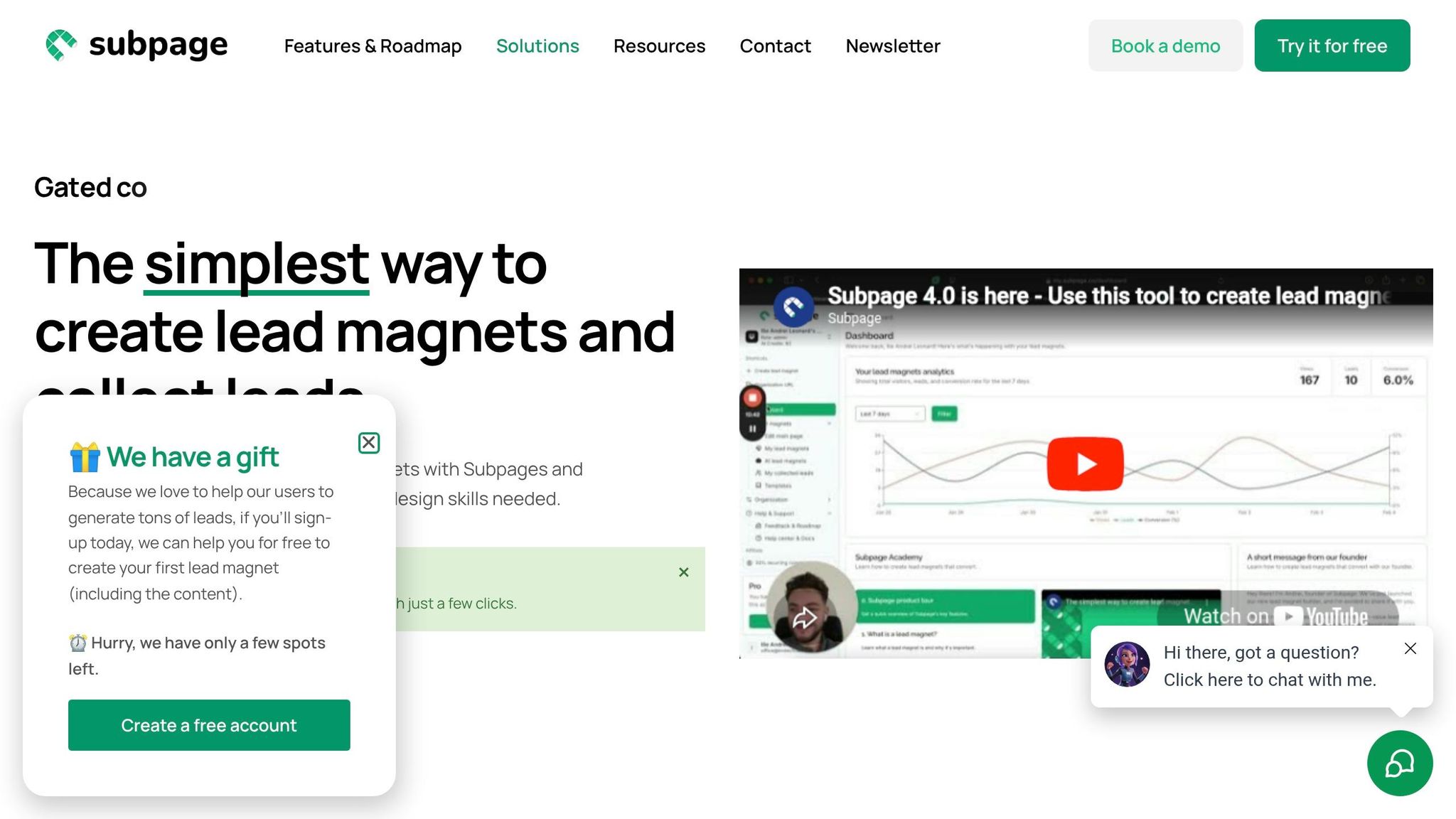
A lot of teams fall back on generic PDFs because polished assets can seem like a pain to make. Subpage.co helps teams build and gate whitepapers, checklists, and business cases without technical or design work.
So after you choose the format, build the offer, gate it lightly, and send people straight to the delivery page.
How to Create, Deliver, and Promote a Lead Magnet
Build the Offer Around One Specific Problem
Once you’ve picked the format, tighten the offer and make signup dead simple.
Start with one urgent problem. Not three. Not a broad theme. One issue your audience wants fixed now. The best place to find it? Sales calls, support tickets, and niche communities like Reddit or Quora. If the same pain point keeps showing up, that’s usually your opening.
Then name the offer around a clear result. A title like "The 5-Email Sequence That Books Discovery Calls" works because it says what the reader gets. "Marketing Tips Guide" is too fuzzy. People respond to a clear promise, not a vague idea.
Also, keep the asset short enough that someone can use it the same day. That matters more than most teams think.
Set Up Gating and Delivery for More Sign-Ups
Your opt-in form can help conversions or hurt them. The safest move is to ask for email only. Every extra field adds drag and usually cuts signups.
Your landing page should do one thing: get the opt-in. That means:
- a clear headline
- a short payoff line
- one CTA
First-person button copy like "Send Me the Checklist" often beats generic copy like "Download Now."
Delivery should feel instant. Right after someone submits their email, they should either hit a thank-you page with direct access or get an automated welcome email within seconds. With Subpage.co, you can gate content pages and send new leads to your email platform through native integrations or Zapier. That cuts out the manual handoff and keeps the experience smooth.
After delivery, send a short follow-up sequence: asset, tip, proof, then offer. A lot of teams stop at the download itself, which leaves a lot on the table.
Once that setup is live, put the offer in front of your highest-intent traffic first.
Promote the Lead Magnet Across Your Channels
Start with the pages you already have. Look for high-traffic posts that pull in the right readers but don’t yet point to a lead magnet. Then add an inline opt-in form at the point where a reader is most likely to think, "I wish I had a template for this." That timing matters. If you want another on-site option, exit-intent popups can help catch visitors right before they leave.
You can also repurpose the offer across:
- social profiles
- social posts
- email signatures
That gives you steady visibility without much extra work.
The message should fit the channel. A checklist inside a how-to blog post should lead with the time it saves. An ROI calculator in a LinkedIn post should focus on the business result. Same offer, different angle.
Once traffic starts coming in, watch which placements and messages get the best conversion rates.
How to Measure Results and Improve Over Time
Metrics That Show Whether a Lead Magnet Is Working
Once your offer is live, don’t stop at download numbers. Look for leaks across the whole funnel. A lead magnet can pull in plenty of sign-ups and still fall flat if people never open the email, click through, or become customers.
Track the full funnel: opt-in rate, open rate, click-through rate, unsubscribes, and customer rate. Each one tells you something different. If landing page conversions are low, the headline or the offer probably isn’t connecting. If email open rates are weak, the promise may not match the audience, or the magnet may be pulling in the wrong people. If lead-to-customer rates are low, the follow-up sequence likely needs work.
| Metric | Typical Range | What It Reveals |
|---|---|---|
| Landing Page Opt-in Rate | 20–40% | Offer clarity and headline strength |
| Delivery Email Open Rate | 68–80% | Deliverability and initial interest |
| Nurture Sequence CTR | 4–8% | Relevance of follow-up content |
| Unsubscribe Rate | < 0.5% | Whether the magnet attracted the right audience |
| Lead-to-Customer Rate | 2–7% | Overall ROI and lead quality |
Also track time to first use. In 2023, the average gap between downloading an asset and engaging with it reached 31.2 hours, up 8.8% year over year. That’s a useful clue. If people download something and then ignore it for more than a day, the topic may be fine, but the format may be getting in the way.
Start with the weakest step. If your landing page conversion rate is below 15%, fix that before you tinker with anything else. Otherwise, you’re patching the back half of the funnel while the front door is still wide open.
Use the numbers above to decide what needs to change: the offer, the format, or the traffic source. Traffic source can change the story fast. Email traffic converts at 19.3% on lead magnet landing pages, compared with 11.3% for paid search. So the exact same offer can look strong in one channel and weak in another.
A monthly review cadence is usually enough. Check the numbers, find the weakest link, and work there first.
Comparison Tables to Guide Format and Funnel Decisions
Not every lead magnet format fits every stage of the funnel. A short checklist might work well for someone just getting to know you, while a free audit makes more sense for someone close to buying.
Format by funnel stage:
| Funnel Stage | Best Formats | Email Engagement Pattern |
|---|---|---|
| Top (Awareness) | Checklists, Infographics, Short Guides | High volume, lower purchase intent |
| Middle (Consideration) | Webinars, Case Studies, Quizzes | Higher quality leads, evaluative intent |
| Bottom (Decision) | Free Audits, Consultations, Free Trials | Lowest volume, highest conversion to sale |
This is where a lot of teams trip up. They offer a bottom-of-funnel asset to cold traffic, then wonder why sign-ups are slow. Or they send a light top-of-funnel checklist to people who are already close to buying. The format has to match the reader’s moment.
Conclusion: A Simple Formula for Better Email Sign-Ups
Measurement only matters if you do something with it. The best lead magnets fix one specific problem, fit the funnel stage, and make sign-up easy.
State the outcome in the title, not just the topic. Keep the form to email only. Put the offer where your best-fit readers already spend time. Then check the numbers every 3–6 months and update anything that’s slipping. A title that says "2024" in 2026 sends a bad signal. It makes the asset look old, and conversions tend to drop quietly because of it.
Subpage.co helps teams build, gate, brand, and track lead magnets in one place – no design or development work required.
"The lead magnets that convert aren’t the ones with the most content. They’re the ones that solve one specific problem faster than the visitor could solve it on their own." – Hardik Shah, Founder, ScaleGrowth.Digital
Measure, compare, revise. Teams that keep iterating are the ones that stack list growth over time.
FAQs
How do I choose the best lead magnet format?
Start by understanding your audience and where they are in the buyer’s journey. People in the awareness stage often respond best to educational guides and eBooks. Decision-stage prospects, on the other hand, usually want case studies, free trials, or product demos.
The format should fit the job. Checklists are great for step-by-step help. Quizzes and webinars can drive more engagement because they add personalization and live interaction. Subpage can help you create formats like whitepapers and checklists without needing technical design skills.
What should I include after someone signs up?
After someone signs up, send the lead magnet right away. That keeps the momentum going and helps you make a strong first impression while their interest is still high.
The simplest way to do that is on a thank-you page or through an automated email.
After that, follow up with a nurture sequence of four to seven emails. The goal is to build trust, keep the conversation moving, and bring the subscriber closer to a purchase. Wrap it up with a clear call to action that puts the benefit front and center.
How can I tell if my lead magnet is attracting the right leads?
Track the numbers that matter with Subpage analytics. Start with registration rates to measure early interest. Then look at post-gate signals like bounce rate and time on page to see if the content delivers on what people expected.
The big one, though, is lead fit. Compare registrant details like job titles and company size against your Ideal Customer Profile. If conversions are slow or leads aren’t moving, run A/B tests on your headlines and calls to action so they line up better with what your audience cares about.
Related Blog Posts
