

10 Community Engagement Ideas for Lead Generation

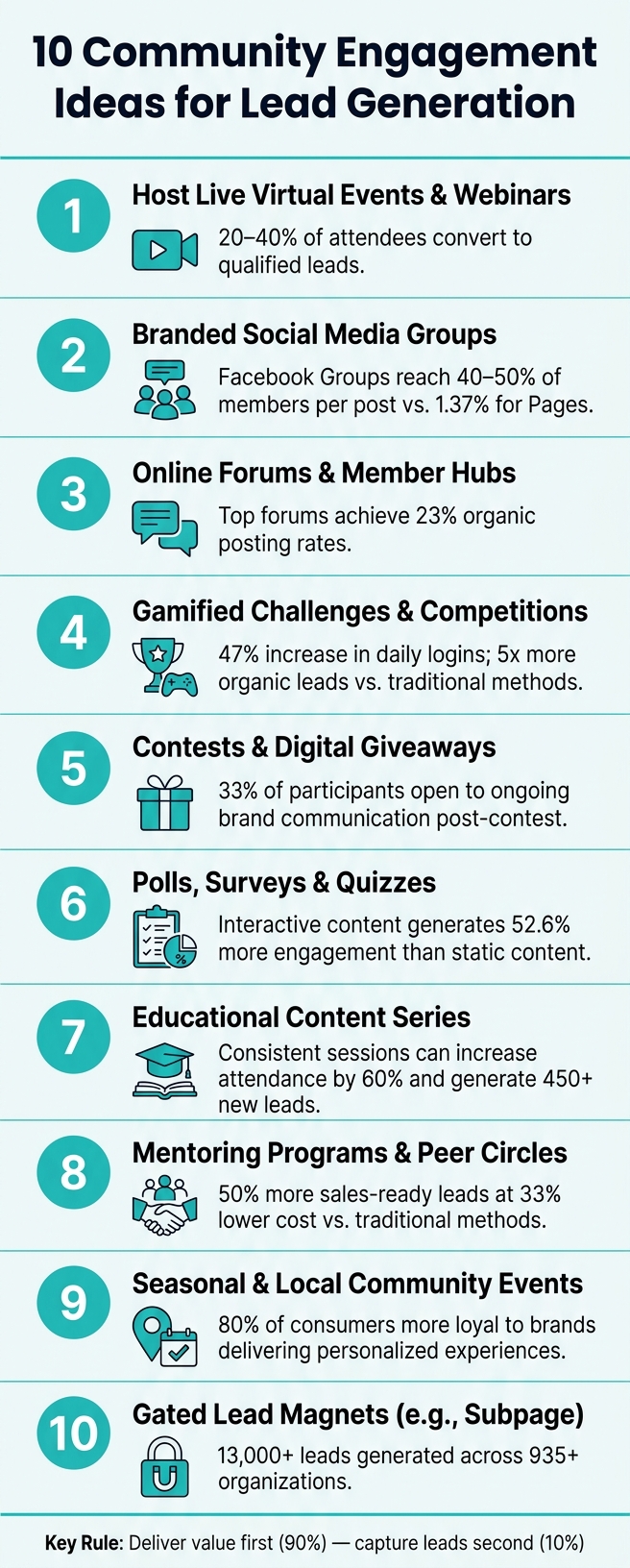
Community engagement can be a powerful way to generate leads by creating spaces where people interact naturally. Instead of relying on cold outreach or generic ads, these strategies focus on building trust and fostering ongoing conversations. Here’s a quick rundown of 10 effective ideas:
- Host Webinars and Live Events: Interactive sessions like Q&As and polls drive engagement and capture detailed lead information.
- Branded Social Media Groups: Create exclusive spaces on platforms like Facebook or LinkedIn to encourage discussions and collect leads via entry questions or value posts.
- Online Forums and Member Hubs: Build searchable, permanent spaces for community discussions and integrate lead generation tools like newsletters or gated resources.
- Gamified Challenges: Use contests, quizzes, or leaderboards to make participation enjoyable while collecting valuable data.
- Contests and Giveaways: Offer prizes aligned with your product to attract high-quality leads.
- Polls, Surveys, and Quizzes: Engage with quick polls or gated quizzes that offer personalized results in exchange for contact details.
- Educational Content Series: Share consistent, recurring sessions like webinars or AMAs to build trust and generate leads.
- Mentoring Programs and Peer Circles: Organize small groups or cohorts for deeper connections and qualified leads.
- Seasonal and Local Events: Host community-focused in-person events to build relationships and gather leads through follow-ups.
- Use Subpage for Lead Magnets: Turn community discussions into gated resources to collect leads seamlessly.
Each strategy focuses on delivering value first, ensuring that leads are naturally drawn to your brand. While these approaches take time to show results, they can significantly shorten the trust-building process and create a steady flow of qualified leads.
10 Community Engagement Strategies for Lead Generation
20 proven ways to boost engagement in your online community
sbb-itb-b3a7196
1. Host Live Virtual Events and Webinars
Webinars and live virtual events demand a scheduled commitment, which naturally filters out casual browsers and brings in those genuinely interested in your topic.
Engagement Potential
Live events create an interactive experience that pre-recorded content simply can’t match. Features like real-time Q&A sessions, live polls, and chat functions keep participants engaged and actively involved. Did you know that 92% of webinar attendees participate in Q&A sessions? That’s a goldmine for understanding their challenges and interests.
Lead Capture Effectiveness
Every registration form is an opportunity to gather valuable lead information. By tracking attendee details like session duration, questions asked, and poll responses, you can gauge their level of intent. On average, 20% to 40% of webinar attendees convert into qualified leads. This makes webinars a much stronger lead-generation tool compared to passive content formats. The combination of active engagement and detailed data capture ensures your webinar keeps adding value long after it ends.
Sustainability Over Time
A webinar doesn’t have to end when the live event does. Record your session and repurpose it into on-demand content, bite-sized social media clips, or even blog posts optimized for search engines. This approach allows you to keep generating leads over time. For instance, Gong, a revenue intelligence platform, excels at this by hosting webinars on advanced sales strategies. They follow up with automated emails featuring recordings and additional resources, helping guide prospects further down the sales funnel.
Cost and Resource Investment
Webinars do require careful planning, from choosing compelling topics to promoting the event and following up afterward. It’s recommended to dedicate about 50% of your webinar budget to promotion, utilizing email campaigns, social media, and relevant online communities. However, compared to in-person events, virtual webinars are far more cost-effective since they eliminate venue and travel expenses. Partnering with an industry expert or a complementary brand can also help you share the workload and expand your audience.
"The biggest mistake I see companies make with lead generation webinars is treating them like product demos. Your webinar should educate first, sell second." – Pawel Laniewski, Content Marketing Expert, ClickMeeting
2. Create and Manage Branded Social Media Groups
A branded social media group operates differently from a public page. Instead of you broadcasting messages to followers, it creates a space where members can interact with one another. This many-to-many dynamic encourages organic conversations and builds relationships, much like live events. Groups are particularly effective for lead generation, as they naturally convert engagement into actionable leads. In fact, social media already accounts for over 20% of leads for 4 in 10 marketers, and groups often attract highly engaged, intent-driven prospects.
Engagement Potential
Keeping a group active and engaging requires consistency. Recurring themes like "Monday Wins," "Tip Tuesday," or "Feedback Fridays" give members a reason to participate regularly. A well-functioning group typically sees more than 15% of its members actively participating each week, while activity below 5% signals trouble.
To maintain momentum, consider the 1-9-90 principle: 1% of members create content, 9% engage with it, and 90% observe. Recognize and reward that top 1% with perks like early access, shoutouts, or special privileges to keep the engagement flowing.
Lead Capture Effectiveness
Lead capture in a group should feel seamless – like a natural part of the community, not an intrusive sales pitch. For example, when new members request to join, you can ask 2–3 entry questions. One of these could request an email address in exchange for a welcome resource. Another strategy is using two-step value posts: offer a free resource in exchange for a comment, then follow up with a direct message.
Mikael Dia, CEO of Funnelytics, successfully implemented this approach in his Facebook group. By offering valuable resources, he generated $28,000 in just 48 hours and eventually scaled the group to over 27,000 members, driving more than $1M in annual revenue.
"Don’t make your group about your software; make it about solving your customers’ problems." – Mikael Dia, CEO, Funnelytics
Sustainability Over Time
The value of branded groups grows over time. For instance, Facebook Groups can organically reach 40–50% of their members per post, compared to just 1.37% for standard Pages – offering a significant reach advantage without the need for additional ad spend. However, building a B2B group that consistently contributes to your pipeline can take 6–12 months.
To ensure long-term success, capture members’ email addresses during onboarding. This way, even if the platform changes or shuts down your group, you’ll still have access to your audience.
Cost and Resource Investment
Managing a high-quality group requires a commitment of about 10–15 hours per week, either from the founder or a dedicated community manager. Avoid splurging on custom bots or expensive tools until your group has at least 100 active members. Strict moderation is also essential – a single overly promotional member can alienate your most engaged participants.
Stick to the 90/10 rule: 90% of your posts should encourage discussions relevant to your industry or niche, while only 10% should directly mention your product.
"The fastest way to kill a community is to use it primarily to push your own content. Members notice immediately, stop participating, and the surface becomes a graveyard of self-promotion." – Abmatic AI
3. Build Online Forums and Member Hubs
Online forums and member hubs offer something social media groups can’t: a permanent, searchable space for your community. Instead of vanishing into a never-ending feed, discussions stay accessible, building a knowledge base over time. This becomes especially important in 2026, as AI-driven search overviews continue to reduce clicks on generic blog posts. Forums, with their conversational and opinion-driven content, are harder for AI to summarize, keeping their click-through value intact. Much like other engagement strategies, forums turn interactions into leads and act as lasting community assets. This long-term structure fosters meaningful, ongoing engagement.
Engagement Potential
Forums often follow the 1-9-90 engagement model, but their searchable content adds extra value. Top-performing forums can achieve organic posting rates as high as 23%. To keep a forum thriving, aim for a conversation density where over 15% of members are active weekly – anything below 5% signals an inactive community. During slower periods, use prompts like "What’s one challenge you’re tackling this quarter?" to encourage authentic member discussions without creating new content from scratch.
Lead Capture Effectiveness
To convert active members into leads, integrate natural "bridge surfaces" like newsletters, gated tools, or calendar links. Encourage staff and advocates to include clear calls-to-action in their post signatures, making it easy for members to take the next step.
Sustainability Over Time
"Communities are not a quick lead spigot; they are a compounding moat." – Abmatic AI
Building a forum takes patience – expect it to take 6–12 months to develop a steady pipeline. The payoff? Once a forum reaches critical mass, members start answering each other’s questions, reducing the workload for your team. Even inactive members can be re-engaged – targeted campaigns can bring back around 30% of lurkers. So, don’t give up on quiet members too soon.
Cost and Resource Investment
Successfully running a forum requires at least one dedicated operator or a founder willing to commit 10–15 hours per week. Start simple – don’t spend too much on custom tools early on. Focus on growing to 100 active members first, then decide if upgrading to a paid platform makes sense. For B2B communities, consider introducing a paid mastermind tier, priced between $500 and $5,000 per member. This not only offsets costs but also attracts highly motivated, high-intent leads.
4. Run Gamified Challenges and Competitions
Gamified challenges work because they turn participation into a fun, game-like experience rather than a chore. Whether it’s a photo contest, a personality quiz, or climbing a leaderboard, participants are focused on winning – not on the fact that they’re sharing their contact details. According to Gamify‘s 2026 report, gamification can lead to a 47% increase in daily community logins and can generate five times more leads organically compared to traditional methods.
Engagement Potential
The key to driving engagement is making the experience itself feel rewarding. Things like an AI-generated portrait, personalized quiz results, or a "Weekly Wins" challenge give participants something fun and shareable – no physical prize required. Features like live leaderboards and submission galleries add a layer of social proof and FOMO, encouraging even more people to join as the challenge gains traction. Additionally, recurring challenges or "rituals" can keep your community engaged between larger events without requiring a lot of resources.
Lead Capture Effectiveness
"The best event competitions are designed so that participation and data capture are the same action. When someone enters a photo contest, they’re not ‘filling a form’; they’re submitting their entry." – Ben L., Snapbar
This is the real strength of gamified competitions: the process of participating naturally includes data collection. For example, participants might provide their email address to receive quiz results or a branded photo. To gather more qualified leads, you can include a couple of targeted questions – like their job title or company size – directly in the entry process. Just keep it simple: too many fields can hurt your completion rates.
Sustainability Over Time
Short challenges lasting 7 to 14 days work well for creating quick spikes in engagement. For building habits or generating higher-quality content, longer formats like 30-day cohorts are more effective. Adding gamified elements, such as badges for milestones like "First Post" or "Helpful Responder", can extend engagement far beyond a single event. Research shows that badge systems can increase user retention by 35%. The trick is to focus on repeatable, lightweight activities instead of one-time events, which keeps your community engaged while complementing other lead generation strategies.
Cost and Resource Investment
Gamified competitions are incredibly cost-effective for lead generation. The user-generated content (UGC) created during these activities can be repurposed for social media ads, email campaigns, or community highlights – at a fraction of the cost of influencer content. Automating tasks like email delivery, progress tracking, and CRM integration can further reduce the workload on your team. Just make sure to follow up with participants within 24 to 48 hours to keep leads warm.
5. Run Contests and Digital Giveaways
Contests and giveaways offer an easy path to growing your lead list while keeping things interactive and engaging. The main difference? Giveaways rely on random winners and are great for quick reach, while contests require skill or creativity, attracting a more engaged and higher-quality audience. In fact, nearly 65% of businesses report success with social media contests for audience growth, and 33% of participants are open to ongoing communication from the sponsoring brand after the contest ends.
Engagement Potential
The format you choose can significantly impact the quality of engagement. For instance, photo and video contests – like asking participants to showcase their workspace or use your product creatively – generate user-generated content (UGC) that doubles as authentic proof of your brand’s value. Interactive formats, such as digital scavenger hunts or "play-to-win" games, encourage participants to spend more time engaging with your brand, building both trust and familiarity.
Consider Chipotle’s #LidFlipChallenge on TikTok in May 2019. This campaign asked fans to flip a burrito bowl lid in a creative way. Within six days, it generated 110,000 video submissions, over 104 million views, and record-breaking app downloads and digital sales. Campaigns like these show how contests can spark massive engagement in a short time.
Once engagement is high, the next step is converting participants into leads.
Lead Capture Effectiveness
The prize you offer plays a bigger role in lead quality than you might think. A generic prize, like a gift card, might attract anyone – including people with no intention of becoming customers. Instead, offer a prize aligned with your product or service to attract participants who are genuinely interested in what you offer.
For example, Pink Panda Digital Solutions spent $600 on a Facebook contest featuring a premium web design package as the prize. The result? They gained 276 qualified email subscribers and 9 direct quote requests from small-to-medium business decision-makers. Adding a few qualifying questions to the entry form – like company size or current challenges – can further refine the quality of leads without discouraging participation.
"The true goal of giveaways and contests isn’t social media clout. It’s building genuine relationships with people." – Sprout Social
Sustainability and Cost
While one-time giveaways can create a quick spike in engagement, recurring formats build consistency. Establishing a regular schedule – such as "Freebie Fridays" or a monthly product bundle giveaway – keeps your audience coming back and creates a steady rhythm for lead generation. Pairing contests with seasonal events or brand milestones (like celebrating your 1,000th newsletter subscriber) also provides natural opportunities for promotion throughout the year.
You don’t need a huge budget to make an impact. Research shows that offering multiple smaller prizes (like several $50 gift cards) can outperform a single high-value prize in terms of conversion rates. For example, $50 Amazon gift cards achieved a 56.5% conversion rate in one B2B white paper study, compared to 43% for $25 cards. Partnering with a complementary brand is another way to stretch your budget while reaching a broader but still relevant audience.
Finally, remember to balance your budget between the prize and its promotion. Even the best-designed contest won’t generate leads if no one knows about it. This strategy ties seamlessly into your broader community engagement efforts, creating a well-rounded approach to lead generation.
"While your direct ROI on a contest is minimal, the long-term indirect ROI is what makes it so valuable and worth it." – Fastory
6. Use Polls, Surveys, and Quizzes
Polls, surveys, and quizzes are fantastic tools for turning casual scrollers into active participants. A quick Instagram or LinkedIn poll, for example, requires just one click to engage, making it perfect for sparking interest at the top of the funnel. Quizzes, on the other hand, feel more interactive and conversational, often prompting users to share their contact details in exchange for personalized results. These elements don’t just boost interaction – they drive results. Interactive content generates 52.6% more engagement than static content and doubles conversion rates compared to passive formats.
Engagement Potential
People love to share their opinions, and simple formats like "This or That" or binary choice questions make it easy for them to participate. These low-barrier options reduce hesitation and encourage quick interaction. Quizzes also leverage something called the IKEA Effect – people value outcomes more when they’ve contributed to creating them.
"The biggest mistake you can make isn’t creating bad polls – it’s not creating polls at all. Your audience has opinions they’re dying to share with you." – Sakshi Gahlawat, Digital Marketing Enthusiast, Outgrow
Lead Capture Effectiveness
Quizzes are especially effective for lead generation when you gate the results. For instance, offering a personalized score, a benchmark report, or an industry comparison in exchange for an email address can feel like a fair trade to participants. ROI calculators take this concept further, letting B2B prospects input their own data to see potential savings or revenue gains. This approach makes the value proposition more tangible and directly relevant.
"Tools and quizzes are a great way to offer something that is valuable to your potential target audience and gather their email or information." – Cassandra Gucwa, Founder, Menerva Digital
Sustainability Over Time
Like other community-building tactics, polls and surveys can evolve into long-term habits. Polls are particularly easy to maintain since they require minimal effort from both you and your audience. For example, a weekly "Pulse Check" or a "What Should We Cover Next?" poll can become a recurring feature that your audience looks forward to. Surveys, when used thoughtfully, can also strengthen relationships. Sharing aggregated results with your community builds trust and closes the feedback loop. Plus, segmenting your audience based on poll and survey responses can boost engagement rates by up to 42%, ensuring your follow-up content hits the mark.
Cost and Resource Investment
The cost of using these tools varies widely. Native polls on platforms like Instagram, LinkedIn, and X (formerly Twitter) are free and require almost no setup time. For more advanced quizzes or surveys, platforms like Typeform or Outgrow offer premium features through subscription plans. If you’re working with a tight budget, dedicating just 5 hours a week to creating organic polls is a great starting point. You can also save time by using generative AI to automate lead scoring and survey analysis, cutting down on over 5 hours of manual work each week. Combining these approaches not only maximizes efficiency but also helps you gather deeper insights for future strategies.
| Format | Best For | Lead Quality |
|---|---|---|
| Polls | Quick engagement, top-of-funnel reach | Low |
| Surveys | Detailed insights and persona building | High |
| Quizzes | Lead qualification and personalized results | Medium–High |
7. Publish Educational Content Series and Web Sessions
Creating recurring educational content – like weekly "Tip Tuesday" threads, monthly webinars, or quarterly AMAs – can drive consistent engagement. When people know they can count on valuable insights from you at regular intervals, they’re more likely to return. Over time, this steady traffic builds momentum for lead generation without feeling forced.
Engagement Potential
Interactive formats like live Q&As and AMAs are especially effective because they encourage two-way conversations rather than just broadcasting information. For instance, one group’s weekly open-mic Zoom sessions grew from 15 to 68 participants in just three weeks. The trick is to keep the format predictable but fresh – quarterly AMAs help avoid overkill, while lighter weekly series can maintain interest without overwhelming your audience. If engagement starts slow, try posting "seed questions" as icebreakers to spark discussions. These regular interactions not only foster a sense of community but also lay the groundwork for lead generation, complementing other strategies discussed earlier.
Lead Capture Effectiveness
Educational sessions are perfect for integrating subtle, effective calls-to-action (CTAs). For example, ending a webinar with an offer for a downloadable guide, a benchmark report, or a resource checklist in exchange for an email feels natural and non-intrusive. Queen’s School of Business in Ontario successfully paired thought leadership content with webinars in a LinkedIn campaign, increasing attendance by 60% and generating over 450 new leads. Leads from these sessions are often highly engaged, as attendees have already invested their time. This makes them ideal candidates for personalized follow-ups rather than generic email campaigns.
Sustainability Over Time
The beauty of these sessions lies in their potential for repurposing. A single 45-minute webinar can be transformed into social media snippets, a newsletter recap, or even an FAQ section for your website. This extends the value of your content and keeps your audience engaged long after the session ends. However, patience is key – especially in B2B contexts, where it often takes 6–12 months of consistent effort for these sessions to reliably contribute to your pipeline.
"Communities are not a quick lead spigot; they are a compounding moat." – Abmatic AI
Cost and Resource Investment
You don’t need a massive budget to get started. Focusing on one platform, like a LinkedIn Group or Slack channel, is far more effective than spreading yourself thin across multiple platforms. Dedicate 10–15 hours per week to a single operator who can manage sessions and handle follow-ups. For larger events, a 4-week preparation timeline works well: confirm your expert four weeks ahead, do a platform walkthrough two weeks out, and ramp up promotion in the final week. Once your community grows to around 100 active members, consider investing in more advanced tools or gated content to scale your efforts effectively.
8. Set Up Mentoring Programs and Peer Circles
Mentoring programs and peer circles create intimate, supportive spaces where participants can build trust and exchange insights. These connections often lead to warm leads, reducing the need for cold outreach.
Engagement Potential
Small, well-organized groups are especially appealing to senior buyers who have limited time. Keeping peer circles to around 16 participants ensures everyone gets a chance to contribute and feel valued, avoiding the pitfalls of larger, impersonal gatherings. Formats like masterminds or cohorts encourage meaningful, peer-to-peer discussions. To maintain focus and engagement, using conversation prompts or structured frameworks can be a game-changer.
"Modern mentoring programs act as a bridge to bring people together, helping to fight the forces that work to keep them disconnected and disengaged." – Jennifer Sokolowsky, Chronus
Lead Capture Effectiveness
Leads generated from these programs are often warm because participants join out of genuine interest and trust. Instead of funneling these leads through standard email sequences, consider using personalized outreach. The best way to capture these leads isn’t through a generic form – it’s through "bridge" resources like private benchmark reports, gated tools, or one-on-one strategy calls that naturally build on the community’s value. In fact, 82% of participants in structured mentoring programs rate their sessions as either "very helpful" or a "breakthrough", highlighting the high level of engagement.
Sustainability Over Time
Mentoring programs take time to establish and gain traction. On average, it takes 6 to 12 months for these efforts to consistently contribute to your pipeline. Over this period, the relationships and trust built within the group compound, leading to 50% more sales-ready leads at 33% lower costs compared to traditional methods.
Cost and Resource Investment
While peer circles don’t require a hefty budget, they do demand a consistent time commitment. You’ll need about 10–15 hours per week from a dedicated team member to keep the community active and engaged. For more formal setups, mentoring cohorts lasting six months can cost between $3,000 and $3,600 per participant. High-end B2B masterminds, on the other hand, might range from $500 to $5,000 for membership. Even simpler setups, like a Slack group with weekly structured sessions, can drive meaningful results. This focused approach to building a community works seamlessly alongside other engagement strategies.
9. Run Seasonal and Local Community Events
Local events, much like digital engagement strategies, can turn casual interactions into meaningful connections and potential leads. What sets these events apart is the chance for face-to-face interaction, something digital channels often can’t replicate. Imagine meeting someone at a spring gardening workshop or seeing your brand’s logo on a local sports team’s apparel. These moments make your brand feel like part of the community – a neighbor, not just another business. That matters because 80% of consumers are more likely to stay loyal to brands that deliver personalized experiences. When paired with digital strategies, these in-person efforts create a well-rounded approach to generating leads.
Engagement Potential
Seasonal workshops or hobby-based meetups – think hiking groups or pickleball tournaments – offer shared experiences where lead generation happens naturally, not forcefully. Seasonal themes work well, too. A back-to-school panel or a holiday-themed photo event can attract people already interested in those topics.
"The nature of community events also helps allow organic, meaningful connections to unfold through shared experiences, a common cause, and more natural conversation." – realtor.com® PRO
Lead Capture Effectiveness
Traditional marketing techniques don’t always shine during in-person events. Instead, focus on easy, low-pressure ways to collect contact information. For example, you could offer a raffle entry, a free professional photo session, or even a simple calendar invite for a follow-up. After the event, send a personalized email within 24–48 hours. Include a recap and an invitation to join a digital touchpoint, like a newsletter or private social group, to keep those connections active.
Sustainability Over Time
The brands that see long-term benefits from local events are the ones that prioritize consistency. Rather than hosting one big annual event, consider smaller, recurring gatherings like monthly breakfast mixers, quarterly expert panels, or seasonal workshops. These regular touchpoints build familiarity and make it easier for attendees to engage. Plus, each event creates reusable assets – photos, testimonials, or even press mentions – that can amplify future marketing efforts. Keep in mind, though, that it might take 6 to 12 months for these efforts to start contributing steadily to your sales pipeline.
Cost and Resource Investment
Running local events doesn’t require a huge budget, but it does demand consistent effort. Setting aside 10–15 hours a week can help keep the momentum going. Partnering with a complementary local business – like a financial advisor teaming up with an accountant – can also help reduce costs while broadening your reach. Additionally, pitching your community involvement as a human-interest story to local blogs or event calendars can boost your visibility.
| Tactic | Typical Cost | Trust Level | Lead Quality |
|---|---|---|---|
| Community Event Hosting | Low to Moderate | Very High | High |
| Local Partnerships | Low | Very High | High |
| Local Media Outreach | Low | High | High |
| Paid Local Ads | Moderate to High | Medium | Variable |
"Community-first lead generation works because it shortens the trust gap: prospects do not need to understand your entire firm before they feel comfortable taking the next step." – Daniel Mercer, Senior SEO Content Strategist, Judgments.pro
10. Turn Community Engagement Into Lead Magnets with Subpage
The idea here is simple: take the authentic interest generated from your community-building efforts – like webinars, forums, challenges, or local events – and turn it into something that drives leads. Subpage is designed to help you do just that. It transforms community interactions into structured, gated resources that collect leads while maintaining the trust you’ve worked hard to build. This approach ties directly into the strategies we’ve already covered, making it easier to convert engagement into actionable results.
Engagement Potential
Let’s face it: interactive lead magnets vs static PDFs and generic sign-up forms can feel out of place in vibrant, active communities. Subpage offers a better alternative with its interactive "Micro-Pages." These are created using a simple, mobile-responsive block editor, so your community members can engage effortlessly. For example, you could take a popular forum thread and turn it into a gated checklist or transform a recurring Q&A session from a webinar into a structured playbook – no designer or developer required.
What’s more, Subpage’s built-in AI assistant can whip up a fully functional, multi-tab lead magnet from just a single prompt. This means even a solo community manager can keep up with the demand for fresh, engaging content without breaking a sweat.
Lead Capture Effectiveness
Subpage uses native gating, which is a fancy way of saying it blurs the content and prompts users to submit their email right on the page. Once they do, the content unlocks instantly. This eliminates unnecessary steps, like waiting for a confirmation email, and delivers immediate satisfaction.
"The user gets immediate gratification by unlocking the content right there on the page, leading to much higher satisfaction rates." – FindFahim, SaaS Tools Reviewer
The platform also includes features like automatic email validation, pop-ups, and top bars, giving you multiple ways to capture leads without overwhelming your audience. So far, Subpage has helped generate over 13,000 leads for more than 935 organizations.
Sustainability Over Time
One of Subpage’s standout features is the ability to update resources in real time without breaking links. This means as your community’s focus evolves, every shared link stays relevant and up-to-date. Plus, native analytics let you track views and conversions, so you can pinpoint where users drop off and make adjustments as needed. Over time, this adaptability pays off, especially since it often takes 6–12 months for community efforts to start feeding a sales pipeline.
Cost and Resource Investment
Subpage keeps things budget-friendly. The free plan includes 5 lead magnets and 7-day analytics, while the premium plan, priced at $9.99/organization/month, offers unlimited lead magnets, a custom subdomain, unlimited lead storage, and integrations via Zapier and webhooks to send leads straight to your CRM. For comparison, building a similar setup with other tools would typically cost around $60/month.
One user summed up the ease of use perfectly:
"This is the FASTEST that I have ever set up a lead capture page! In just a few clicks, the page was live." – Sumoling_Number_1, User
To make this strategy work, follow the 90/10 rule: spend 90% of your energy delivering genuine value to your community and just 10% directing them to gated resources. If the resource itself is high-quality – like a private benchmark, curated checklist, or members-only guide – that 10% will feel natural and convert effectively. This approach fits seamlessly into the broader goal of turning authentic community engagement into a steady flow of leads.
Conclusion
Building community engagement is a powerful way to generate lasting leads. Whether it’s through webinars, branded Slack groups, or local meetups, the strategies discussed here share a common foundation: delivering consistent value first, and capturing leads second. These approaches succeed because they prioritize trust, which naturally leads to stronger connections and opportunities over time.
However, patience is key. Community-driven efforts don’t yield instant results, but their long-term benefits far outweigh the wait. A loyal audience that trusts your brand can’t be bought through paid ads – especially as platforms like LinkedIn see rising B2B ad costs. Community-led growth is proving to be one of the most cost-efficient and sustainable strategies available today.
The beauty of these strategies lies in how they complement each other. For example, events can inspire discussions in your forums, forums can spark fresh content ideas, and that content can be turned into gated resources that collect leads. Tools like Subpage help structure and measure these efforts without compromising the trust you’ve worked hard to build. As Steli Efti, CEO of Close, aptly said: "Transactional content that asks readers to buy in the first sentence doesn’t sell. You need to be a teacher who is invested in the future of your students."
When measuring success, don’t just focus on the size of your community. Instead, track conversation density – are at least 15% of your members actively engaging each week? This is the real indicator of a thriving community that drives leads, not just an inflated member count. By focusing on meaningful engagement, applying the 90/10 rule, and blending these strategies, you can turn every interaction into a measurable lead opportunity.
FAQs
Which community tactic brings leads the fastest?
The quickest way to drive leads through community interaction is by leveraging interactive tools like ROI calculators, assessments, or comparison tools. These tools grab attention, offer immediate value, and motivate potential customers to take the next step.
How do I measure if my community is actually working?
To determine if your community is effectively generating leads, focus on tracking engagement metrics like how active members are, how often they participate in discussions, and the frequency of their interactions. Additionally, keep an eye on conversion data, such as sign-ups for gated content or newsletter subscriptions. Tools like Subpage.co can simplify the process by helping you gather leads and analyze these activities, ensuring your community efforts contribute to attracting qualified leads and driving business growth.
What should I gate to capture leads without hurting trust?
To gather leads while maintaining trust, offer gated content that truly matters to your audience – think whitepapers, checklists, or business cases. This content should address their needs and deliver real solutions or insights. Avoid gating content that feels overly promotional or lacks depth, as this can erode trust. Instead, aim to solve pressing problems or answer key questions your audience has. This approach builds trust and encourages lasting engagement.
Related Blog Posts
