

Gated Content SEO Guide: Hybrid Tactics

Hiding your best content can hurt your search visibility. AI tools like ChatGPT and Google AI Overviews can’t access gated content, meaning your brand may miss out on critical exposure. Yet, gated content remains a key lead-generation tool, converting 41% more visitors than ungated options.
Here’s how to balance SEO and lead generation:
- Use hybrid gating: Make content indexable for search engines but gated for users.
- Create ungated summaries: Share key insights publicly to earn AI citations.
- Optimize technical SEO: Add schema markup, use canonical tags, and configure robots.txt correctly.
- Leverage pillar pages: Create long-form, ungated content to drive traffic to gated assets.
- Promote smartly: Use internal links, social media, and email campaigns to drive traffic to landing pages.
A CRM provider saw a 329% traffic boost by ungating a market report while keeping premium resources gated. This layered strategy ensures visibility and conversions without sacrificing one for the other.
How to Use Gated Content for Lead Generation Without Killing Your SEO or AI Visibility
sbb-itb-b3a7196
Technical SEO for Gated Content
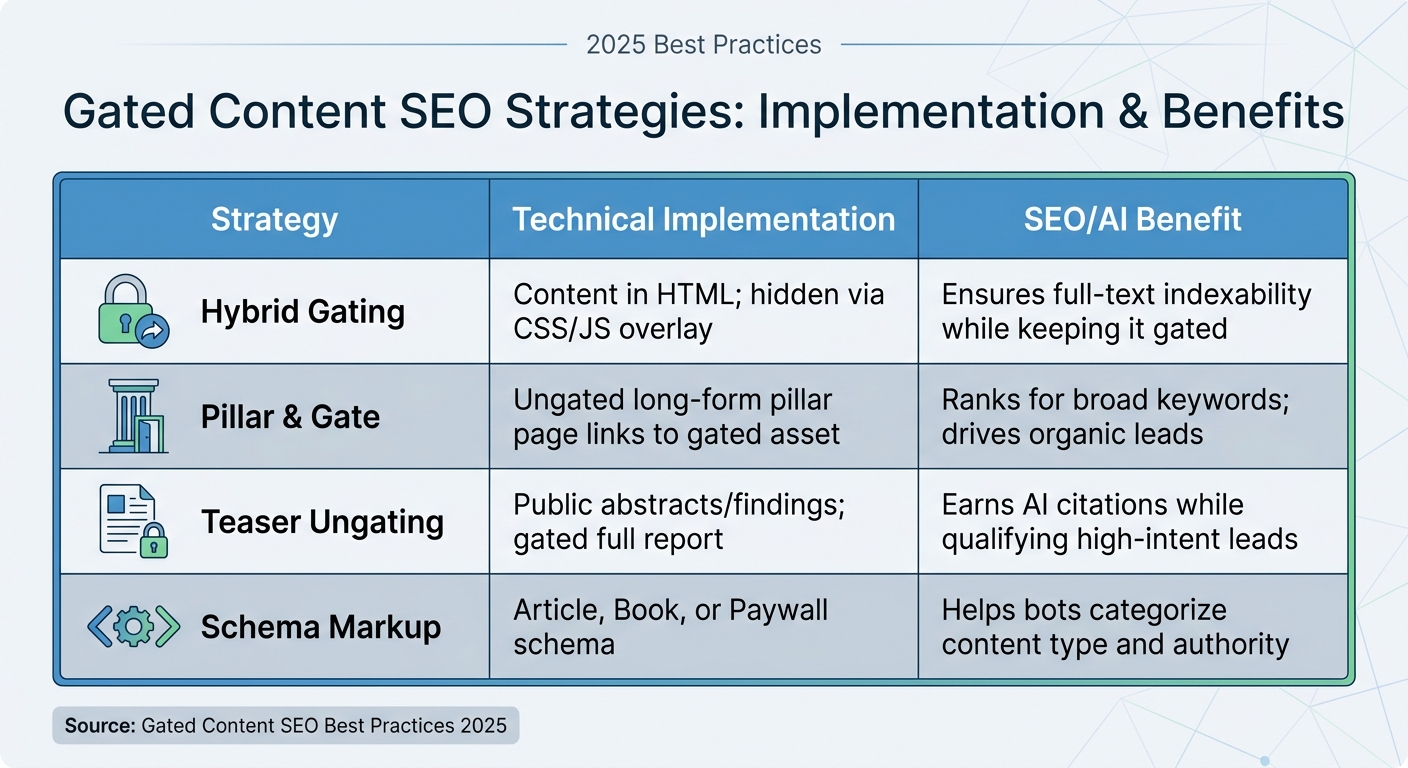
Gated Content SEO Strategies: Technical Implementation and Benefits Comparison
When managing gated content, the challenge is to make it accessible for search engines while keeping it restricted for users. The idea is to let search engines and AI crawlers (like Google, ChatGPT, and Perplexity) understand what’s behind the gate while still requiring users to complete a form for full access.
One effective approach is hybrid gating, where the full content is loaded in the HTML but hidden with CSS or JavaScript overlays. This way, search engines and AI crawlers can index the content. As Mary Palumbo, an SEO Consultant at Conductor, points out:
"The gated portion of your content is often the richest and most exclusive source of insights you publish – and the part most valuable to both search engines and AI models."
Another option is the separate URL strategy, which involves hosting the gated content on a dedicated, hidden URL. The URL isn’t included in the main navigation but is added to the XML sitemap and linked internally from high-value ungated articles. For example, in April 2026, Conductor used this method for a gated AI visibility guide. They discovered that including the URL in the XML sitemap alone wasn’t enough – contextual links and a footer-linked HTML sitemap significantly improved crawler discovery.
Avoid relying on soft gates (e.g., content hidden behind toggles), as AI crawlers may not interact with elements like buttons, leaving the content ignored.
Schema Markup for Gated Content
Schema markup plays a key role in signaling content accessibility to search engines. It allows you to explicitly inform search engines about the gated content while distinguishing it from cloaking. Google suggests using structured data to clarify the nature of gated content. The best practice is to use the isAccessibleForFree property (set to "False") and define gated sections with a cssSelector in the hasPart property . As Rank Math explains:
"The structured data allows Google to understand the content of the article. It also assures Google that you are not engaged in cloaking."
For categorizing content, applying Article or Book schema helps search engines understand the type and depth of your resource. This includes details like title, description, and duration, even if the full content remains gated . If you’re using hybrid gating, schema markup becomes even more crucial to validate your approach.
Robots.txt and Crawl Directives
Once your content delivery methods are set, managing crawler access is essential. A properly configured robots.txt file ensures that you control what crawlers can access without unintentionally blocking important pages. For HTML pages, use the noindex meta tag in the <head> section to keep gated pages out of search results while still indexing your landing page.
Laura James, SEO Manager at Uscreen.tv, emphasizes:
"If a robots.txt file blocks the page or if the crawler is otherwise unable to access it, the crawler won’t be able to detect the noindex directive."
To avoid this, use targeted disallow directives (e.g., Disallow: /course-content/) to block private directories while keeping landing pages accessible. A private or footer-linked HTML sitemap can guide crawlers to discover gated assets, and linking from high-authority ungated pages passes link equity and highlights their importance.
Canonical Tags for Preview Pages
Canonical tags help prevent duplicate content issues when you have multiple versions of the same content, such as a landing page, a preview page, and the gated asset itself. These tags consolidate link equity and authority to the main version, ensuring that search engines focus on ranking the content you want.
In a "Pillar and Gate" strategy – where a detailed ungated pillar page links to a gated version – the canonical tag on the preview page should point to the pillar page if they share similar content. This avoids competition between the two pages, allowing the ungated version to rank while the gated version captures leads.
To implement, add a <link rel="canonical" href="URL"> tag in the <head> section of the preview page. For hybrid gating, canonical tags also help clarify which version of the content search engines should prioritize. Combining canonical tags with noindex directives on gated assets (e.g., private download URLs) ensures only the landing page appears in search results .
These technical strategies ensure that gated content remains secure while maximizing its visibility and SEO potential.
| Strategy | Technical Implementation | SEO/AI Benefit |
|---|---|---|
| Hybrid Gating | Content in HTML; hidden via CSS/JS overlay | Ensures full-text indexability while keeping it gated |
| Pillar & Gate | Ungated long-form pillar page links to gated asset | Ranks for broad keywords; drives organic leads |
| Teaser Ungating | Public abstracts/findings; gated full report | Earns AI citations while qualifying high-intent leads |
| Schema Markup | Article, Book, or Paywall schema | Helps bots categorize content type and authority |
On-Page SEO for Gated Content Previews
The preview page acts as the entry point to your gated content. Since search engine crawlers can’t access content hidden behind forms, the preview page takes on a critical role. To drive organic traffic, it needs to rank for the right keywords, clearly showcase value, and entice users to click. Here’s how to optimize these pages effectively.
Keyword Optimization in Previews
When crafting your ungated preview, focus on delivering key insights concisely. Use the Pillar and Gate strategy to enhance keyword visibility. Start with an ungated pillar page of at least 1,500 words that provides a detailed summary of your gated content, creating an SEO-friendly gateway for visitors.
To highlight relevance for search engines, integrate your primary keyword into the H1 tag, at least one H2 heading, and within the first 100 words of the preview. Include 200–300 words of public-facing text on the landing page, such as an executive summary or a list of takeaways. This ensures search engines can index enough content for ranking purposes.
As JVG Labs explains:
"Google’s primary job is to crawl, index, and rank publicly accessible information… When your most valuable insights are hidden behind a form, search engine crawlers hit a wall."
Writing Meta Descriptions That Highlight Value
Think of your meta description as a mini advertisement. It needs to explain what the resource is, the problem it addresses, and why it’s worth clicking. For best results, include your primary keyword and the main value proposition within the first 60–90 characters. This ensures important details aren’t cut off and helps trigger bolding in search results.
Try using the "Mini-Pitch" formula: Problem + Value + Proof + Next Step. For example:
"Struggling with SaaS pricing? Download our pricing trends report [Guide] used by 500+ B2B teams to optimize revenue."
This approach clearly conveys the benefits of the resource while enticing clicks. Optimized meta descriptions can boost click-through rates by 5.8%, and those with strong calls to action have seen CTR increases of up to 20%. Avoid overused phrases like "ultimate" or "best-ever" and stick to specific, natural language.
Internal Linking to Gated Content
Once your meta description grabs attention, internal linking ensures visitors find their way to your gated content. Adding links from high-traffic blog posts to your gated content previews is a proven way to attract qualified leads. Use descriptive anchor text and create bidirectional links between your pillar and landing pages to strengthen topical relevance and boost SEO authority.
A great example is the Unstoppable team, led by TK Kader, which generated over 14,000 quality B2B leads in January 2026. By promoting gated content daily on social platforms and linking to high-converting landing pages, they achieved conversion rates between 40% and 80% – far surpassing the 4% industry average.
To replicate this success, audit your high-traffic pages and add internal links to relevant gated content previews. Align the links with the buyer’s journey. For instance, link a "Buying Guide" from a "Solution Comparison" post to ensure the audience is primed and ready to engage.
Promotion Strategies for Gated Content SEO
Getting your gated content to rank is just the first step. The bigger challenge? Driving qualified traffic to your landing pages. Since gated content itself can’t be crawled by search engines, you’ll need to lean on off-page strategies to boost visibility, earn backlinks, and establish authority with Google.
Building Backlinks to Gated Content Pages
In , digital PR and original research are dominating as go-to link-building methods. In fact, over two-thirds of SEOs consider digital PR their top strategy for acquiring high-authority links. The secret lies in creating research-driven content that journalists and industry leaders naturally want to reference. If your gated asset includes proprietary data, survey findings, or industry benchmarks, pitch your results directly to reporters and bloggers with a personalized approach that highlights the most compelling takeaways.
To make this process smoother, create an ungated pillar page summarizing the key points of your gated content. This page serves as a more linkable resource while also passing authority to your gated landing page through internal links. Most websites are more comfortable linking to accessible content rather than a page locked behind a form. Additionally, using social media to expand your reach can attract more traffic and increase the likelihood of earning quality backlinks.
Promoting Gated Content on Social Media
Social media shares may not directly improve your search rankings, but they can drive significant traffic to your landing pages and boost your chances of earning organic backlinks. The trick is to share value-packed, native content instead of just dropping links. For instance, write 100–200 word mini blog posts on platforms like LinkedIn or Facebook. These posts can deliver immediate insights while working around algorithms that often deprioritize external links.
Your messaging should fit the platform. On Twitter, focus on highlighting new data or stats. On Facebook, lean into storytelling. If you’re in the B2B space, posting on Tuesdays around 11:00 AM Eastern often results in higher engagement. You can also create eye-catching visuals using tools like Canva to spotlight a key data point from your gated content. And don’t forget to optimize your landing page’s title tags to stay within 80–100 characters – this ensures they appear fully when shared on social media.
Email Marketing for Gated Content Promotion
Email marketing is another powerful way to drive engagement and traffic to your content. It complements your social and backlink efforts by nurturing leads and guiding them back to your ungated pillar pages. Given that only 62% of people who download gated content actually read it, a well-planned email sequence can make all the difference.
Here’s an example of a four-part email sequence:
- Email 1: Send immediately with the download link and a key insight from the content.
- Email 2: Follow up three days later with a surprising data point and a link to related content.
- Email 3: Share a case study or success story seven days in to build trust.
- Email 4: Wrap up on day fourteen with a direct sales offer or demo invitation.
Using a "tease, then gate" strategy in newsletters can also boost engagement. Share the introduction or first section of your gated content, then direct readers to the full landing page. Segmenting your email lists based on the content each lead downloads ensures your messaging stays relevant. Finally, on your post-download "Thank You" page, include a link back to your ungated pillar page to reinforce internal linking.
| Nurture Stage | Timing | Goal | Content Type |
|---|---|---|---|
| Delivery | Immediate | Value Delivery | Direct download link with a key insight |
| Re-engagement | 3 Days Later | Consumption | Surprising finding with a link to related content |
| Trust Building | 7 Days Later | Credibility | Case study or customer success story |
| Conversion | 14 Days Later | Sales Pipeline | Direct offer, assessment, or demo invitation |
Using Subpage.co for SEO-Optimized Gated Content
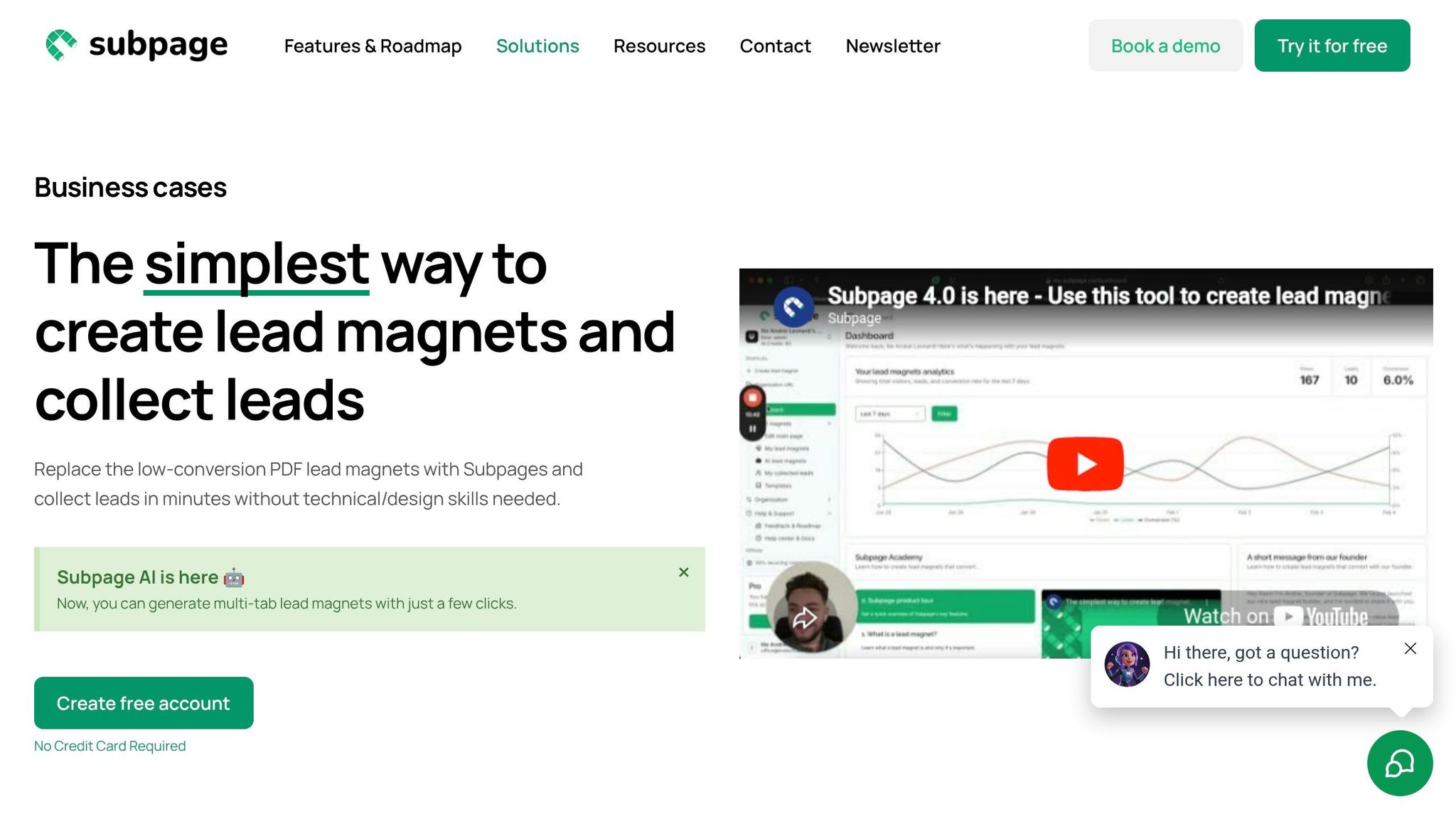
Using modern platforms can simplify technical and on-page SEO tasks, making them more efficient. Creating gated content that ranks well on search engines no longer requires a tech-savvy team. Subpage.co offers a solution by replacing outdated PDF lead magnets with web-based gated content pages. Unlike static files hidden behind download forms, these pages are easily indexed by search engines, enhancing visibility. The platform’s Notion-like editor allows you to directly copy and paste from Google Docs, enabling the creation of SEO-friendly landing pages without any coding.
This method works because gated content is hosted on actual web pages instead of being buried in PDFs. For example, in April 2026, Subpage users generated over 1,000 leads in just two weeks. Subpage.co also offers Subpage AI, which helps generate multi-tab lead magnets quickly, so you can focus on strategy rather than design.
SEO-Ready Templates for Gated Content
Subpage.co simplifies the shift from content creation to optimization with built-in features that make technical SEO integration seamless. The platform provides pre-designed templates optimized for lead generation and search engine performance. These templates incorporate SEO essentials like optimized titles, meta descriptions, and proper heading structures (H1, H2).
You can also implement the "Pillar and Cluster" model, where comprehensive pillar pages link to related subtopic clusters. This approach improves site navigation and keyword targeting. Plus, all templates are mobile-optimized, which is critical since mobile performance directly affects search rankings. Subpage.co also supports internal linking between pillar pages and clusters, helping to distribute authority across your website.
Custom Branding and Domain Setup
Using generic subdomains can hurt both trust and SEO. Subpage.co allows you to connect a custom subdomain or domain to your account, which boosts brand authority and creates a professional appearance in search results. This matters because nearly half (47%) of B2B buyers consume three to five pieces of content before reaching out to sales. Every interaction should build credibility.
Custom domains also let you craft URLs that clearly highlight the value of your resources. This not only helps search engines discover your content but also improves click-through rates. Subpage.co’s Premium plan, priced at $19/month, includes whitelabeling, which removes all Subpage branding, making your gated content appear fully aligned with your brand. This ensures your landing pages maintain SEO visibility.
| Feature | Free Plan | Premium Plan ($19/mo) |
|---|---|---|
| Lead Magnets | 5 | Unlimited |
| Domain Setup | subpage.co subdomain | Custom subdomain |
| Branding | Subpage branding | Whitelabel (No branding) |
| Analytics Access | Max past 7 days | Unlimited |
| Integrations | Limited | Full (Zapier, Webhooks) |
Analytics and Performance Tracking
Subpage.co also includes built-in analytics to help you measure lead quality and conversion rates. You can use this data to refine your SEO strategy based on real-world performance. Key metrics tracked include page views, unique visitors, time on page, bounce rates, and form-fill conversion rates. These insights help pinpoint which gated content is driving qualified traffic and which pages may need adjustments.
The Free plan limits analytics access to seven days, while the Premium plan provides unlimited data. Having access to historical data is crucial for identifying trends and understanding how changes to your landing pages impact performance. Subpage.co also integrates with tools like Zapier, enabling seamless lead export and workflow automation. This makes it easier to connect your gated content’s performance to your broader marketing analytics.
Measuring and Improving Gated Content SEO
To ensure long-term success with gated content, accurate measurement and regular improvement are essential. Tracking the right metrics can make or break your strategy. In fact, companies that monitor at least five key metrics see a 72% higher marketing contribution to revenue compared to those who focus solely on conversion rates.
A structured, four-tier measurement framework is a good starting point. Break it down by timeframes: track activity metrics like landing page conversion rates weekly, assess quality metrics such as lead-to-MQL rates monthly, review revenue metrics quarterly, and evaluate SEO impact metrics monthly. For reference, the average landing page conversion rate across industries is about 6.6%, while top performers hit closer to 11.45%.
Key Metrics for Gated Content SEO
When it comes to your pillar pages, focus on metrics like organic traffic, keyword rankings, time on page, and pillar-to-landing page click-through rates. For gated landing pages, prioritize form conversion rates, the bounce-to-form ratio, and overall lead quality. It’s also important to monitor how downloaded assets are consumed and track the lead-to-opportunity conversion rate. Calculating the cost per marketing qualified lead (CPMQL) can help measure ROI effectively. Additionally, keep an eye on the content amplification rate – factors like shares, mentions, and backlinks per 1,000 views can significantly influence long-term SEO visibility.
A noteworthy challenge is that gated content is referenced up to 64% less often in AI-generated search results compared to ungated content. To counteract this, ensure your ungated pillar pages are packed with valuable data.
Once you’ve established these metrics, the next step is to refine your landing pages through rigorous testing.
A/B Testing for Landing Page Optimization
A/B testing plays a critical role in improving landing pages. Aim to test until each variant reaches at least 100 conversions. Focus on impactful elements – form length can swing conversion rates by ±40%, CTA wording by ±15%, and social proof elements by ±25%.
Here are some real-world examples from : An Industrial IoT Company introduced a two-stage gating model for technical whitepapers, offering an executive summary and a free preview of the first five pages. This approach boosted their conversion rate by 64% compared to traditional hard-gating methods. Similarly, a mid-sized IT Service Provider adopted a journey-based gating strategy, leading to 47% more marketing qualified leads, a 22% reduction in acquisition costs, and a 31-day shorter sales cycle over six months.
Adopting a 90-day review cycle with monthly, quarterly, and annual assessments can help sustain improvements. Using a "value-forward" design – where benefits are clearly outlined and supported by features like a table of contents or a quick 30-second video preview – can further enhance user engagement and conversions.
Comparing Analytics Tools
Once your metrics and A/B testing reveal insights, advanced analytics tools can take your strategy to the next level. While free tools like Google Analytics are great for basic tracking, they might not offer the depth needed for optimizing gated content. Premium tools provide features like multi-touch attribution, lead scoring, and automated segmentation, giving you a clearer picture of how landing page changes impact performance. For those looking to refine their strategy, investing in premium analytics tools can uncover trends and enable smarter optimization decisions.
Conclusion
The world of gated content SEO has shifted significantly as of . AI crawlers now bypass hidden content, meaning tools like ChatGPT and Google AI Overviews won’t reference it. But this doesn’t mean you should ditch gated content entirely – it’s about finding smarter ways to balance visibility with lead generation.
One effective method is the hybrid "Pillar and Gate" strategy. Create a comprehensive, ungated pillar page (1,500+ words) to establish search authority. Then, gate mid-to-lower funnel resources like research reports, interactive lead magnets, or case studies behind forms.
Start by nailing the technical setup. Use schema markup like Article or Book, include a 200–300 word teaser, and host gated content on separate URLs with contextual links. AI bots only crawl visible HTML, so these elements are critical for discoverability.
Once the technical side is covered, shift your focus to improving user conversions. Simplify forms to just three fields, deliver assets instantly on the thank-you page, and implement a four-step, 14-day nurture sequence. Keep an eye on metrics like landing page conversion rates, lead quality, organic traffic, and keyword rankings to fine-tune your approach.
If you’re looking for a no-fuss way to implement these strategies, tools like Subpage.co provide SEO-optimized templates, custom domain options, and built-in analytics. Remember, content that isn’t seen won’t build authority – start testing and refining your strategy today.
FAQs
Will hybrid gating get my site penalized for cloaking?
When done correctly, hybrid gating – using clear signals like CSS selectors and structured data – is not treated as cloaking by search engines. This method adheres to search engine guidelines, meaning it won’t trigger penalties from Google or others. Just make sure your setup is transparent to maintain compliance.
What should be indexable vs. gated for the best SEO results?
When it comes to SEO, it’s crucial to make ungated content – like blog posts, videos, and infographics – indexable. Why? Because this type of content helps drive organic traffic and boosts your site’s visibility on search engines.
On the other hand, gated content – such as whitepapers and webinars – should be used more selectively. While gating content is great for collecting leads, it limits its ability to be indexed by search engines.
The key is finding the right balance. Ensure you have plenty of ungated, indexable content to support your SEO efforts. At the same time, reserve gating for high-value resources that can capture leads effectively. This way, you can maintain a steady flow of traffic while also driving growth.
How do I track SEO impact when the asset itself is behind a form?
To measure the SEO impact of gated content, rely on first-party tools like Google Analytics or a CRM to track form submissions and conversions. Since gated content is typically hidden from search engines, a hybrid strategy can be useful. For example, you could allow search engines to index related content or partial previews of the gated material. This approach lets you evaluate both lead generation and organic visibility, ensuring your efforts align with your broader SEO objectives.
Related Blog Posts
